Then…
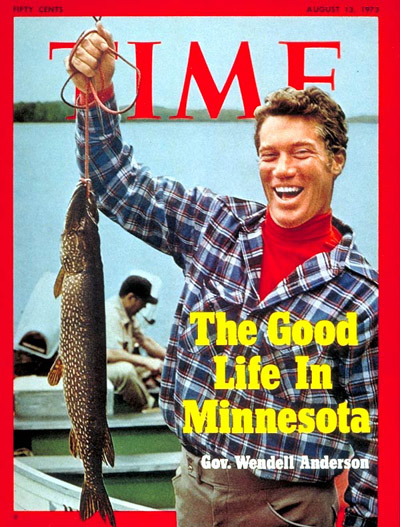
In August 1973, the cover of TIME magazine featured a man in a plaid shirt standing in a boat in the middle of a lake holding up a fish. That man was Wendell Anderson, governor of Minnesota, and the headline ran: “The Good Life in Minnesota.” Turning to page 24, readers found Lance Morrow’s cover story: “Minnesota: A State That Works.” In it, authior Lance Morrow painted a seductive portrait of life in our state, where the “residual American secret still seems to operate. Some of the nation’s more agreeable qualities are evident there: courtesy and fairness, honesty, a capacity for innovation, hard work, intellectual adventure and responsibility.”
“Politics is almost unnaturally clean,” Morrow continued. “No patronage, virtually no corruption.”
Nobody would write that about Minnesota in 2025.
…now
We at Center of the American Experiment have been tracking the avalanche of fraud in Minnesota under Governor Tim Walz since day one. A recent story in City Journal — “The Largest Funder of Al-Shabaab Is the Minnesota Taxpayer” — attracted national attention. This weekend, the New York Times carried a story titled “How Fraud Swamped Minnesota’s Social Services System on Tim Walz’s Watch.”
The problem of taxpayers being defrauded via government programs is especially bad in Minnesota.
Federal prosecutors say that 59 people have been convicted in those schemes so far, and that more than $1 billion in taxpayers’ money has been stolen in three plots they are investigating. That is more than Minnesota spends annually to run its Department of Corrections. Minnesota’s fraud scandal stood out even in the context of rampant theft during the pandemic, when Americans stole tens of billions through unemployment benefits, business loans and other forms of aid, according to federal auditors.
But why is fraud so widespread in Gov. Walz’ Minnesota?
One reason is that the state government tolerated it. Ryan Pacyga, a lawyer who has represented several defendants in these fraud cases:
…said that some involved became convinced that state agencies were tolerating, if not tacitly allowing, the fraud.
“No one was doing anything about the red flags,” he said. “It was like someone was stealing money from the cookie jar and they kept refilling it.”
But, again, the question is why?
Here, one answer is that the DFL didn’t want to alienate a key voting bloc.
Kayseh Magan, a Somali American who formerly worked as a fraud investigator for the Minnesota attorney general’s office, said elected officials in the state — and particularly those who were part of the state’s Democratic-led administration — were reluctant to take more assertive action in response to allegations in the Somali community.
“There is a perception that forcefully tackling this issue might cause political backlash among the Somali community, which is a core voting bloc” for Democrats, said Mr. Magan, who is among the few prominent figures in the Somali community to speak about the fraud.
The fact that such reporting is appearing not only in national news outlets but in the New York Times of all places should be a wakeup call for those in this state who have turned a blind eye for too long to the whole sale ripping off of Minnesota’s hard-pressed taxpayers. If TIME magazine put Minnesota’s governor on its cover now, what would it say?