
This summer’s One Big Beautiful Bill brought an innovative expansion of the federal Pell Grant system. Starting in 2026, Pell Grant eligibility will be expanded to include certain types of short-term career training programs, like construction or welding training programs.
What is a Pell Grant?
A Pell Grant is a federal grant of funds to first-time students pursuing undergraduate education. (Some exceptions are made, such as teachers pursuing postbaccalaureate teacher certification programs.) The grant almost never has to be repaid to the federal government, except in limited circumstances, such as when a student drops out of their program.
Designed for low-income students, applicants qualify for Pell Grants based on their household income, as reported by the Free Application for Federal Student Aid, or FAFSA. The maximum Pell Grant per student is $7,395 for the 2025–26 award year.
Students are only eligible to receive Pell Grants for 12 terms, or 6 traditional years. Once they earn a degree or use up all 12 terms of eligibility, they must seek funding from an alternate source.
In 2024, 34 percent of American students received a Pell Grant. The average Pell Grant award is $4,491. A slight majority (51 percent) of grants go to students whose families make less than $20,000 per year.
Before the Big Beautiful Bill, Pell Grants were not available for short-term, non-degree- seeking, career training programs.
What kinds of career training programs are eligible?
The new Workplace Pell Grant requirements involve some education policy innovation.
Perhaps the most interesting new requirement for program eligibility is post-graduate outcome transparency. Programs must publicly report student outcomes, including completion rates, job placement, and median earnings. To qualify for grants, a program must ensure that its graduates’ earnings three years after completion exceed 150 percent of the federal poverty line ($23,475 in 2025) plus the price of tuition.
From UPCEA, programs must also:
- Be at least 150 clock hours in length and span a minimum of 8 weeks
- Be offered by an eligible institution of higher education
- Provide training aligned with in-demand, high-wage, high-skill occupations
- Lead to a recognized postsecondary credential
- Be reviewed by a state workforce board, recognized accreditor, or appropriate federal agency
- Report student outcomes, including completion rates, job placement, and median earnings
- Be non-transfer-oriented, meaning it is not primarily designed for credit transfer into a degree program
The 150 hour program length requirement is longer than many current career training programs. A recent study that analyzed Texas career training programs found that the average program length was about 90 hours.
Students who take advantage of the Workforce Pell Grant cannot concurrently be enrolled in an undergraduate institution and use Pell funds there. Additionally, funds used in a Workforce Pell Grant count towards their lifetime semester unit limit. Since Pell Grants can be granted for 12 semesters total, this means that a student could theoretically complete a career training program in one semester and still receive federal aid during a four-year degree.
Pell Grant funds will be prorated according to the program’s duration, intensity, and cost. Most workforce program attendees will not receive the maximum amount of yearly funds available to them.
Rulemaking is still in progress. Prospective students will not be able to access Workplace Pell Grants until 2026.
Do these career training programs actually help students?
Just like an undergraduate degree, it’s important that a prospective student research their institution, desired area of study, and potential job prospects before embarking on their course. While an undergraduate degree is still a strong predictor of increased lifetime income, some Americans have been surprised to find that their bachelor’s degrees landed them in nothing more than a pile of debt. To avoid this outcome, Workplace Pell Grants will require that institutions publish student outcomes. This institutional check will hopefully encourage programs to maintain high course quality standards and allow prospective students to choose their program wisely.
A recent report by Peter Riley Bahr and Rooney Columbus studied 128,138 students without previous college experience who attended workplace programs in Texas. The study focused on students from 23 to 60, meaning that students were past the traditional age for a bachelor’s degree and would be considered a nontraditional student in most contexts.
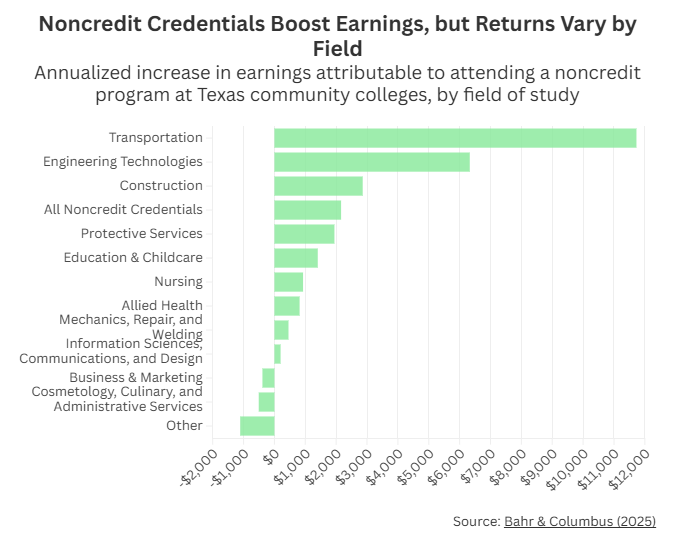
While only 1 in 5 of the programs studied fit the Workplace Pell Grant’s length requirement, the results of those programs were promising. The study found that noncredit students in Texas who attempted more than 150 contact hours (150-300 hours) realized strong earnings gains, averaging about $4,800 of additional pay per year within just two years. The earnings gains increased by time spent in the program. Students who took more than 300 hours of training averaged $3,600 per year of additional pay in the next two years. Assuming that these students gained high-quality workplace skills, it is safe to predict that their pay will continue to increase as the years go on.
In their broader examination of the Texas workplace programs, the report authors found that earnings outcomes depended significantly on the type of program chosen. Transportation and engineering technologies improved earnings, but cosmetology, culinary, and administrative services did not. Transportation credentials (mostly commercial vehicle operation) improved earnings by $12,000 per year on average.
Study authors noted that some of the apparent negative outcomes may be tricks of the data. For example, many cosmetologists are self-employed, meaning that their reported earnings were not recoverable by the study authors. AEI commentator Preston Cooper noted that the findings can also inform students as to the most effective program length, arguing that the report data shows that longer welding programs seem to have more economic value than the short-term ones studied.
These programs can be an avenue for significant salary gains for many Americans. Since workplace programs are often short, sometimes less than one semester, adults can make a career change without sacrificing long-term financial wellbeing. Additionally, their low costs and relatively immediate salary boosts are an accessible quality of life increase.
For the taxpayer, the federal government’s new investment in Workplace Pell Grants is a no-brainer. Since participants are using up some of their lifetime eligibility in programs that almost certainly will use fewer Pell Grant dollars, it’s a smart use of federal dollars. Participants who are happy with their newfound credentials and their line of work will not choose to pursue a bachelor’s degree, meaning that their potential Pell Grant dollars will go unused. Plus, students who earn more money create a thriving economy, benefiting us all.
The program also makes two movements towards American institutional reform. First, many blue-collar jobs currently report a dearth of interested candidates (quite possibly because college appears to be accessible to so many). Workplace Pell Grants could funnel students towards these industries.
Second, since participating programs are required to collect and publish student outcomes, programs are highly incentivized to ensure quality financial outcomes for students. In a landscape where many undergraduate students are surprised to find that their degree is functionally useless, this is a thoughtful first step towards making four-year colleges more transparent.
Workplace programs tend to be smaller, and cater to local interests and local needs. Especially if they are required to publish student outcome data, students will be unlikely to accidentally enter a course of study that is highly in demand—but only in a location four states over. Strengthening local institutions leads to healthier communities.
While there will be more changes once the rulemaking process is complete, the innovation of the Workplace Pell Grants is a promising first step.