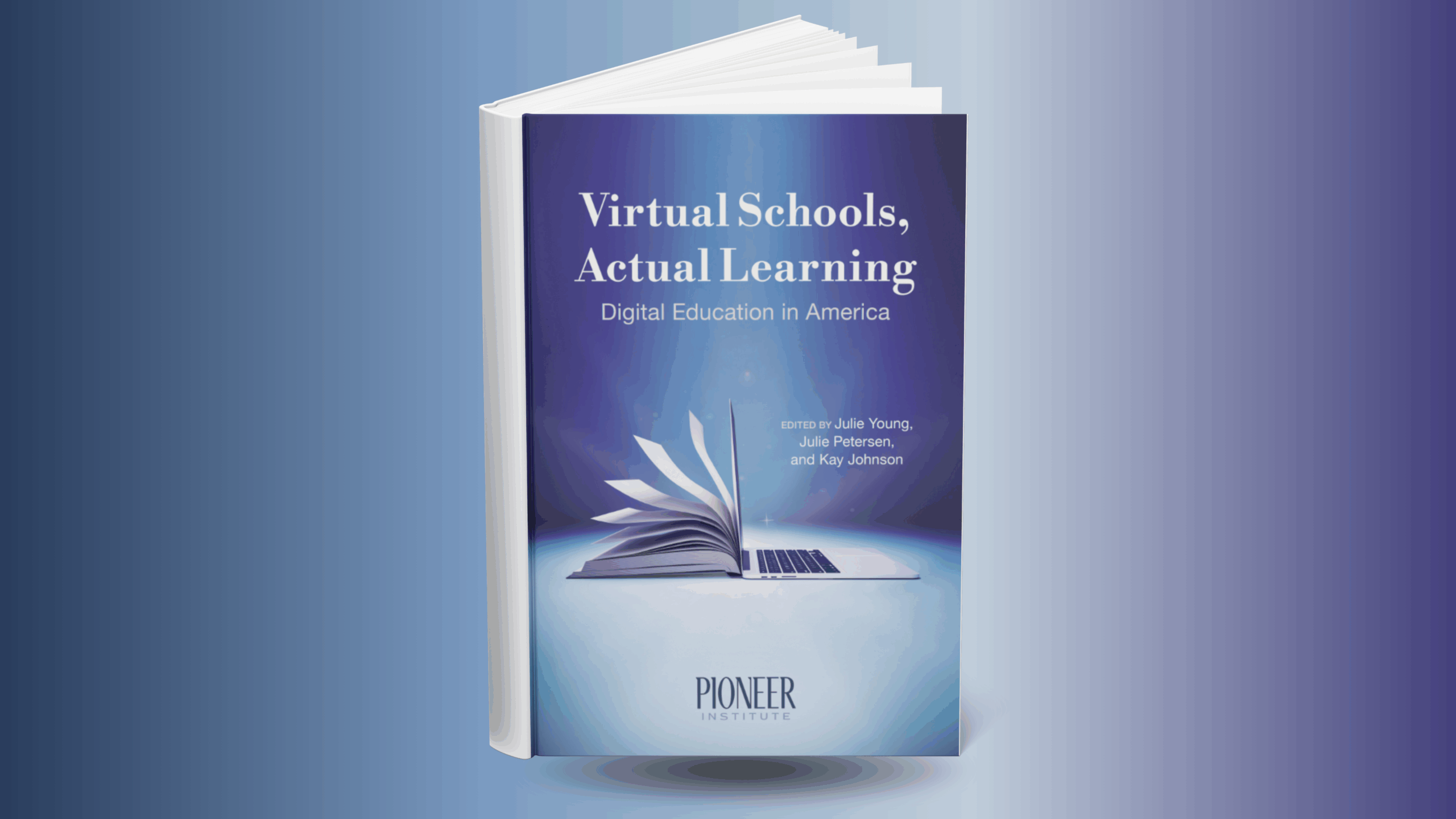
BOSTON – A new book co-edited by national digital education leader Julie Young draws on best practices and multiple studies published by Pioneer Institute to recount three decades of advances in digital education and highlights the policies necessary for students to fully benefit from virtual schools provide. “Virtual Schools, Actual Learning: Digital Education in America” shows how online learning has evolved from a niche supplement to a core part of modern education—and how state policy can either unlock or block its potential.
“Not every student is suited for learning in lockstep with their peers like they did in the Industrial Age, nor to the constraints of the traditional school day and year,” said Julie Petersen, a co-editor of “Virtual Schools, Actual Learning: Digital Education in America” with Julie Young and Kay Johnson. “Virtual learning sets students free from the constraints of time, place and pace, and unbundles learning so students can choose the courses and formats they prefer—or enroll in a fully online school if they like.”
Students in virtual courses and schools can learn on their own schedules and at their own pace until they demonstrate mastery. Today, highly interactive and visual, data-driven platforms can detect small struggle points to personalize instruction with increasing precision.
Nearly 30 years ago, the Florida Virtual School—where co-editor Julie Young served as founding President and CEO—became the first public statewide virtual school, offering courses and a full educational experience to students across Florida and later globally. It was also the first to have a performance-based funding model tied to successful course completions. The school provided a path to reducing class sizes and offered hard-to-staff courses, foreign languages, and Advanced Placement offerings to rural students and others who might not otherwise be able to access them.
Over time, digital learning shifted from a complementary option to an integral part of many students’ education—and a full-time format for some. Students shift to online programs for varied reasons: escaping bullying at their school, addressing unmet academic needs, or seeking flexibility.
For some students, online learning is simply the the “better-fit” option, whether for select courses or as a full-time pathway. A growing body of research shows that students in high-quality online learning programs can perform as well as—and sometimes better than—their counterparts in traditional schools. Students with special needs often choose online settings because increased pace flexibility and tailored support can lead to better outcomes.
“We’re at the beginning of an explosion in education entrepreneurship—and students are voting with their feet to move to more and more models?that are untethered from the traditional calendar, classrooms, and courses,” said Michael Horn, co-founder of the Clayton Christensen Institute and author of the book’s foreword.
Online learning has also proven critical during emergencies. Schools that had well-designed virtual learning models in place showed remarkable adaptability and resilience during the pandemic. ASU Prep—a network of physical campuses and fully digital programs led by Julie Young as CEO at the time—moved all 3,000+ students to online learning within a week.
“The lesson isn’t to return to 2019 and pretend the pandemic never happened,” Young said. “It’s to build systems flexible enough to serve students no matter what disruption comes next, whether that’s another health crisis, a natural disaster, or simply a student who can’t learn in a traditional classroom.”
Over the past three decades, some states have proactively built policy infrastructure to support innovative learning environments. Florida and Michigan stand out for introducing pivotal legislation and funding structures that have enabled virtual learning to take root and thrive, benefiting both students and schools seeking solutions. By contrast, other states constrained digital learning through heavy-handed regulations that hindered growth and quality, lacked high-level champions, limited public demand and awareness, and yielded political opposition from teacher unions and district and state leaders. In Massachusetts, for example, only two small statewide virtual schools are in operation today because of strict enrollment caps, limited funding, and persistent resistance from the bureaucracy.
To maximize the benefits of virtual education, policymakers must align regulations with the evolving landscape. Critical levers include vetting processes for providers, the form and amount of public funding, quality/accountability metrics, and online teacher preparation. Advocacy group ExcelinEd recommends a bottom-up approach in which stakeholders design the vision for blending digital and traditional learning. Virtual Schools, Actual Learning provides context, recommendations, and insights for leaders committed to expanding learning options that put students and families at the center.
Options are critical at a time when student achievement scores are ringing alarm bells. “Online learning?is not a panacea, nor are traditional or even non-traditional classrooms, and that is the point,” notes co-editor Kay Johnson. “Learning choices should be as diverse, plentiful, and imaginative as our students.”
“Virtual Schools, Actual Learning” is available on Amazon Kindle.
###
Enjoy Our Author Video!
About the Authors:
 Julie Young (Co-Editor) is an edupreneur—an educator, innovator, and visionary leader, renowned for her expertise in school design for diverse educational models, including virtual, blended, and technology-enhanced learning. As the Vice President of Education Outreach and Student Services at Arizona State University (ASU), and in her former role as CEO and Senior Advisor to ASU Preparatory Academy and ASU Prep Global, she has played a pivotal role in integrating innovative digital strategies into education. Young’s pioneering work began as the founding President and CEO of Florida Virtual School in 1997. In that visionary role, she not only embraced virtual schooling but helped lay the groundwork for an entire industry. She envisioned and built FLVS into a trailblazing incubator, continually testing and evolving innovative digital learning models while cementing Florida’s reputation as an epicenter of virtual school advancement. Young led FLVS as its President and CEO for over 17 years, building one of the nation’s first fully-online public schools, while exploding enrollment made it the largest state virtual school in the United States. Her transformative tenure set key precedents for the future of education reinvention in the digital age.
 Julie Petersen (Co-Editor) is a freelance writer and editor based in California. As a former nonprofit communications director and journalist, her work has been published by Stanford Social Innovation Review, Harvard Education Press, EdSurge, and Education Next. Julie began her career as a venture capital reporter for Red Herring Magazine, where her print cover story on educational technology was featured in Best Business Stories of the Year. She went on to lead communications at venture philanthropy firm NewSchools Venture Fund. Since 2012, Petersen has written and edited papers, articles, case studies, strategic plans, grant proposals, impact reports, and other publications in partnership with more than 40 education nonprofits, companies, philanthropists, and government agencies. Julie holds a bachelor’s degree in English from Vanderbilt University and a master’s degree from the Medill School of Journalism at Northwestern University.
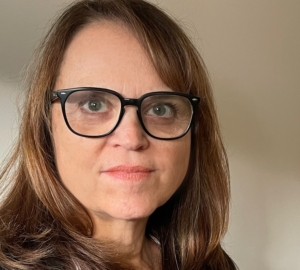 Kay Johnson (Co-Editor) is a strategic communications leader with over two decades of experience at the intersection of education, policy, and innovation. She has supported national initiatives that shaped the early growth of online learning, including legislative efforts that led to the first statewide virtual school funded through public education dollars. Kay has led executive communications, research, and thought leadership for education organizations across the K–12 and higher education spectrum, including Florida Virtual School. Her work spans policy analysis, internal and external communications, and strategic advising for executive teams. A seasoned ghostwriter and editor, she has contributed to numerous articles, white papers, and books on digital learning and education reform. Kay currently serves as Director of Strategic Communications for ASU Prep Digital, where she supports national partnerships, research, and storytelling that advance future-ready learning models.
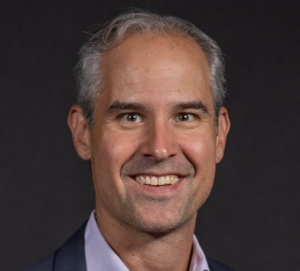 Michael B. Horn (Foreword) is the co-founder of and a distinguished fellow at the Clayton Christensen Institute for Disruptive Innovation, a non-profit think tank, and teaches at the Harvard Graduate School of Education. He is the author of several books, including most recently Job Moves: 9 Steps for Making Progress in Your Career and the award-winning Disrupting Class: How Disruptive Innovation Will Change the Way the World Learns. Michael also serves as an executive editor at Education Next, is a contributor to Forbes, and his work has been featured in outlets such as New York Times, Washington Post, Wall Street Journal, The Atlantic, and NBC. He was included on Tech & Learning magazine’s list of the 100 most important people in the creation and advancement of the use of technology in education, and serves on the board and advisory boards of a range of education organizations, including Imagine Worldwide and Minerva University. Michael holds a BA in history from Yale University and an MBA from the Harvard Business School.