Elite opinion aside, the Supreme Court has not aggressively attacked the bad precedents of the past century. Maybe it should.
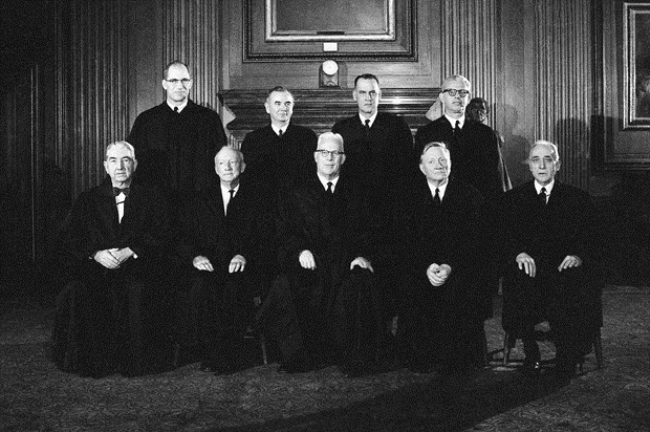
Above: A photo of the Supreme Court during part of the 20th century.
This essay first appeared in Law & Liberty on January 21, 2026.
“Looks Like the Supreme Court Will Continue to Overturn the 20th Century.”
That was the December 9, 2025, New York Times headline introducing a printed colloquy among three law professors. The headline bore almost no relationship to the subject of the discussion, which focused on a few of the court’s executive power cases.
In addition to misleading the reader, the headline was prejudicial because it implied that no one would want to “overturn the 20th century.” But the twentieth century was marred by horrific events that all decent people would wish to “overturn”—such as the massacre of more than 200 million people by collectivist governments. Those events, in turn, were byproducts of the twentieth century’s unfortunate repudiation of classical liberalism in favor of state-imposed collectivism.
The headline also communicated a falsehood about the Supreme Court: The current crop of justices is not overturning twentieth-century jurisprudence. In nearly all particulars, the court continues to apply twentieth century precedents to twenty-first century cases. For example, the court still applies twentieth-century “balancing” methodology to individual rights cases. It still adheres to twentieth-century jurisprudence in Fourteenth Amendment and “dormant commerce clause” controversies. It has left unaltered all the twentieth century’s landmark decisions that shifted power away from the states and to the central government.
True, there are a few isolated exceptions, but you can count them on the fingers of one hand: Roe v. Wade (but not the controversial “privacy right”) is gone, and the current bench is notably less deferential to self-serving decisions by the federal bureaucracy. But very little else has changed.
I found the New York Times headline irksome for yet another reason: It converted what the court should be doing into an accusation of wrongdoing. In my view, the justices should overturn certain pernicious twentieth-century precedents. Those precedents are based on judicial opinions that were incoherent, constitutionally inaccurate, occasionally dishonest, and promoted bad consequences.
In particular, the court should re-examine its twentieth century precedents pertaining to federal spending, federal economic regulation, and federal land ownership.
Spending
United States v. Butler (1936) addressed the constitutionality of a New Deal farm subsidy program. The court’s opinion, composed by Justice Owen Roberts, contained two principal sections. The first argued that the Constitution’s Taxation Clause (Article I, Section 8, Clause 1) somehow contained a spending power encompassing almost any outlay Congress claims promotes “the general Welfare.” The second section embodied the actual decision of the court: that the farm subsidy program violated the Tenth Amendment and was therefore unconstitutional.
Roberts’ discussion of the Taxation Clause was abysmally researched. Although there is an abundance of relevant evidence in the records of the Constitution’s framing and ratification, Roberts mentioned just two Founders, James Madison and Alexander Hamilton. They propounded contradictory versions of the congressional spending power, and Roberts adopted Hamilton’s version. But Roberts failed to mention that Hamilton’s claim was issued for political purposes after the Constitution had been ratified, that it was inconsistent with public representations Hamilton had made before the Constitution was ratified, and that it was inconsistent with the views of all of the Constitution’s other advocates.
The second section of Roberts’ opinion did not follow from the first. The Tenth Amendment says that powers not granted to the federal government are reserved to the states and the people. If, as the first section claimed, the Constitution granted Congress authority to spend whatever it wants, then the farm subsidy program would have been within Congress’s delegated powers, and the Tenth Amendment would not apply.
One might have taken comfort in the fact that Roberts’ spending ruminations were dicta: They were not part of the holding and actually were inconsistent with it. However, the following year in Helvering v. Davis, the court, speaking through Justice Benjamin Cardozo, disingenuously announced that Congress’s power to spend for any general welfare purpose was “now settled by decision” and that any reasonable doubts as to whether a spending program furthered the general welfare would be left to Congress.
Cardozo also wrote the opinion in Steward Machine Co. v. Davis, issued the same day as Helvering. Although the Founding-era evidence is overwhelming that levies on labor are “direct taxes,” Cardozo characterized a federal tax on employers’ use of labor as “indirect,” thereby dispensing with the Constitution’s requirement that they be apportioned among the states (Article I, Section 2, Clause 3; Article I, Section 9, Clause 4).
The effect of these decisions was to remove virtually all constraints from federal spending. Before 1936, the federal government usually balanced its budget in peacetime or ran a surplus. Since then, it has rarely done so. The results are capitalized in a national debt approaching $40 trillion.
But these decisions had sinister consequences beyond the accumulation of debt. As Justice Pierce Butler predicted in his Steward Machine dissent, they enabled Congress to bribe states with their citizens’ own money. This undermined state independence and weakened a check in the constitutional system.
Removing limits on the federal spending power also fostered special interests that pursue federal dollars irrespective of the public interest. Because those special interests fund congressional re-election campaigns, cooperative members of Congress can remain in office for decades. Since the 1960s, moreover, the federal government has used its unfettered spending authority to create dependency, fund favored political causes, promote fringe social theories, and undermine traditional culture.
The Butler and Helvering decisions—and, ideally, Steward Machine as well—should be overruled, or at least narrowed in meaningful ways. In a previous Law & Liberty essay, I suggested one way to narrow them.
The Commerce Power
The Constitution grants Congress certain economic powers, the most important of which is authority to “regulate Commerce” across political boundaries (Article I, Section 8, Clause 3). The Founding-era evidence tells us clearly what the framers and ratifiers understood by “regulate Commerce”: The Commerce Clause granted to Congress governance of the pre-existing body of law referred to as the law merchant. This body of law encompassed the regulation of mercantile trade, markets, navigation, cargo insurance, and some allied subjects. It did not extend beyond those activities.
Another component of Congress’s Commerce Power is the Necessary and Proper Clause (Article I, Section 8, Clause 18), which granted Congress authority to pass laws “incidental” to commercial regulation—laws of lesser importance, but customarily associated with commercial regulation or reasonably necessary for its effectiveness.
Supreme Court jurisprudence before the 1930s largely, if imperfectly, reflected this understanding. But during the Great Depression, the court tried to balance the restrictions of the Constitution against the political realities of the Great Depression. In the 1930s Commerce Power cases, therefore, the federal government sometimes won and sometimes lost. Particularly notable was National Labor Relations Board v. Jones & Laughlin Steel Corporation (1937), where the court, speaking through Chief Justice Charles Evans Hughes, allowed the government to regulate labor relations in a huge interstate company, while effectively limiting the decision to those companies with outsized impacts on interstate commerce.
However, the court swept away those limits in United States v. Darby Lumber Co. (1941). In that case, it extended the Commerce Power to operations in a small company and, by implication, to nearly all economically-productive activities.
Chief Justice Harlan F. Stone’s meandering opinion in Darby Lumber is characteristic of others from that era. Stone appeared to rely on the Necessary and Proper Clause, but never mentioned that clause by name. He cited Hughes’ decision in Jones & Laughlin, but disregarded Hughes’ limiting language. He concluded that Congress could regulate any production with a “substantial effect” on commerce, but never defined “substantial effect.” Stone asserted that Congress may regulate production that is “so related to the commerce and so affect[ing] it as to be within the power of Congress to regulate it”—apparently not conscious that this statement is circular.
Darby virtually dictated the result in the more famous case of Wickard v. Filburn (1942). Writing for the court in Wickard, Justice Robert Jackson acknowledged that raising wheat for home consumption was not “Commerce.” But he relied on the Darby case to hold that Congress could regulate Filburn’s conduct because that conduct, when amalgamated with others like it, had a “substantial effect” on commerce.
Jackson’s opinion, like some others from the time, contained serious misrepresentations of law and fact. Jackson wrote:
At the beginning Chief Justice Marshall described the federal commerce power with a breadth never yet exceeded. Gibbons v. Ogden … [Marshall] made emphatic the embracing and penetrating nature of this power by warning that effective restraints on its exercise must proceed from political rather than from judicial processes.
In fact, however, Marshall never said that “effective restraints … must proceed from political rather than judicial processes.” On the contrary, in McCulloch v. Maryland (1819) he affirmed explicitly that if Congress exceeded its authority, “it would become the painful duty of this tribunal … to say, that such an act was not the law of the land.” Nor did Marshall’s opinion in Gibbons authorize congressional control over production under the pretense that production affected commerce. Rather, Marshall addressed navigation, a subject within the core of the Commerce Clause. And in the same case, Marshall affirmed that various activities (such as “health laws of every description”) were outside the federal sphere, although they certainly had a substantial effect on commerce.
Jackson’s duplicity in Wickard was exceeded only by Hugo Black’s in United States v. South-Eastern Underwriters Association (1944). South-Eastern Underwriters overruled longstanding Supreme Court precedent to hold that Congress may regulate all forms of insurance because all of them (not just cargo insurance) are “Commerce.”
Black’s opinion claimed that eighteenth century “dictionaries, encyclopedias, and other books” defined “Commerce” to include all forms of insurance, but failed to cite a single dictionary, encyclopedia, or book saying so, because, I can safely say, there was none. Black cited Alexander Hamilton’s Report on Manufactures, but failed to reveal that Hamilton’s report referred only to cargo insurance. Black referenced Marshall’s opinion in Gibbons v. Ogden to show that insurance is a form of commerce, but Marshall’s opinion never mentions insurance.
The court’s 1940s Commerce Power decisions led directly to the modern bureaucratic state, which governs largely without regard to election results. Few people would claim that most federal regulation is beneficial. And regulations that are beneficial but fall out of the category of “regulating Commerce” could be administered at the state level—particularly in an era of interstate compacts, uniform state laws, instant communication, and decentralized and readily-shared information.
Federal Land
When most Americans think of federal land ownership, they think of the national park system and preservation of other environmental treasures. Few citizens outside the rural West know the uncomfortable truth: The federal government owns well over a quarter of the real estate in the country, and most ownership has little or nothing to do with environmental preservation.
The federal government, backed by certain special interests, has reason to cling to land ownership because power over land is power over people. When government acquires or retains land, the legacy media may say the government is “conserving” or “preserving” it. Behind those euphemisms is the fact that when government owns land, the power of the bureaucrats and special interests is greater, and the freedom of the people is less. Additionally, federal land ownership enables the bureaucracy to weaken the political integrity of Western states by manipulating voters and officials within them, and by governing much state territory without regard to democratically-enacted state policies. These results clearly distort the constitutional balance.
The 1787 Constitutional Convention actually considered allowing the federal government to hold vast tracts of real estate in perpetuity, but rejected the idea. Most of the Constitution’s framers understood that limiting the federal government requires limiting federal jurisdiction over, and ownership of, land. In order to understand how the Supreme Court undermined the framers’ decision, we need to understand how the Constitution addresses the subject.
The Constitution’s Property Clause (Article IV, Section 3, Clause 2) governs federal land ownership within state boundaries. It grants Congress unqualified authority to dispose of land, but no unqualified power to acquire land. The Constitution’s Enclave Clause (Article I, Section 8, Clause 17) governs the power to acquire federal jurisdiction over territory within state boundaries.
The document’s text, coupled with its history, shows that the federal government may acquire ownership or jurisdiction over acreage dedicated to a purpose enumerated in the Constitution.
But the Constitution grants no authority to acquire jurisdiction over, or ownership of, parcels merely because the government thinks they would be nice to have. Property acquired in excess of constitutional needs (such as that obtained by international treaty) must be disposed of.
The Enclave Clause thus speaks only of a capital district and “needful Buildings.” The Constitution uses the word “Buildings” to mean improvements of all kinds, not only enclosed structures. However, “Buildings” doesn’t encompass vast tracts of territory. Before 1938, Supreme Court cases on federal enclaves involved areas of limited size dedicated to enumerated purposes. Examples included navigational facilities (included in Congress’s Commerce Power) and military installations. With the exception of the enclave called Washington, DC, which the Constitution authorizes explicitly, those enclaves were relatively small.
Spanning 748,000 acres, Yosemite National Park isn’t a “needful Building.” It serves no purpose mentioned in the Constitution. Rather, it’s a precious environmental and recreational preserve, and should be protected and managed by a fiduciary trust—or perhaps by the State of California—not by the highly politicized federal government.
Nevertheless, in Collins v. Yosemite Park & Curry Co. (1938), the Supreme Court ruled that California’s cession of Yosemite to the federal government was valid under the Enclave Clause. Ever since, the court has permitted the feds to own or control land almost without limitation.
Readers without experience in the American West may not appreciate how damaging the Collins decision has been. It ratified the power of federal bureaucrats and politicians over 28 percent of American real estate. The feds own over 80 percent of Nevada, over 60 percent of Alaska, Idaho, and Utah, and more than half of Oregon.
Most of this land has no unique value, and there’s no reason for the federal government to own it—other than for political power. Almost everyone agrees that the quality of federal management hasn’t been high.
The Supreme Court should overrule cases like Collins so government land ownership is limited to enumerated purposes. National Parks and other environmental treasures can be placed in perpetual trusts, where they will be free from baleful political influences. Alternatively, the constitutional amendment process can be used to allow the American people to determine what real estate should, and should not be owned, by the federal government.
The New York Times notwithstanding, the Supreme Court is not overturning the twentieth century—or even its twentieth-century jurisprudence. The court could not do so completely if it tried. But it can, and should, correct the worst mistakes from that era.