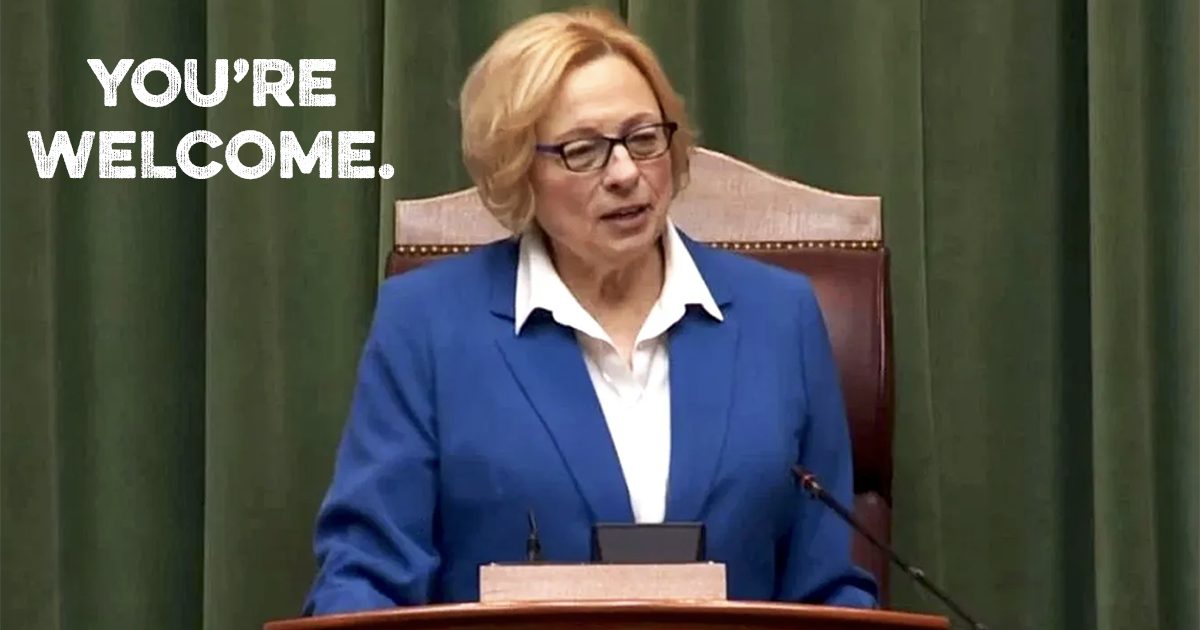
Last week Governor Janet Mills delivered her final State of the State address. The hour-long speech was heavy on reflection and self-congratulation. Again and again, the Governor reminded Mainers, sometimes explicitly, that we should be thanking her for her governance. But self gratitude is not a governing philosophy. And after seven years in office, Mainers deserve more than a victory lap. They deserve results.
Across the Governor’s major policy themes of energy, housing, education, and affordability, the gap between rhetoric and reality was impossible to ignore. The address celebrated effort, intention, and spending, while sidestepping the hard question voters care about the most, are these policies actually improving the lives of Maine families? The answer, unfortunately, is no.
Energy was one of the most troubling portions of the Governor’s address. Governor Mills argued that Maine’s high electricity costs are not driven by renewable energy mandates, but by an overreliance on fossil fuels. That claim may be comforting rhetoric for those who wish to embrace full scale renewables, but it collapses under even minimal scrutiny.
Just weeks before the State of the State, Maine Policy Institute released a comprehensive energy study examining the real cost of New England’s energy policies. The findings directly contradict the Governor’s narrative. The report shows that pursuing a renewables-heavy energy system would cost the region an additional $815 billion by 2050, while a strategy centered on natural gas would only cost approximately $107 billion over the same period. That is not a rounding error, it is a staggering cost difference that would ultimately be borne by ratepayers, working families, and small businesses.
Yet the Governor claimed that reliance on fossil fuels is what is driving up energy costs in Maine. But this claim does not even pass the straight face test. If renewable mandates were truly lowering costs, then costs would already be declining after 7 years of Mills’ governance and Mainers wouldn’t need repeated rounds of “relief” checks to offset energy bills. Saying “you’re welcome” does not change the math.
On housing, the Governor announced two new pilot programs, funded through the Rainy Day Fund, promising to support the construction of roughly 530 new homes and apartments statewide. On first thought, that may sound helpful, until it’s put into context.
A comprehensive housing study released in 2023 determined that Maine needs approximately 38,500 homes to remedy historic underproduction and we will need to build an additional 37,900 to 45,800 homes to meet expected population growth and household changes by 2030. This creates a need for approximately 84,000 new housing units by 2030. Against that backdrop, 530 units are not a solution, they are a rounding error.
Maine’s housing crisis is not the result of not enough government programs. It is the result of policies that make housing expensive and difficult to build in the first place. Maine Policy Institute’s housing research has shown repeatedly that rent control, inclusionary zoning mandates, large minimum lot sizes, parking requirements, height restrictions, and slow permitting processes all restrict housing supply and drive up costs.
These policies function as taxes on housing development. They discourage builders from responding to demand, especially in the middle of the markets where working families are most affected. As MPI research shows, towns with land-use zoning consistently have higher home prices, and stricter minimum lot size requirements are directly correlated with increased housing costs.
Until state and local leaders confront these regulatory barriers head-on, no amount of pilot programs or one-time funding infusions will fix the problem. You cannot subsidize your way out of a housing shortage created by regulation. The uncomfortable truth is this, Maine doesn’t have a housing shortage because the government hasn’t tried hard enough. It has one because the government keeps getting in the way.
Education was another area where the Governor highlighted her commitment, investment, and effort, but again, she avoided a serious discussion of outcomes.
Despite years of increased spending and constant policy changes, Maine’s student performance continues to raise concerns. Test scores are down, proficiency rates are slipping, and too many students are falling behind in core subjects like reading and math. According to a recent report Maine is now in the bottom 10 states for K-12 education, dropping from 37th a year ago to 41st. According to this report, Maine’s low ranking is based on low preschool enrollment, low test scores and declining graduation rates. Even the Governor acknowledged declining NAEP scores before quickly pivoting away from accountability.
The administration’s solution, once again, was to spend more and declare progress. The proposal to make two years of community college permanently “free” fits this pattern. It’s an idea that sounds appealing on paper, but falls apart when examined closely. When education is treated as free, accountability declines. Students have less skin in the game, institutions face less pressure to improve outcomes, and taxpayers are left funding a system with weak results.
Making this program permanent would shift costs indefinitely onto taxpayers, including those who are already struggling with Maine’s rising cost of living. At a time when the state continues to raise taxes and fees, this is not a serious affordability strategy. Applause lines do not replace academic excellence and Maine families deserve better than rhetoric. Maine families deserve an education system that delivers strong academic results without exploding costs or shifting an ever-growing burden onto taxpayers.
The Governor also proposed sending $300 “affordability relief” checks to hundreds of thousands of Mainers. At first glance, that might sound generous. But zoom out, and the picture looks very different.
Over the past year alone, the administration has supported or signed off on multiple new taxes and fees including a new streaming tax, increases to the cigarette tax, and more. There are even additional proposals moving through the Legislature right now that could raise income taxes even further. Because of Governor Mills and her policies, Mainers are paying more at the gas pump, more to heat their homes, and more in property and other taxes. Against that reality, a one-time $300 check is not relief. It is a partial refund of money that never should have been taken out of the hands of Maine taxpayers in the first place.
More troubling is what these checks represent, an admission that state policies have made life more expensive, paired with a refusal to change those policies. Writing checks may be politically convenient, especially in an election cycle when the governor is attempting to run for a senate seat, but it does nothing to address the structural drivers of high costs.
If government policies were working, and Maine really was moving in such a great direction because of Governor Mills’ “strong fiscal governance” Mainers wouldn’t need recurring relief payments to stay afloat.
Governor Mills’ final State of the State was confident in tone, but lacked in substance. Across energy, housing, education, and affordability, the Governor’s address followed a familiar pattern: ambitious promises, a lack of results, and then an expectation that Mainers should thank her for it. But Maine families don’t need to be told “you’re welcome,” they need policies that actually work. Policies that reduce costs, expand opportunity, and deliver real relief by allowing competition, innovation, and the free market to do what government programs and mandates have failed to accomplish.