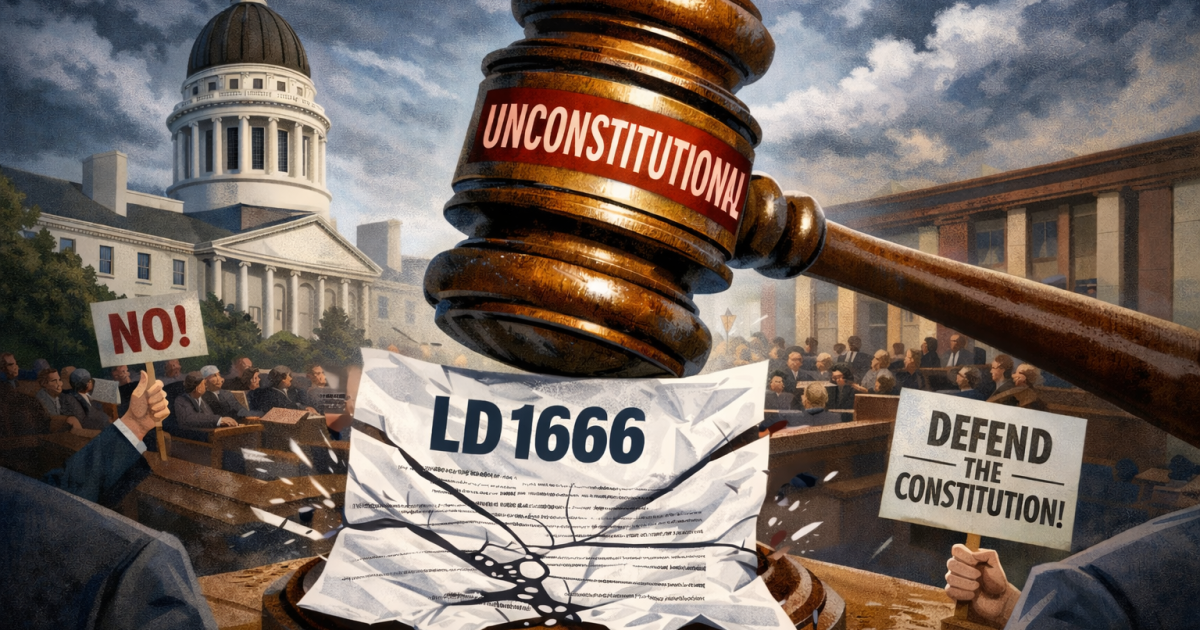
Last June, Maine Policy Institute urged Governor Janet Mills to veto LD 1666, a bill expanding ranked-choice voting (RCV) to elections for governor, state senator, and state representative.
That request was grounded in clear constitutional text, the Maine Supreme Judicial Court’s 2017 advisory opinion, and Governor Mills’ own legal analysis as Attorney General. Since then, nothing material has changed, except the Legislature’s willingness to ignore those constraints.
Despite an explicit veto threat from the governor and an unresolved constitutional defect already identified by Maine’s highest court, the House has advanced LD 1666 anyway. That choice deserves scrutiny.
The Legislature Knows the Constitutional Problem Exists
There is no genuine ambiguity about Maine law here. In 2017, the Maine Supreme Judicial Court determined that ranked-choice voting is incompatible with the Maine Constitution’s plurality requirements for gubernatorial and legislative elections. That conclusion rested on the Constitution’s text, structure, and history, particularly Maine’s deliberate rejection of multi-round majority systems in favor of single-count plurality elections.
That same year, then-Attorney General Janet Mills agreed. In briefing to the Law Court, she described RCV as a “fundamentally different voting methodology,” not merely a new tabulation technique, and concluded that it violated both the letter and history of Maine’s Constitution.
LD 1666 does nothing to resolve that conflict. It simply reenacts it.
Why Out of State Rulings are Irrelevant
Proponents of LD 1666 increasingly point to decisions from the Ninth Circuit (which makes up the American west coast, nowhere near Maine) and the Alaska Supreme Court to argue that Maine’s constitutional concerns are outdated or mistaken. That argument misunderstands both precedent and constitutional structure.
First, neither the Ninth Circuit nor the Alaska Supreme Court has any binding authority over Maine courts. Federal equal-protection cases interpreting municipal election systems do not control the interpretation of a state constitution’s explicit vote-counting requirements. Nor do rulings construing Alaska’s constitution, written differently, amended differently, and grounded in a different electoral history, override Maine’s own constitutional text.
Second, these cases address different legal questions. The Ninth Circuit’s RCV decision examined whether a limited-ranking system violated one-person-one-vote principles under the U.S. Constitution. It did not address whether a state constitution requiring plurality winners permits multi-round tabulation schemes. Alaska’s decision, meanwhile, turned on that state’s constitutional silence regarding plurality rules, a silence Maine’s Constitution does not share.
Finally, Maine courts have already spoken. When the Law Court issued its 2017 advisory opinion, it did so with full awareness of national RCV debates and chose to anchor its analysis in Maine’s own constitutional history. No amount of citation to federal or out-of-state cases changes that baseline reality. Invoking Alaska or the Ninth Circuit does not rebut Maine law.
Redefining a “Vote” to Circumvent the Constitutional Plurality Requirement
At the core of LD 1666 is a conceptual maneuver: an attempt to redefine what a “vote” is under Maine law in order to sidestep the Constitution’s plurality requirement.
Under Maine’s Constitution, a vote is a specific act: cast once, counted once, and aggregated with other votes to determine which candidate received the most support. That understanding is embedded not only in constitutional text, but in centuries of electoral practice and statutory design.
RCV departs from that model. It allows a ballot to shift from one candidate to another after tabulation has begun, depending on which candidates are eliminated in successive rounds. To reconcile this with the plurality requirement, RCV proponents argue that rankings are merely “alternative expressions” of a single vote. That argument was explicitly rejected in Maine in 2017.
As Attorney General, Janet Mills explained that RCV does not merely count votes differently; it changes when and how votes are cast, transforming later preferences into operative votes in subsequent rounds. A ballot that first counts for Candidate A, then Candidate B, then Candidate C is not being counted once; it is being counted repeatedly, for different candidates, at different stages of the election.
This is precisely the type of multi-round voting system Maine’s Constitution was amended to prevent. Calling this process “one vote” does not make it so. It is a legal fiction designed to evade a constitutional command, not a faithful interpretation of it.
Completely Changing Election Rules Right Before an Election
Compounding the problem is timing. LD 1666 is being advanced close to upcoming statewide elections, with full knowledge that its constitutionality is disputed and unresolved. Election law is not ordinary legislation. Changes to the rules governing how votes are cast and counted demand stability, clarity, and public confidence.
Passing a constitutionally suspect election law shortly before voters head to the polls invites confusion for election officials, uncertainty for candidates, and litigation risk for the state. It also places courts in an impossible position: forced to choose between intervening in active elections or allowing potentially unconstitutional results to stand. What happens if the Supreme Judicial Court needs to strike this law weeks or even days before the 2026 election? Even some of the bill’s sponsors expressed these concerns during the January 30th public hearing.
This law passing now could cause a full blown electoral crisis in Maine, even with multiple different candidates declaring themselves governor based on different potential electoral systems. It almost seems like the legislature is choosing to pass this constitutionally suspect law now to pressure Governor Mills to pass it due to her upcoming senate primary, due to the support among progressive democrats for the reform.
This is not how responsible election governance works. Maine’s plurality rule was designed precisely to avoid this kind of post-hoc uncertainty, and laws shouldn’t be passed simply because of inter-politician pressure plays.
Why a New Solemn Occasion is Unnecessary and Misplaced
In response to constitutional objections, legislative leaders now propose requesting a new advisory opinion from the Maine Supreme Judicial Court before final Senate action. That move is being framed as prudence. In reality, it is an attempt to re-litigate a question that has already been answered.
Advisory opinions are meant to clarify unsettled constitutional questions, not to invite the Court to reverse itself because legislators dislike the answer they previously received. Asking whether the Constitution now permits what it plainly forbade in 2017, absent any constitutional amendment, places the Court in the position of acting as a political escape hatch rather than a constitutional referee.
Moreover, the rationale offered by supporters – that ranked-choice voting has become more familiar or more widely used – is legally irrelevant. Constitutional meaning does not evolve based on administrative comfort or popular acclimation. If experience alone could override constitutional constraints, amendments would be unnecessary.
Requesting a solemn occasion under these circumstances risks weakening the advisory process itself. It signals that advisory opinions are provisional suggestions, subject to reconsideration whenever political pressure builds, rather than authoritative constitutional guidance. That undermines separation of powers and encourages future legislatures to treat constitutional limits as negotiable.
A Choice Still Remains for Maine’s Senate and Governor
The Senate has not yet enacted this law. The Legislature can still pause, and accept the validity of the explicit and clear previous decision by the Maine Supreme Judicial Court, and simply decline to pass it again.
And if LD 1666 reaches her desk, Governor Mills faces the same choice she did in June 2025. The law’s legal reasoning has not changed. The Constitution has not changed. The Legislature’s failure to address the problem has only made the risk more acute.
Conclusion
The issue is no longer just ranked-choice voting. It is whether Maine’s Legislature will respect constitutional boundaries, or knowingly legislate past them and hope the courts will sort it out later.
That is not good governance. That is not respect for separation of powers. And it is not how election law should be made.
LD 1666 should not advance further. And if it does, it should be vetoed – again.