
Last week, the Star Tribune published an op ed on how to grow Minnesota’s economy. It was pretty wide of the mark, in my view, so I submitted a response. Not surprisingly, they declined to print it. You can read it below with a couple of added charts.
It’s the per capita GDP, stupid
Too often, commentators looking for ways to boost Minnesota’s slow rate of economic growth fail to distinguish between growing total Gross Domestic Product (GDP) or growing GDP per person or per capita. It is an important distinction: would you rather live in China — where total GDP (PPP (constant 2021 international $)) was $33.6 trillion in 2024 and per capita GDP was $23,846 — or Luxembourg, where total GDP was $87.0 billion and per capita GDP was $128,475?
The choice of which goal you prioritize — growing total or per capita GDP — determines which policies you pursue. In his recent column “Immigration is Minnesota’s top issue. We need to hear specific numbers,” Evan Ramstad notes that Minnesota is “growing more slowly than ever” and suggests that “every candidate running for state or federal office in Minnesota…declare a growth target for the state’s population” and “should also say the mix of native-born and immigrants needed to reach that target and offer a vision for national immigration policy that will be needed to get the state growing faster than it has been.”
Leave aside the fact that, Constitutionally, state officials have no authority over immigration policy, Ramstad is focused here on growing total GDP via greater immigration.
And it is true that growing your population will, generally, grow your total GDP. More people working means more goods produced and services provided and that is what GDP basically is: output of goods and services.
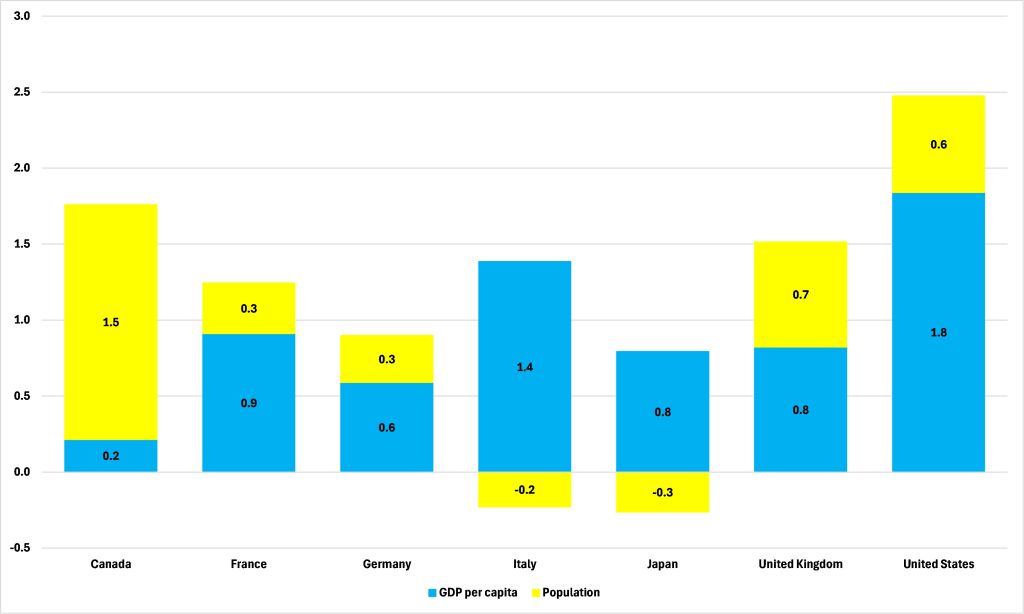
This is the growth model Canada has pursued in recent years. Its 1.5% average annual rate of population growth ranks top of the G7 since 2014, double the rate of the second placed United Kingdom, and its average annual rate of real total GDP growth, 1.8%, ranks second only to the United States.
But if you’d rather be living in Luxembourg than China, your aim will be to grow GDP per capita. This is just total GDP divided by the population, so it follows that the growth rate of GDP per capita is just the growth rate of total GDP minus the growth rate of the population. In Canada’s case, that gives us 0.2% annually, on average (with rounding), which ranks dead last among the G7, just one third the rate in Germany — 0.6% — which was second from last. Canada has used high rates of immigration to achieve high rates of total GDP growth, but measured by rates of per capita GDP growth, the average Canadian has got little better off as a result (Figure 1).
Figure 1: Components of annual real GDP growth, 2014-2015 to 2023-2024, percentage points
Immigration can grow per capita GDP, but whether it does depends on two things. First, are the immigrants more, as, or less likely to be employed than the population already resident and, second, are they less, as, or more skilled, on average, than the population already resident?
Immigration increases both the numerator and the denominator of our GDP per capita equation so whether immigration increases GDP per capita depends on whether it increases the numerator — GDP — by more than it increases the denominator, population. If the immigrants are less likely to be employed or less skilled, they will increase the population by more than GDP and GDP per capita will fall: if they are more likely to be employed and more skilled then they will add more to GDP than to the population and GDP per capita will rise.
The bottom line is that for immigration to boost per capita GDP we want skilled workers. Some state Gosplan setting a target growth rate for raw numbers of immigrants has nothing to do with this.
Per capita economic growth doesn’t come from adding more inputs but from generating more output from each given input: increased productivity, in other words, not simply more workers but more productive workers. We can increase labor productivity by increasing per worker skills or the stock and quality of physical capital — the tools — they have to work with. This is where state and federal policymakers ought to be focused.
So, whenever you hear someone talking about economic growth, always ask them if they are talking about growing total GDP or GDP per capita, because it is the latter which matters for living standards. And, as a once wise man once said, “Productivity isn’t everything, but in the long run it is almost everything. A country’s ability to improve its standard of living over time depends almost entirely on its ability to raise its output per worker.” The same goes for states, and that wise man was Paul Krugman.