Idaho is about two-thirds through the current budgeting year, Fiscal Year 2026 (FY26). Adjustments to the budget are now underway in the Legislature. Recall how the governor observed a softening of revenues during the early part of last year and issued a “hold-back” through Executive Order 2025-05 of three percent to all agencies except public schools. That means agencies were asked to reduce their spending for the current fiscal year by three percent. Constitutional Officers, who don’t report to the governor, were simply invited to offer reductions. The Legislature increased the governor’s holdback by $15 million, with Senate Bill 1331 (SB 1331), yet based on the debate in the Legislature, you would think it was ten times that amount.
One of the debate points was that the across-the-board cuts were indiscriminate and that JFAC should have used a scalpel to go agency by agency. Those objections are easily dismissed. For starters, the cuts overall are not large, considering years of budget growth. But more importantly, we are two-thirds through the current fiscal year, and it is a bit late to try to do a line-by-line review for cuts after the agencies have been operating with the three percent hold-back for over six months. And these agencies have already responded with detailed reductions.
The debate is not really about the budget cuts. It is about who controls the process. Right now, the majority of the Joint-Finance and Appropriation Committee (JFAC) has set the stage for the budget process. The fight for control by a dissident minority group of Democrats and fiscally soft Republicans is about trying to wrest control away from the majority. It is important to note that the dissident Republicans are not a majority of their caucus and can only win by partnering with Democrats.
Let’s look at some numbers. You can see more details here.
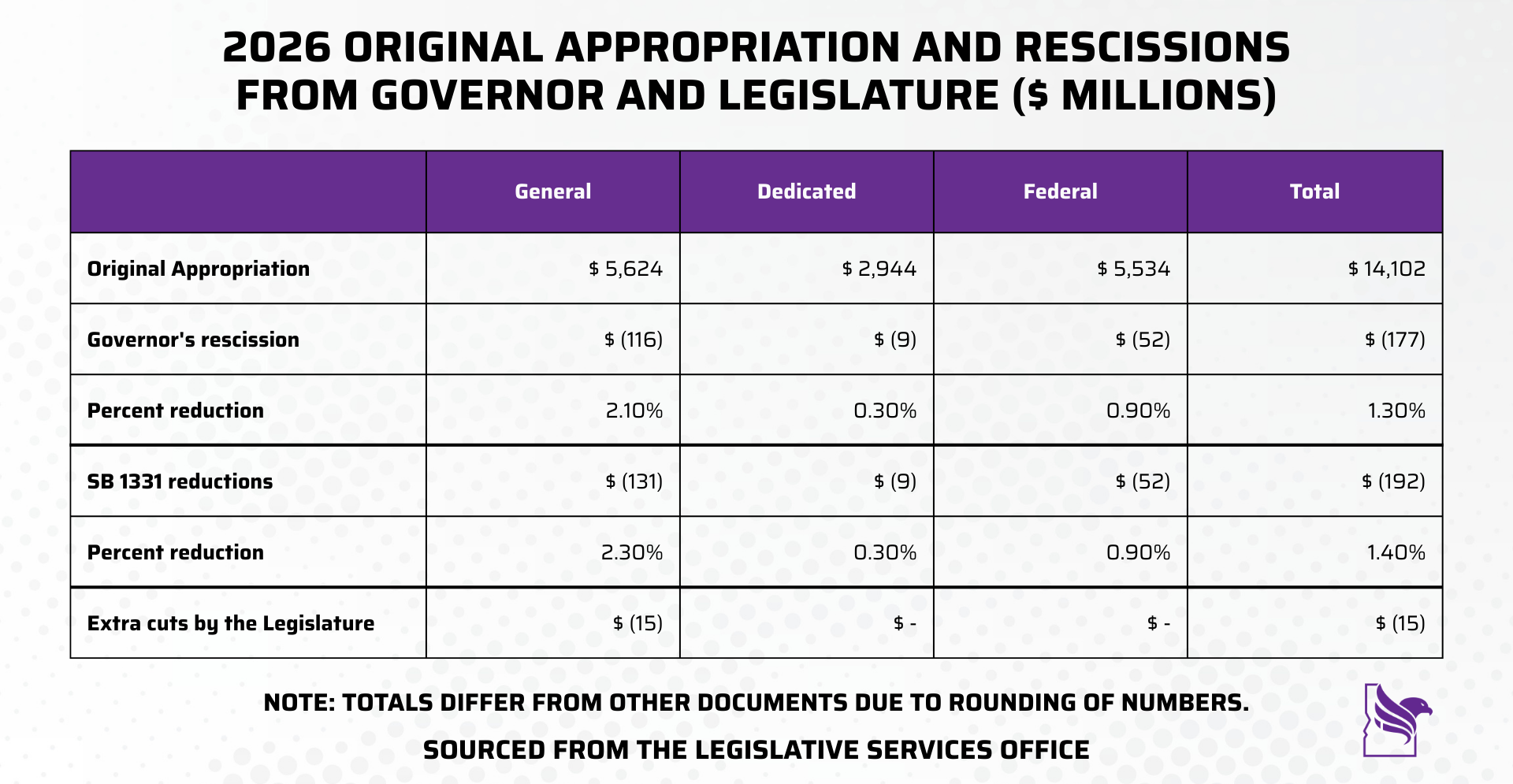
You saw that right: the difference is $15 million between what the dissidents object to and the majority of the committee proposed. Note that of the $192 million total cut, 63% is to payments to outside parties, known as Trustee and Benefit Payments. The largest such category is payments to Medicaid providers, which are to be reduced by about $62 million out of a total of over $5 billion. Not all providers were even subject to cuts.
After growing about 60% over the past six years, Idaho’s budgets need to be right-sized, and SB 1331 is the first step in the process. Those opposed to the cuts naturally didn’t seem to mind the spending growth. Brought up in debate by those opposed to the cuts was the fact that inflation-adjusted, per capita spending hadn’t really increased that fast. Well, let’s look at the numbers. Inflation-adjusted all funds spending was $5,330 per capita back in 2005, and was $5,327 a decade later in 2015. But by 2025, it had climbed to $6,565, a 23% increase from 2015. What that means is it was $1,238 higher per person after you adjust for inflation. And since there are about 2 million people in Idaho, that translates to an additional $2.5 billion of spending. Keep in mind that $2.5 billion is what Idaho collected in property taxes in 2025. So yes, we have surged spending in the last decade, and it is time to trim it back.