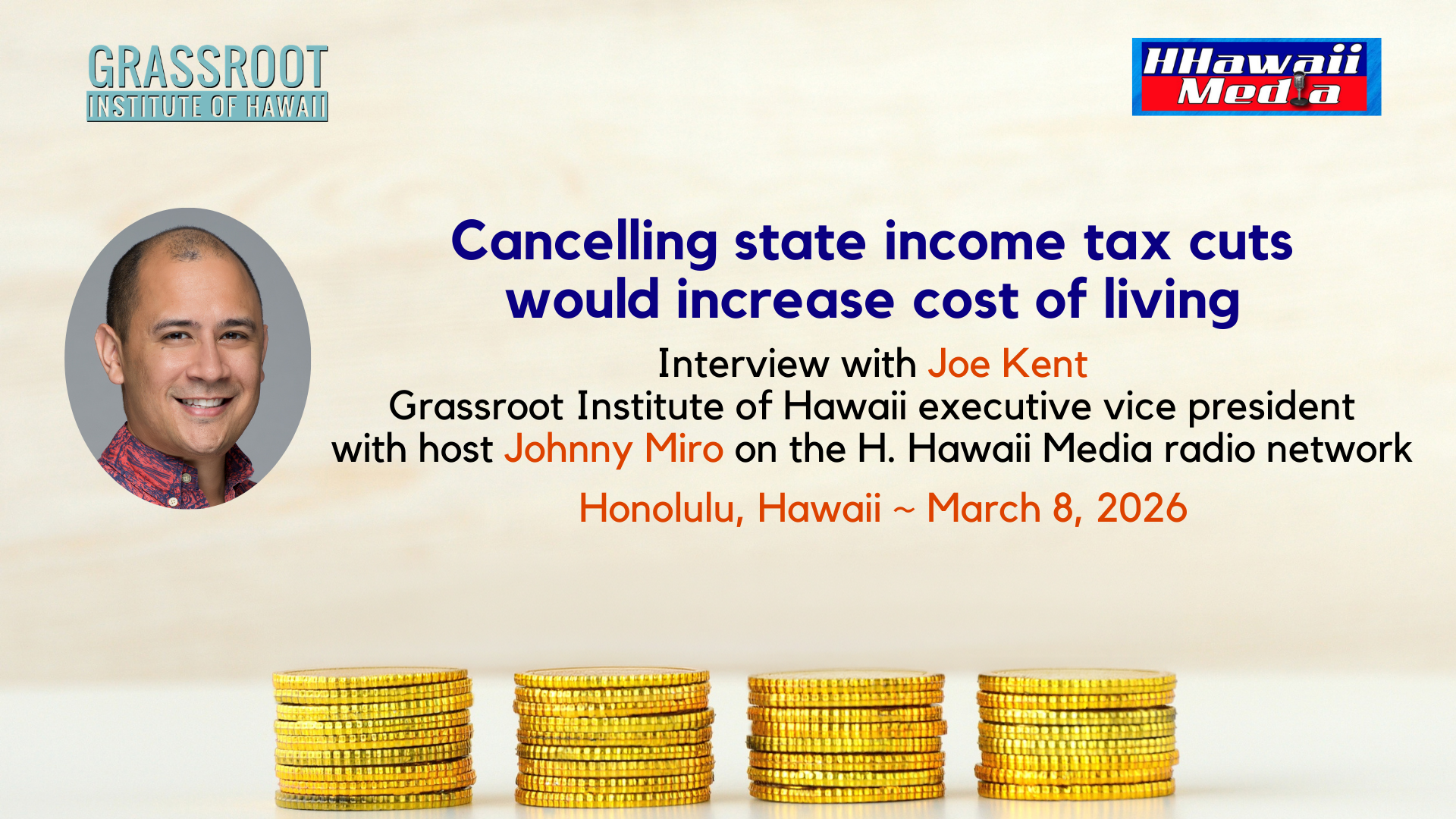
The Hawaiʻi Legislature passed sweeping income tax cuts in 2024 to help prevent residents from moving away in search of a lower cost of living, according to Grassroot Institute of Hawaii Executive Vice President Joe Kent. But now, some lawmakers are considering walking them back.
Speaking this past Sunday with H. Hawaii Media radio host Johnny Miro, Kent said Gov. Josh Green’s proposal to balance the state budget by pausing the remainder of the cuts that are scheduled to phase in through 2031 is a “clunker of an idea.”
He also said the governor’s official plan didn’t wind up being a pause at all, because the two bills that were submitted on his behalf — HB 2306 and SB3125 — actually proposed cancelling the remainder of the phase-in. They have since been amended.
An outright repeal of the cuts, Kent said, would effectively amount to a tax increase on Hawaii residents who are already struggling to afford basic necessities.
“The tax cut originally was designed to be for the middle class and lower classes,” he said. “Some for the wealthy. But mostly right in the middle. And so if they stop it, then that’s going to hit the middle and lower classes.”
Kent noted that the governor unveiled his official plan quietly because “no politician likes to talk about a tax hike.”
“Typically, the governor releases his budget with a press conference,” he said. “But this year, there was no press conference. … And it kind of flew under the radar for that reason, I think.”
Rather than end the tax cuts, Kent said the state could trim the biannual budget through measures such as eliminating vacant government jobs, worth about $350 million, and restoring certain department budgets to their pre-COVID levels, adjusted for inflation, for an additional $100 million-plus.
Kent also mentioned that proposed tax hikes being considered by the Legislature — such as raising the rental car tax or pulling more revenue from real estate investment trusts — “probably won’t generate much” revenue. Plus, he added, such moves could contribute to the cost of living for residents.
“I’m a local,” Kent said, “and I rent cars all the time — you know, when I visit the neighbor islands or visit my family members there. And so that would hit me too.”
To listen to the entire 18-minute conversation between Kent and Miro, click on the image below. A complete transcript is provided.
3-8-26 Joe Kent with radio host Johnny Miro on the H. Hawaii Media radio network
Johnny Miro: Happy to have you along on this Sunday morning. I’m Johnny Miro. It’s time for our H. Hawaii Media family of radio stations’ public access programming on our five Oahu radio stations, our four radio stations on Maui and five radio stations on the island of Kauai.
Hawaii Stream.FM and Live365 — another way to find us here each and every Sunday morning, pretty much at 9:00 a.m. Some other stations might air it a little bit earlier. But nonetheless, you can always catch replays from time to time.
Remember the historic income tax cuts the Hawaiʻi Legislature passed in 2024? Well, the largest in state history.
Now, Gov. [Josh] Green, as you might know, is proposing what he calls a pause on part of those cuts to help balance the state budget. Supporters say it’s a necessary step to deal with the financial uncertainty. Critics argue it’s effectively a tax hike that would hit local families and small businesses at the worst possible time.
So, joining us to break it all down is, once again, Joe Kent from the Grassroot Institute of Hawaii. Joe, thanks for being here. Good morning to you.
Joe Kent: Good morning, Johnny. Thanks for having me.
Miro: Absolutely. Joe, let’s rewind just for a second. Last year, lawmakers passed what was billed as the biggest income tax cut in Hawaii history. And now we’re talking about the possibility of hitting the brakes on it. So what changed?
Kent: Well, that’s right, Johnny. In 2024, the Legislature miraculously passed the biggest income tax [cut] in state history. But, now recently, Gov. Josh Green proposed a bill that would pause that, so to speak. This is his language: He says that he will pause this.
He, of course, needs the state Legislature to do that. But when we look at the bill, it’s not really pausing it; it’s just stopping it altogether. That bill is HB2306 and SB3125 at the Legislature.
Miro: Joe Kent, executive vice president with Grassroot Institute of Hawaii. Joe, the governor says that this isn’t really a tax hike, of course, just a pause. Political speak, I guess. When you look at it practically, though, for families sitting at the kitchen table, is there really a difference?
Kent: [Chuckles] Well, yeah. To me, it looks like a tax hike, and to a lot of other people who are counting on those tax cuts in the future.
I mean, how the tax cut worked — originally — is that it stepped the tax cut every year. So, the first year, you’d get a little tax cut. Then the next year, it gets bigger, and bigger every year.
You know, the first year, it might save the average family around $1,000. Then the next year, $2,000. Then the next year, $3,000, and so on. So it’s a tax cut that grows.
But in future years, if they’re going to stop the rolling in of that, then that constitutes more money than is expected to come from my pocket to the state pocket, and your pocket too [chuckles].
Miro: I really saw the impacts, positive impacts of the, you know, the tax cut. So obviously, the question is, who’s going to feel this the most? Are we talking primarily middle-class families, small business owners, higher earners? Who’s taking the biggest hit?
Kent: Well, originally, they billed this as, “Oh, don’t worry, we’re just stopping this for the wealthy.” But the tax cut originally was designed to be for the middle class and lower classes. Some for the wealthy. But mostly right in the middle. And so if they stop it, then that’s going to hit the middle and lower classes. So, really, it’s a tax hike for everyone except for the wealthy [chuckles].
Miro: And are we talking about $250,000 and up? What was that salary range again, per family?
Kent: Oh, yeah, well. Yeah, the average family might make between $100K to $200K. So in that bracket, you know, that’s where the real hits are going to be.
Miro: OK. And put this into real numbers for us now, but if the rest of those cuts don’t go through, what does that actually mean in dollars for the average Hawaii household?
Kent: Well, it means, you know, the $1,000 that you needed to afford gas to take your child to piano lessons or tap dancing lessons, or it might mean the extra piece of grocery, you know, food item that you wanted to get but can’t afford it.
I mean, let’s not forget we have so many people leaving the state right now, and the No. 1 thing they’re saying is because of the cost of living.
This is actually the reason, the original reason that they passed the tax cut back in 2024 because, you know, they wanted to try to reverse that trend.
And, you know, we still need a bigger cut in order to afford the cost of living, which keeps rising. So for most people, this is going to hit their pocketbook, and they’re going to feel it. If it passes.
Miro: Yeah. Joe Kent, executive vice president with the Grassroot Institute of Hawaii joining us today. I’m Johnny Miro.
I guess there’s been some reporting that lawmakers are being pretty quiet about this. Why do you think no one seems eager to take a public position right now?
Kent: Yes, that’s right, even the way that Gov. Josh Green had originally unveiled this clunker of an idea. Of course, no politician likes to talk about a tax hike. But typically, the governor releases his budget with a press conference. So all these lights and cameras. He brings it into the governor’s office, and he talks all about how the budget is working. But this year, there was no press conference. It was just releasing the budget quietly. And it kind of flew under the radar for that reason, I think.
Then at the Legislature, you know, politicians didn’t really talk much about this, and haven’t been talking much about it. All we’re hearing from anyone is from the state budget director, Seth Colby, who outlined the whole, you know, supposed reason for the tax hike. So, but, you know, legislators seem to be hiding.
Miro: And the timing is interesting. We might not get maybe a final answer until just a few months before the August primary. Does that political calendar actually matter here?
Kent: Oh, absolutely. I mean, a lot of people think that in Hawaii, you know, politicians are locked into their elected office. But it’s not so true, actually. You know, every politician knows that their office is up for grabs by anyone who has a better idea. And any politician — from any party, by the way — who ran on this issue could probably get a lot of support.
Miro: The governor argues that it’s about bracing for our federal funding cuts. That’s what we see, and I believe the City [and County of Honolulu] budget that just came out is also putting that also into play for their new budget they just put out. How real are those concerns, according to you, Joe? Is that truly the driving issue behind the shortfall?
Kent: Yeah. It’s true that the feds are cutting back on monies they give to the state, but I don’t think it’s the whole picture. That probably accounts for a drop in the bucket compared to the increased spending that they want to create in future years, “they” being the state legislators and state budgeters.
I mean, if you look at the projection of spending for future years, it’s off the charts. And it exactly equals the tax hike that they’re wanting to propose. So this is less about trying to make up for a shortfall in some federal funds, which might be, I don’t know, a few million dollars, maybe tens of millions of dollars. But this is more about big spending increases at the state level, which are billions of dollars.
Miro: And I’m sure you folks have some suggestions. You said there are some other ways to balance the budget without touching the tax cuts. Now, if you were sitting in the governor’s chair, where would you start trimming, Joe?
Kent: [Chuckles] Well, the first thing I would do is look at the vacant positions. Oddly, we fund, at the state budget, employees that aren’t even there. We fund the positions, of course, because they have to try to find people to sit in those positions.
But year after year, those positions remain unfilled, yet are still budgeted. So that means that taxpayers are paying not only for the employees, the people who are employed by the state, but also for people who aren’t employed by the state, just for the positions. So that’s an easy one to cut because it would affect no one.
Miro: Do you have a ballpark figure on that?
Kent: And if you do that …
Miro: Do you have a ballpark figure on that number or … ?
Kent: Yeah, yeah, yeah. That would be around $380 million …
Miro: OK.
Kent: … for all of them. That’s a huge one.
Miro: Wow. That’s budgeted in, and these are unfilled positions, you’re saying?
Kent: Oh yes. Yes.
Miro: OK.
Kent: Now, if you wanted to cut all of the positions that had been vacant only for the last four years, then that would be $30 million.
So, now the departments counterargue that and say, “We need this vacant position funding because they help to deal with the fluctuations, you know, as needed,” and they operate somewhat like a slush fund for some of these departments.
But, you know, it’s hard to make an argument for a slush fund.
Miro: [Chuckles] OK. All right. During the pandemic, COVID time, a lot of programs saw those big spending increases, Joe. Which ones, in your view, never really, never really returned to normal levels?
Kent: Since the pandemic, there was a big spike in spending, mysteriously, especially at the Office of Enterprise Technology Services, at around $33.6 million per year. You know, one day it just went up and never went down again.
Then, you know, $13.5 million at the State Foundation on Culture and the Arts. And then $5 million for marketing and support.
So, you know, these types of things go under the radar as well. It’s very easy for little budget spikes to add up. And if you look across all departments, you know, it’s over $100 million that you could save just by reverting to the baseline before all of these mysterious spikes.
Miro: Makes sense. All right, let’s talk some big-ticket items. How much does something like the new Aloha Stadium factor into this broader budget picture?
Kent: Yeah, the Aloha Stadium is being funded to the tune of $400 million already from the state. But there’s millions more coming. There’s, you know, all these upgrades that are needed — needed, supposedly — for the Aloha Stadium. And so, that’s, you know, tens of millions of more in the state budget. Although that’s a one-time cost, it’s a huge one-time cost.
Miro: Lawmakers, Joe, have also floated ideas like raising the rental car tax or even pulling more revenue from real estate investment trusts. Now, are those serious solutions or just some temporary patches?
Kent: Well, those probably won’t generate much. I mean, the rental car tax and the real estate investment trust, that might increase some revenues — tax revenues — by tens of millions of dollars. But, you know, again, we’re talking about a couple billion dollars that the state’s trying to make up. So that probably won’t do it on its own.
And besides, you know, it still makes everything more expensive. I’m a local, and I rent cars all the time, you know, when I visit the neighbor islands or visit my family members there. And so that would hit me too.
Miro: So they’re talking rental car tax, and that doesn’t … ride-sharing. That’s out of the realm of ride-sharing then, so it would just be rental car tax then, right? Because …
Kent: Yeah, that’s right.
Miro: … you’re still getting around. OK. And they haven’t really said much about that, that industry yet. Maybe they’re not aware of the potential of the raising of revenues via them.
OK. Bottom line, reading the room at the Capitol right now, if that’s possible, what do you think the odds are that these tax cuts survive?
Kent: Well, I hope the tax cuts survive. And, a lot depends on the outlook for the economy.
The Council on Revenues is going to meet. These are the state estimators, projectors, of what they think the economy will be. And the state economists basically think that the state economy seems to be looking better, if you look at the latest University of Hawai‘i Economic Research Organization forecast.
So that’s good. That’s a good thing in terms of this tax situation because it means that maybe we’ll get more money than we thought we did — “we” being the state. Although, you know, we are not the state; they are the state. But in any case, you know, I hope that that is a good thing in terms of this tax situation.
Miro: And they’re just basing that on what exactly? Remember, is this more tourist dollars coming in, or is revenues coming in from other sources? What are they basing this on?
Kent: Yeah, mostly tourists …
Miro: OK.
Kent: … dollars coming in. Tourists are still coming to Hawaii, and they seem to be coming more and more.
But, you know, any little glitch in the economy could shake things up, of course.
Miro: Yeah, what we’re going through at this particular moment. It looks like the tourism from Japan is expected to rise up a little bit also. So we’ll see how this works out in the coming months as we roll through the year. All right.
When will they be making final decisions on this in the Legislature?
Kent: Well, that’ll be at the very end of April …
Miro: End of April.
Kent: … and early May.
Miro: OK.
Kent: But then, of course, it has to go to the governor.
Now, of course, the governor, at the last second, has all kinds of options available to him. As he typically does, he could veto spending. He could pull back with budget restrictions. So he’s got a whole box of tools to deal with cutting.
But he can’t increase revenues without the Legislature. And so that’s why I think the Legislature should just kill the tax and force the governor to cut.
Miro: Play some political hardball. And if the governor did veto it, it would go back to the Senate and they can override it with an amount of votes. Is that correct, Joe, locally?
Kent: Yeah. So if the state budget were line-item vetoed by the governor, the Legislature could take that up. But they typically don’t. You know, there’s a lot of political capital that you spend in doing so, and especially during an election cycle.
Miro: So they’ve got to calculate their risks as far as re-election is concerned.
OK. Interesting situation. A chess match is going to be going on, apparently.
Joe Kent from Grassroot Institute of Hawaii, the executive vice president. Can you let them know how they can find your work at Grassroot Institute?
Kent: Yeah. If you would like to learn more about us, we’re at the grassrootinstitute.org. That’s grassrootinstitute.org. And if you click on our tax calculator, you can see how much the tax cuts would affect you. And you can see more information about that there. Grassrootinstitute.org.
Miro: Appreciate the time once again, and look forward to our next conversation.
Kent: Thank you, Johnny.