
Net AGI Loss to Florida and New Hampshire Quintuples in a Decade as 26-35-Year-Old Outmigration Continues
Newly released 2023 IRS migration data – the first full year after the 4 percent surtax on incomes over $1 million took effect – show Massachusetts losing more than double the amount of adjusted gross income (AGI) than in any year prior to 2020, ranking fourth among states in net AGI out-migration, behind only California, New York, and Illinois.
Massachusetts’ net loss of AGI to other states grew from roughly $900 million in 2012 to $4.18 billion in 2023, representing a 467 percent increase over the past decade. To Florida and New Hampshire alone, the state lost $2.75 billion in AGI, a 5-fold increase. The Bay State has lost a net total of $14.8 billion since 2020. The persistence and scale of these losses signal structural competitiveness challenges for the Commonwealth.
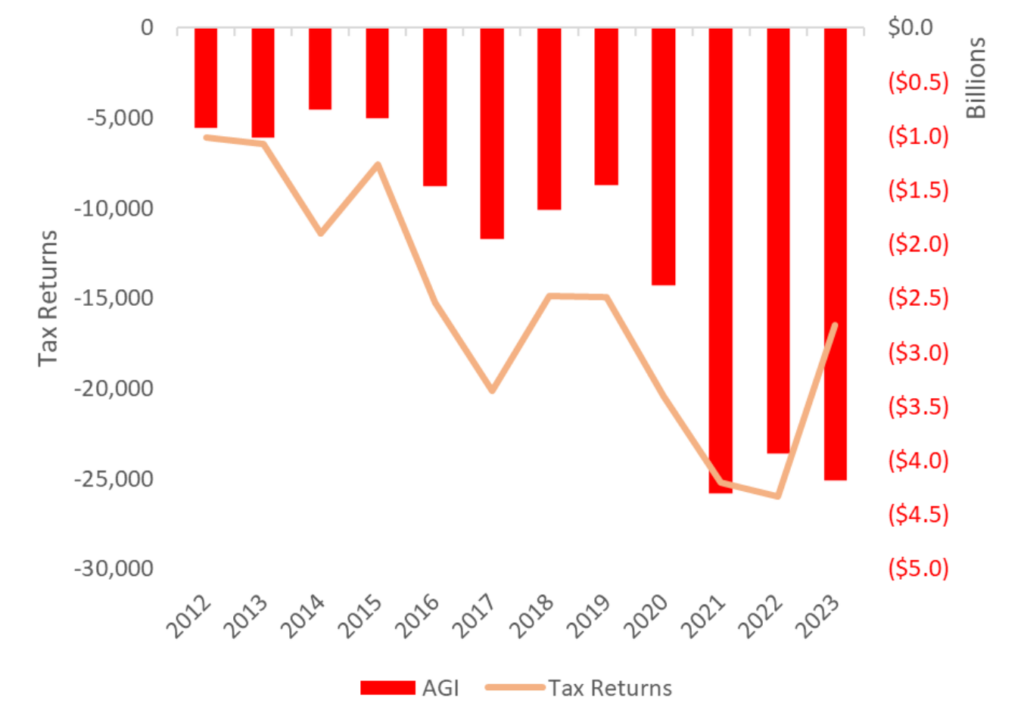
Florida and New Hampshire, two states without income or estate taxes, remain the top destinations for former Massachusetts residents. In 2023, roughly half of all outbound filers moved to one of those two states, accounting for approximately 66 percent of the total AGI lost through domestic out-migration.
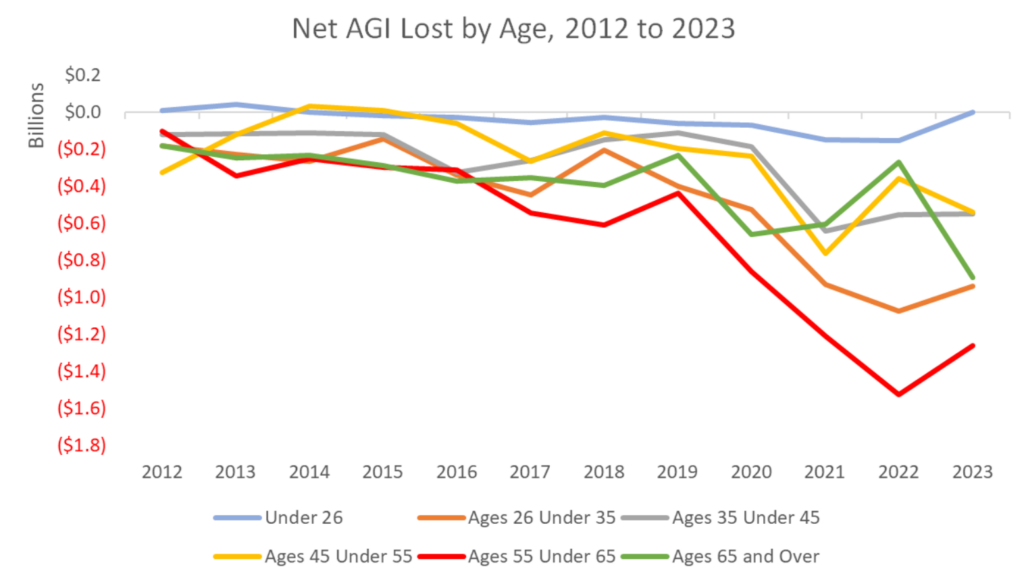
The largest net loss of filers continues to be among young adults. In 2023, Massachusetts saw a net loss of approximately 7,582 filers aged 26 to 35, more than five times the net loss recorded a decade earlier, raising concerns about the state’s long-term workforce and innovation pipeline. In total, the Commonwealth lost 16,464 net tax filers and 29,870 net individuals in 2023.
Massachusetts is also experiencing its largest net AGI losses among residents nearing retirement age. In 2023, a net 3,304 filers aged 55 to 64 left the state, taking with them approximately $1.3 billion in AGI. The net AGI loss for this age group has increased nearly thirteen-fold since 2012, a trend likely to accelerate as baby boomers continue to retire. The Commonwealth’s estate tax remains a significant factor influencing these relocation decisions.
“Massachusetts’ losses are concerning because they are big, broad and persistent year after year,” said Pioneer Institute’s Jim Stergios. “We are losing key working-age and pre-retirement cohorts—even as federal policy changes have shut off immigrant labor. That combination poses real risks for the state’s labor force, tax base, and long-term economic vitality. The question is: Are elected officials getting the message?”
For years, international immigration offset domestic losses. Recent Census population estimates show that buffer is eroding: since peaking in 2024, international migration has fallen sharply and is projected to decline nearly 90 percent by 2026 – heightening the urgency of addressing domestic out-migration.
The 2023 IRS data – the first full year of the voter-approved 4 percent surtax, which took effect January 1, 2023 – show high-income taxpayers continuing to leave in significant numbers, taking billions in AGI and future tax revenue with them. While some taxpayers relocated in anticipation of the tax, departures remain elevated. Since 2020, AGI losses among high-income earners have accelerated sharply. Of the wealth lost in 2021 and 2022, approximately $4.8 billion – roughly 60 percent – came from taxpayers earning $200,000 or more. In 2023, that figure totaled $2.9 billion, accounting for 70 percent of the Commonwealth’s total AGI loss. As a result, Massachusetts lost fewer taxpayers in 2023 than it did in 2022, yet because of the relative wealth of those leaving in 2023 Massachusetts lost more in AGI that year than in any year previous.
These sustained losses are narrowing the Commonwealth’s tax base, tightening its labor market, and increasing long-term fiscal risk.