When economists assess a state’s economic health, private sector employment is one of the clearest signals of momentum. It’s a lagging economic indicator that corresponds to increases in business creation, wage growth, and consumer activity, so when private sector employment is growing robustly, it bodes well for a state’s overall economic outlook and health.
In recent years, Florida has stood out as one of the strongest performers in the country. Since 2020, the state has seen roughly 11.7 percent growth in private sector employment, the third highest rate of any state. Only Idaho (17.7 percent) and Utah (13.9 percent) grew faster.
That growth rate equates to a private sector employment increase of 927,000 jobs. While some states, like Massachusetts, have struggled to regain their footing after the pandemic, Florida has moved in the opposite direction, adding jobs at a rapid and sustained pace.
This growth reflects more than just a rebound. It points to a deeper pattern of economic competitiveness that has led to business expansion, domestic and international in-migration, and economic dynamism.
What Industries are Driving the Growth?
Population growth has played a central role in Florida’s private sector expansion. Over the past several years, Florida has attracted a steady influx of new residents from across the country. These newcomers don’t just add to the labor force – they also increase demand for housing, healthcare, retail, and other services. Businesses respond by hiring, which in turn supports further growth.
Florida’s job gains have been relatively broad based, which is a key reason they’ve proven durable. Rather than relying on a single industry, multiple sectors have contributed to employment growth. Private education services (28.5 percent); professional, scientific, and technical services (26.9 percent); transportation, warehousing, and utilities (21.8 percent); and healthcare and social assistance (16.8 percent) have led the way.
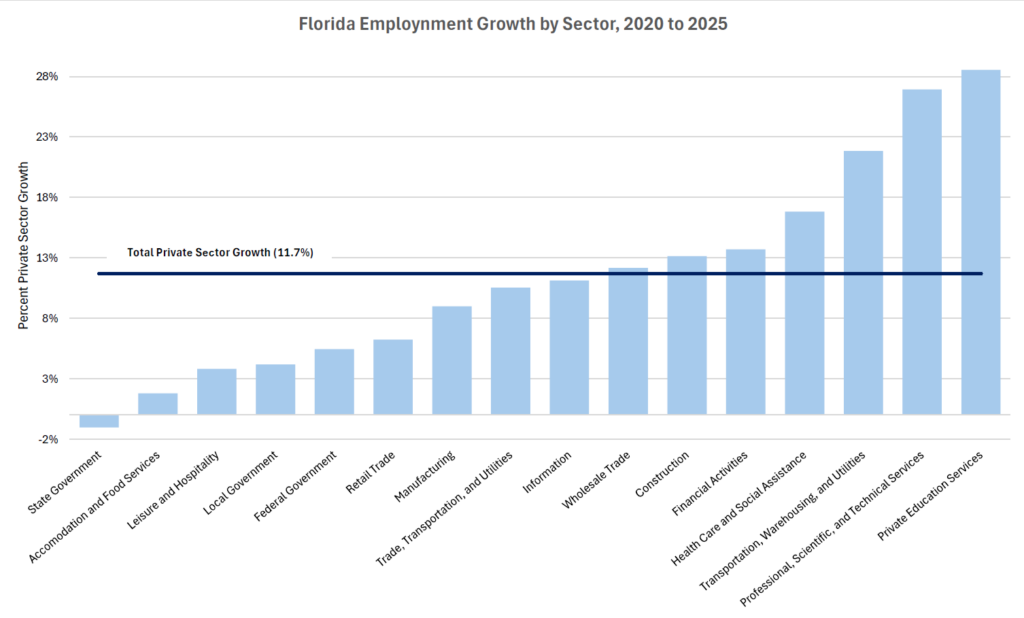
In fact, nearly every industry, large or small, grew at a rate greater than the average state growth rate for the private sector (4.6 percent). The only notable industries not to do so were leisure and hospitality (3.8 percent), accommodation and food services (1.8 percent), and administrative and support and waste management and remediation services (4 percent).
The only sector to see a decline in employment from 2020 to 2025 was state government – Florida lost about 2,600 state workers during that time, or 1 percent. The average state growth rate was lower for state government than for the private sector (2.9 percent), but the rate of growth in Florida was still considerably lower. Local government (4.2 percent) and federal government (5.5 percent) employment grew at significantly faster rates in Florida than state employment
What Regions of Florida are Benefiting the Most?
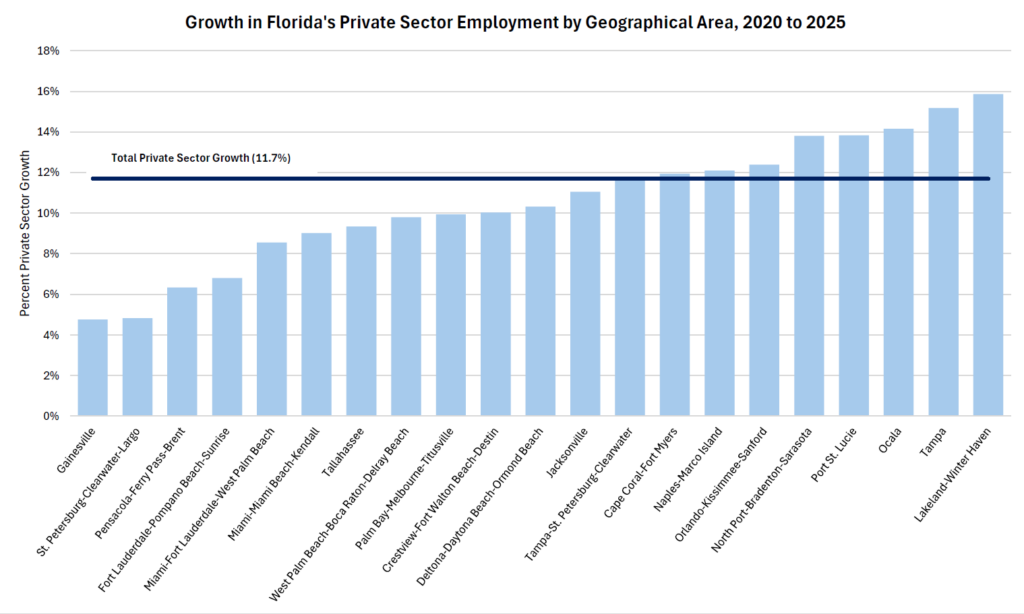
Private sector employment growth was robust across the state. Every major metropolitan area grew at a rate either close to or above the national growth rate (4.6 percent), and no area lost employment. The fastest growing metro areas were Orlando-Kissimmee-Sanford (167,400 jobs or 12.4 percent), Tampa (142,600 jobs or 15.2 percent), and Jacksonville (81,200 jobs or 11.0 percent). Other smaller metro areas like Lakeland-Winter Haven (15.9 percent), Ocala (14.2 percent), North Point-Bradenton-Sarasota (13.8 percent), and Naples-Marco Island (12.1 percent) also grew at higher rates than the state average.
Even the slowest growing major metropolitan areas — St. Petersburg (22,500 jobs or 4.8 percent), Fort Lauderdale-Pompano Beach-Sunrise (59,500 jobs or 6.8 percent), and Miami-Miami Beach-Kendall (111,400 jobs or 9.0 percent) — grew significantly faster than most areas of the country.
Why It Matters
Strong private sector job creation has ripple effects throughout the economy. It supports higher incomes, creates more opportunities for workers, and generates tax revenue without necessarily increasing tax rates. Just as importantly, it signals that businesses are confident enough to invest and expand.
Florida’s performance is especially notable when compared to slower-growing states, where weak job creation can lead to out-migration and reduced economic opportunity and social mobility for residents. In contrast, Florida has built a reinforcing cycle: more people move in, demand rises, businesses expand, and jobs follow.
Several factors have helped support this environment:
- No state income tax, lowering costs for workers and businesses
- A relatively friendly and flexible regulatory and business climate
These advantages have made Florida an attractive destination for both firms and workers, which helps sustain its momentum.
Looking Ahead
Rapid growth brings challenges, particularly around housing affordability and infrastructure. But Florida’s recent trajectory shows how powerful private sector expansion can be in shaping a state’s economic outlook.
At its core, the story is straightforward: when businesses are growing and hiring, everything else tends to move in the right direction. Florida’s experience over the past few years is a clear example of that dynamic in action.