BIRMINGHAM, Ala. – The three Republican candidates running to be Alabama’s next attorney general expressed Thursday different potential approaches to the role, but all three spoke with a sense of urgency about the current political moment.
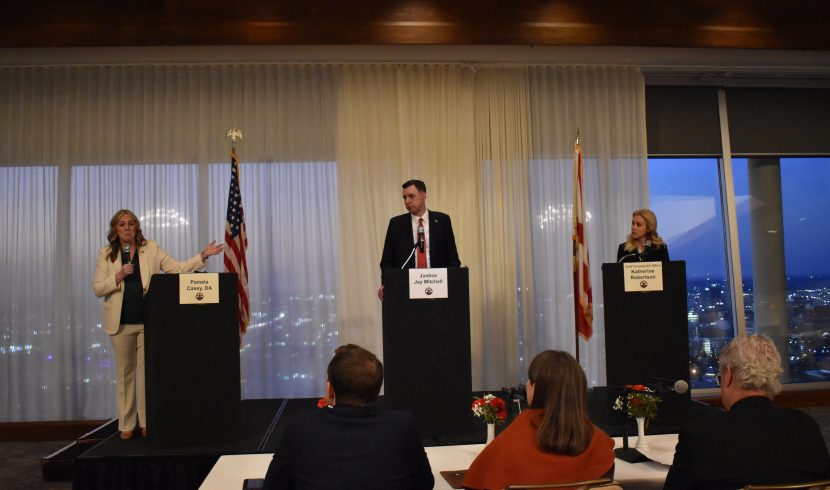
Blount County District Attorney Pamela Casey, former Alabama Supreme Court Associate Justice Jay Mitchell and Katherine Robertson, chief counsel to current AG Steve Marshall, faced off at a debate hosted by the Jefferson County Republican Party.
With President Donald Trump back in the White House, Mitchell said he has “a unique opportunity in this country to get generational conservative victories.”
“As Christians, as conservatives, we’ve been on defense,” Mitchell said. “We’ve been on defense against D.C., against the media, the culture, against a lot of the junk coming out of our colleges and universities. But now for the first time in our lives, with President Trump going back in for a second term and with the mandate that he’s carrying from the American people, we’re not on defense, we’re on offense.”
Robertson also positioned herself as a strong ally to Trump and called it “critically important” for both Trump and Tommy Tuberville, the GOP’s frontrunner to be governor in 2027, to have an experienced attorney general ready in January.
Casey talked about the urgency of trying to attack problems she has already identified in her courtroom experience as a prosecutor. She said she had discussions about instating the death penalty for cases of child rape with Rep. Matt Simpson, R-Daphne, in December of 2024 because she felt there should be higher sentences available for pedophiles.
The Legislature did not pass the bill in 2025, and later that year, law enforcement discovered a child sex trafficking ring involving multiple victims and adult predators in Bibb County.
“We would have had (the death penalty) option for Bibb County had the Legislature passed that bill the first time it came up from Rep. Simpson, but too many times, we wait until it becomes a popular topic before we pass the law,” Casey said.
The Legislature passed a new version of the bill this session, and Gov. Kay Ivey has signed it into law.
Prison crowding
With all three running on a tough-on-crime platform, the candidates also talked about how to address Alabama’s crowded prison system.
Robertson said the whole judicial system is “very well aware” of the prison issue, which is a factor in every decision made by the system. She said she doesn’t buy into the “myth” that state law like the Habitual Felony Offender Act and harsh sentences for minor drug charges have led to crowding.
“What causes prison overcrowding is lots of crime, specifically violent crime,” Robertson said. “Alabama’s prisons are full of violent offenders. In fact, it’s 85% violent. It is a very difficult population to manage and incarcerate, but that is not a reason to turn away from harsh sentences, it’s just dealing with the reality that, for some reason, we have violent crime in different places in Alabama, and the way we deal with it is to get them off the streets and put them away.”
The HFOA dates back to the 1970s and allows for a sentence of life in prison without parole on a fourth felony conviction. It has been modified occasionally, including in 2015 when lawmakers created a new class of felony for non-violent crimes, including thefts and forgeries, that don’t qualify for a life sentence. The law change was not retroactive.
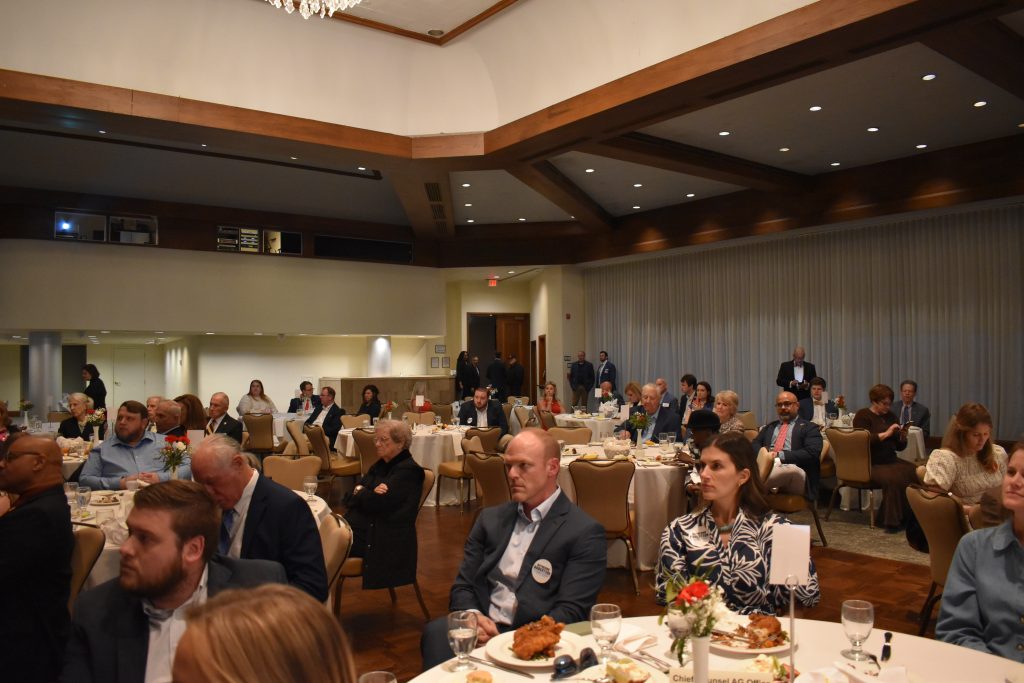
Members of the audience listen to the Jefferson County GOP’s attorney general debate in Birmingham on March 19, 2026.
Casey agreed that crowding is a result of a large population of violent criminals and said the strict sentencing guidelines prevent more people who she feels deserve prison time from being incarcerated, which she called “a slap in the face.”
“We currently have sentencing guidelines in the state, which is a worksheet, and unless you commit a violent crime, I, as a prosecutor, have to go through a worksheet and give you a little score, and this little book will tell you whether or not I can send you to prison or not,” Casey said.
Mitchell said the answer is to build more prisons.
The state is currently building a new $1 billion-plus mega prison in Elmore County with plans for a second in Escambia County. The two new prisons won’t add beds to the Alabama Department of Corrections’ capacity, but will largely replace existing space in three outdated facilities.
“We may have to get creative about the way we’re doing it,” Mitchell said. “Maybe we’re not building mega prisons in the same way that we’re doing it right now. Maybe we’re building prisons with different configurations. Maybe we’re building work camps in some ways, to kind of get other prisoners out of the way. We can keep the habitual offenders locked up in some of these more high-security correctional facilities.”
The candidates also touched on several high-profile issues like gambling and age and parental restrictions for children on social media.
Mitchell and Robertson said they were against expanding legalized gambling, while Casey said that though she is against gambling personally, she thinks it should be the Legislature’s decision if it gets put to a vote of the people.
AG candidates’ priorities
In terms of priorities, the three candidates’ answers detail different approaches their administrations would take.
Mitchell said his priority was addressing violent crime, which he called “a problem that plagues our state.” He said he would support Tuberville’s proposal to send in the National Guard in an attempt to stop crime.
“I think we can do that in a strategic and precise way that’s really helping the people who live in these cities and those of us who live around these areas,” Mitchell said. “But we’ve got to make sure that state government is really flexing its muscles on some of these blue cities being led by soft-on-crime mayors and these mayors who aren’t backing up law enforcement.”
Robertson jumped to the defense, claiming a lot of blue cities “don’t want help” and explaining the work she’s done as a part of the AG’s office to combat crime.
For Robertson, a day one priority would be ending the desegregation orders that have been in place over Alabama schools since the 1960s.
“We have school systems across our state that still have to report on the race of every teacher they hire, every student they have, every student they discipline, every student they put in a gifted program, and I want to see that end.”
Casey said her main priorities would be establishing a better partnership between the DAs’ and the AG’s offices to help DAs handle cases and setting up law enforcement training across the state.
“I started my career at the Alabama Attorney General’s office as an assistant attorney general in capital litigation and violent crimes. When I was in violent crimes, I tried cases and I handled cases,” Casey said. “Currently, the Alabama Attorney General’s office handles very few cases on behalf of DAs. We need to have a better partnership between the DAs’ offices and the AG’s offices. When you call down there right now, the answer is, find someone else to handle it, and we’ll appoint them. That is not acceptable.”
Looking ahead: polling and campaign finance
Polling released earlier this month by Mitchell’s campaign shows him leading the GOP primary field, but a vast majority of voters are still undecided with the primary two months out.
According to the most recent campaign finance data available, Mitchell and Robertson are neck-and-neck in total funds received, her $3.26 million to his $3.28 million. Casey has raised about $146,000 and loaned her campaign $500,000.
Robertson has dominated spending in the race, at about $1.18 million to date. Mitchell and Casey have spent $589,000 and $36,000, respectively.
Mitchell has attacked much of Robertson’s fundraising, including about $1.7 million from out-of-state non-profit political organizations. Robertson’s campaign has said the contributions show her support among conservative groups.
The primary is May 19.
This story was updated at 11:30 on Friday, March 20, to include new campaign finance numbers made available Friday morning.