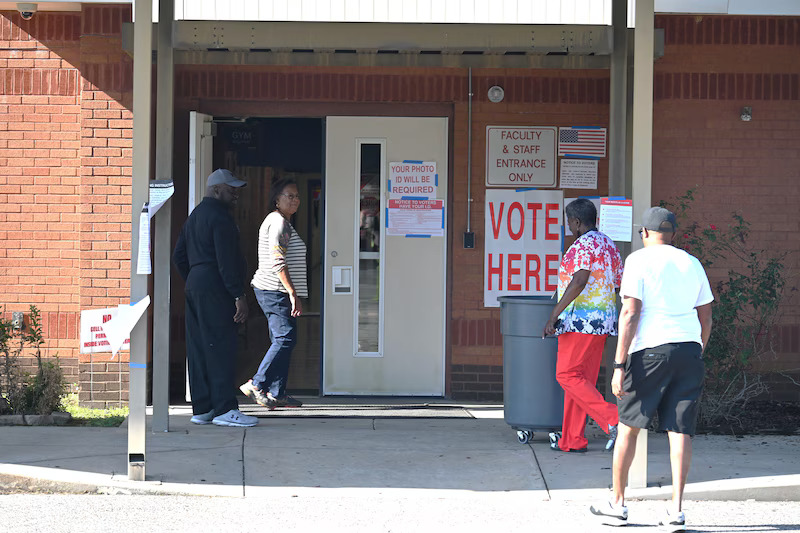
Voting takes place at Gilliard Elementary School on Dauphin Island Parkway in Mobile, Ala.John Sharp
As Alabama lawmakers grapple with the future of primary elections, the debate returns to a simple question with potentially costly implications: Should taxpayers foot the bill of a closed primary?
That question surfaced during a brief but pointed exchange on the Alabama House floor Thursday, just before lawmakers advanced HB541 and sent it to the Senate, where its prospects remain uncertain.
It has also sparked a second, more ideological question that cuts at traditional Republican principles: Should a fiscally conservative government adopt a voting system funded by all taxpayers that’s closed to unaffiliated voters?
With the Alabama Republican Party pushing for state party registration, a system that would require voters to declare a party two months before a primary, the Legislature is edging toward a dramatic shift in how the state conducts its elections.
If HB541 becomes law, Alabama would be only the second state in recent memory to move from an open primary system to a closed one. West Virginia made the switch last year, and it took effect for this year’s primary.
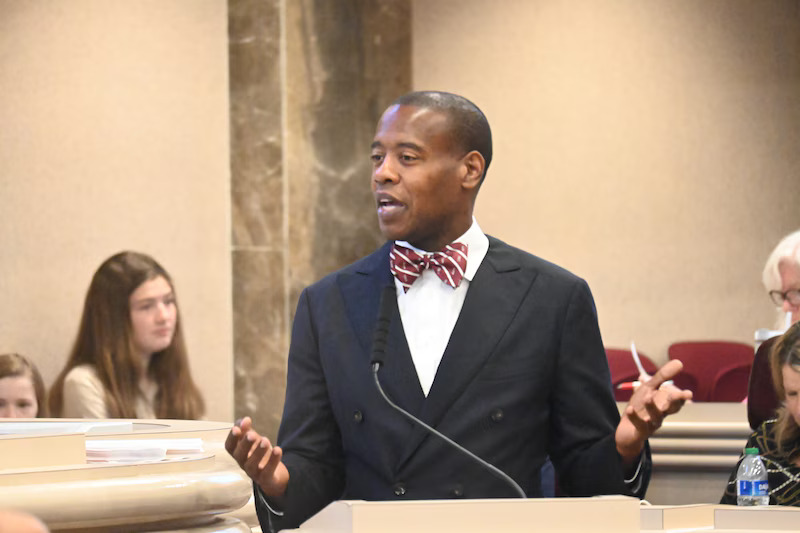
State Rep. Anthony Daniels, D-Huntsville, the House Minority Leader, on the Alabama House floor during a debate over the Education Trust Fund on Thursday, May 9, 2024, at the State House in Montgomery, Ala.John Sharp
“Shouldn’t the parties who want to make the change, but the one responsible for the costs?” said House Minority Leader Anthony Daniels, D-Huntsville, the lone lawmaker to raise the fairness issue over whether public money should underwrite what critics argue is essentially a private election. “The State of Alabama is footing the bill.”
Supporters of HB541, sponsored by Rep. Ernie Yarbrough, R-Trinity, argue that Alabama’s primaries will remain open in practice. Voters could still switch party affiliations from one primary to the next, as long as they do so ahead of time. Under the bill, that switch must occur 60 days before the election to account for absentee voting.
GOP strategists warn that requiring political parties to finance their own primaries could lead to tighter restrictions on access, potentially disenfranchising voters. Closed caucuses, famously used in Iowa, require voters to register with a party months in advance and appear at a specific location to cast their ballots.
“There are states where they do that, they have the ability to control,” said Jon Gray, a GOP strategist based in South Alabama. “The party could decide to have a caucus and throw the names on a secret ballot. The problem is that, for better or worse, Alabama has chosen the primary to be conducted at-large. The parties agree to subscribe to all state laws. As a result, the state has to pick up the tab.”
Costly contests
While an exact estimate for running an Alabama primary is unavailable – and there is no estimated cost in the legislative fiscal note attached to HB541 — a statewide election can cost more than $10 million, based on past estimates for the 2017 special U.S. Senate election.
In Madison County, home to fast-growing Huntsville, the probate office is budgeting $1.7 million for the primary election and a possible runoff. And while some counties struggle to recruit poll workers, Madison County is not among them. Approximately 1,000 election workers are lined up to work the primary, according to Probate Judge Frank Barger.
In Baldwin County, the estimated cost to run this year’s primary election is $842,000. The county anticipates operating additional polling locations to help alleviate congestion in higher-volume precincts, which may also impact overall costs, according to spokesperson Jessica Waters.
Sonny Brasfield, executive director of the Association of County Commissions of Alabama, said he is concerned that closing the elections would discourage people from serving as poll workers at a time when its becoming increasingly difficult in some counties to recruit them.
“Because the election is funded by the taxpayers, there should not be a requirement that one register with a political party in order to vote,” he said.
The high cost of administering elections is also drawing scrutiny in other states with closed systems, where lawsuits have emerged challenging the use of taxpayer funds. In larger states, the costs can soar beyond $50 million to hold a primary contest.
Jeremy Gruber, senior vice president with Open Primaries, a nonprofit advocacy group opposed to closed primaries including HB541, summed up the concern: “The issue of funding of closed primaries is an issue that no one who has been in favor of closed primaries wants to touch because they don’t have a good answer for it.”
Gruber said primaries are fully state-funded operations, from voting machines to hiring poll workers.
“The entire enterprise is publicly paid for and administered, yet proponents of closed primaries like to argue they are private party elections,” he said. “They use analogies of why would the Eagles like the Giants pick their starting lineup? Or why would the Lion’s Club allow folks who are not members of the Lion’s Club participate in their elections? They are false analogies. But they are private organizations who run their own enterprises. The parties claim the primaries are theirs but play no role in paying for them. They take no responsibility for the administration or the party for any of it.”
If Alabama passes HB541, it would join 14 other states that close primaries to unaffiliated voters. But at least three of those states — Maryland, Oregon, and Pennsylvania — face litigation. Open Primaries is a plaintiff in the Maryland case, which argues that excluding unaffiliated voters is unconstitutional because the primaries are publicly funded.
Gruber said Alabama would likely face a similar lawsuit. He also noted the political irony, given Republican dominance in Alabama over the past 15 years.
“The idea that private organizations should have their elections paid for and administered by the state, and yet be able to control who can vote in them, is the very basis of anti-conservative big government,” he said. “And yet, it’s the basis for the argument of closed primaries. The Republican Party of Alabama wants it both ways. They want control over who votes in the primary, but they want the taxpayers to fund it and the government to run it. There is nothing less than conservative than that.”
Concerns about fairness are not limited to Democrats. In Louisiana, where GOP lawmakers considered closing primaries in 2024, Republican U.S. Sen. Bill Cassidy argued the move would be costly and would shut out tens of thousands of unaffiliated voters.
Few changes
Alabama closed primary bill
What is HB541?
A proposed bill requiring voters to register with a political party 60 days before primary elections.
Current Status:
Recently advanced by the Alabama House and set to be reviewed by the Senate.
Key Provisions:
Voter registration must be party-affiliated two months prior to primaries.
Alabama would become only the second state within the past few years to implement this closed primary system following West Virginia.
Financial Impact:
Estimated cost for Alabama’s statewide primary elections exceeds $10 million, raising concerns over taxpayer funding for party-controlled elections.
Opposition Concerns:
Potential constitutional challenges regarding taxpayer-funded elections.
Questions about voter access and potential disenfranchisement of unaffiliated voters.
Supporter Argument:
Proponents argue that closed primaries protect party integrity and prevent crossover voting by non-affiliated individuals. They also say that unaffiliated voters can still participate in the primary election.
Next Steps:
The Senate is expected to vote on HB541 after spring break. The legislation would not take effect until the 2028 election if it passes the Legislature and is signed by Gov. Kay Ivey.
Supporters of closed primaries say critics misunderstand the system. They argue that little would change beyond the requirement to pre-register with a party.
“There isn’t an independent right now in the party system,” Grayh said. “You cannot go vote for a Democratic candidate you like and nominate and then go vote for three Republican candidates. It doesn’t exist. You still have to choose the primary ballots you want. It’s been that way since the history of the primary system in Alabama.”
Gray and Chris Brown, a longtime GOP consultant, said statistics show that primary voters overwhelmingly choose one of the two party ballots, and that independents are not participating in significant numbers.
“I want to stop this perception that we are changing something,” Gray said. “We are not changing something. You cannot vote in two primaries right now.”
In addition, Gray said that anyone who wants to vote in a primary can vote a provisional ballot even within a closed primary system. Election officials would later determine if the voter was properly qualified to vote within the party’s primary.
“Under Alabama law, nobody can ever be turned away and denied the opportunity to vote, although it’s no guarantee with a provisional ballot that their vote would count if they are not, in fact, eligible,” he said.
He added that voters could still switch parties between election cycles and switch as a registered Republican to Democrat, and vice versa. “If you vote in the Democratic primary in 2028, and then vote in the Republican primary in 2030, you can do that,” Gray said.
Crossover voting
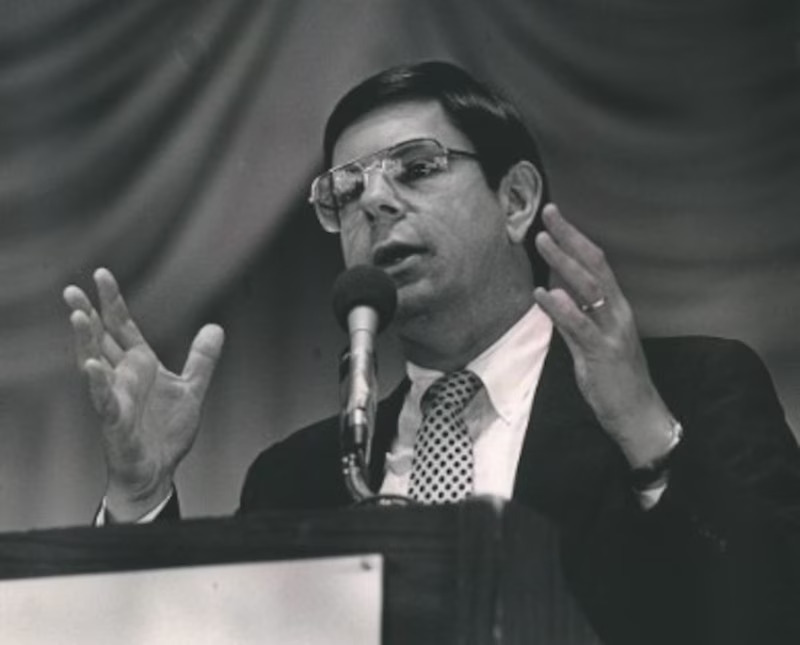
Charles Graddick, as pictured campaigning for Alabama governor in 1986.
Opponents of open primaries often argue that crossover voting allows one party to meddle in the other’s nomination process. But Democratic lawmakers say that concern is overstated, and some Republicans argue the legislation is unnecessary given the GOP’s dominance under the current system.
The last time a Democrat won statewide office in Alabama was in 2017, when Doug Jones defeated Roy Moore in a race that drew national attention.
Daniels said Moore’s primary victory over Luther Strange was not the result of Democratic crossover voting.
“There is an illusion that Democrats are voting in their primaries,” Daniels said. “Let’s get real. They are not trying to interfere and impact (GOP) elections.”
Gray pointed to a different example: the 1986 governor’s race, when Charles Graddick appeared to defeat Bill Baxley in the Democratic primary, only for party leaders to declare Baxley the nominee, arguing Graddick benefited from Republican crossover voters. The backlash helped Republican Guy Hunt win the general election, becoming the state’s first GOP governor in 100 years.
Closed primary fate
Republicans pushing HB541 say they have strong backing from within the party, with 90 percent of the GOP executive committee supporting the change. Only six days remain in the 2026 session, which is expected to wrap up early next month.
Senate President Pro Tem Garlan Gudger said Republican senators have not yet decided which bills will come up for a vote in the final days. A decision on HB541 is expected after next week’s legislative spring break.
If the bill advances, the fairness issue will likely resurface.
“Critics of closing the primaries have recently argued that such a system would disenfranchise independent voters and/or unfairly use taxpayer dollars to fund party business, but the reality is that a party’s nominee should reflect the genuine will of its members,” said Stephanie Smith, president and CEO of the conservative Alabama Policy Institute. “We want candidates who stand firmly by a platform of ideas rather than politicians who pivot to please everyone but truly represent no one. To ensure that process is pure, the people picking the players should be members of the team.”
Gruber said that closing primaries could cut out the “fastest growing party in the country” — independents. He said that a majority of Gen Z voters — those born between 1997 to 2012 — identify as unaffiliated from either of the two political parties. Millennials, also, are likely to be considered independent voters, Gruber said.
“They are larger than baby boomers and they are all going independent,” Gruber said about the combination of Millennial and Gen Z voters. “The party that rejects independents is imperiling itself.”
Democratic lawmakers and some Republicans warn that backlash could follow if unaffiliated voters feel shut out of the process.
“There are a lot of people who talk about being conservative on paper, but not in reality,” Daniels said. “The whole conservative argument is going to eventually go away and not be labeled in on party because you can look at the spending on a lot of things, and some of the constitutional arguments where a rule of law is applicable to only certain groups of people. For me, this will reduce the participation in the primaries. And I would expect huge backlash against the Republican Party for this legislation.”
This story was updated at 2:30 p.m. on Monday, March 23, 2026, to include additional information from Baldwin County.