A revealing moment at the March 27 Finance, Revenue and Bonding Committee hearing showed how quickly policy arguments can weaken when they are not grounded in the specifics of the legislation being discussed.
That dynamic was on display during testimony on Senate Bill 514, a proposal to fund out-of-school, community-based programs aimed at improving early literacy and workforce outcomes in high-poverty communities. The Connecticut Education Association (CEA) testified in opposition.
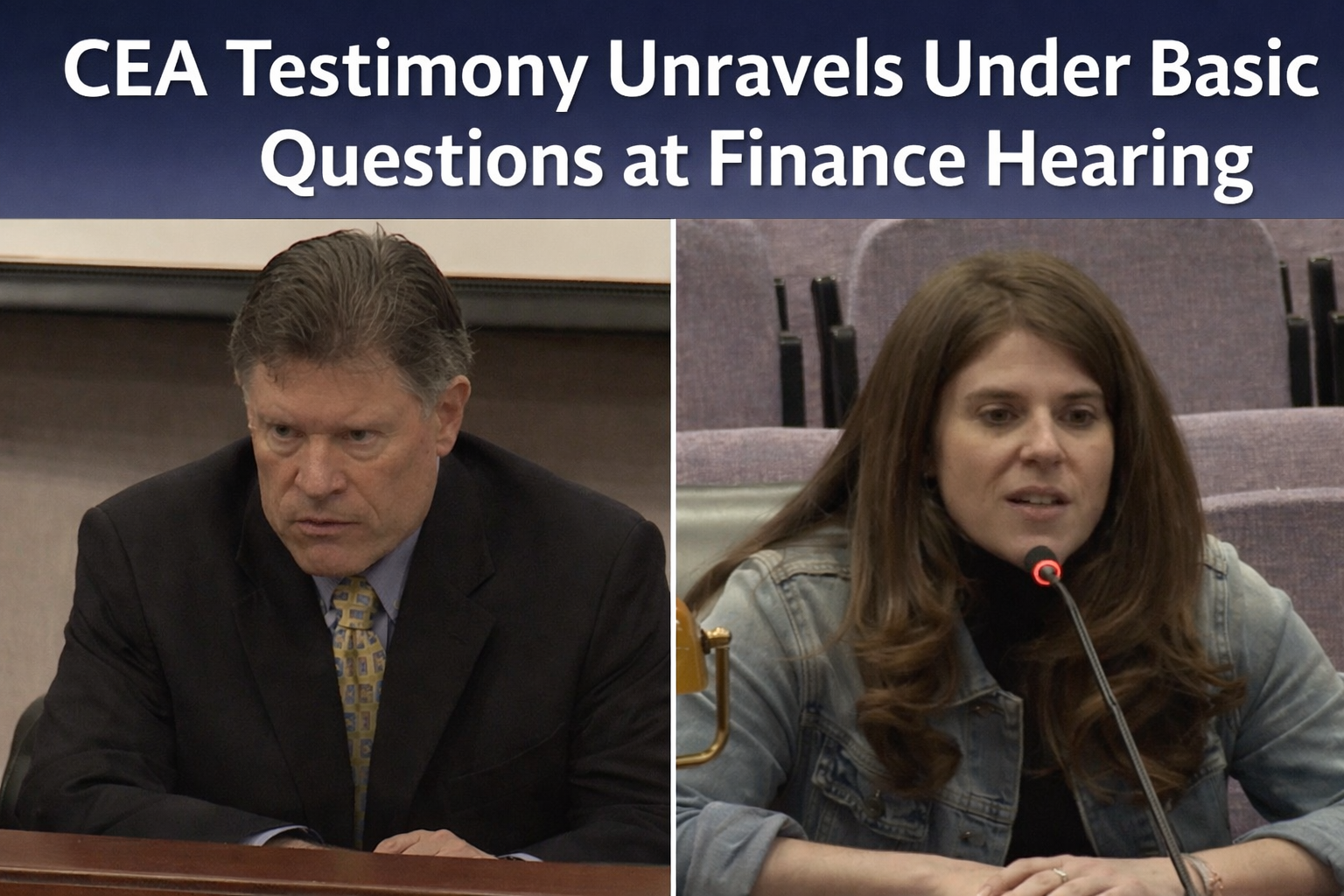
The exchange between Sen. John Fonfara (D-Hartford) and CEA Vice President Joslyn DeLancey shifted notably once questions turned from general concerns to the details of the bill itself.
DeLancey, representing more than 40,000 educators, raised objections centered on “pay for success” models. She expressed concerns about investor involvement, outcome-based funding, and the broader risks of tying financial returns to educational performance. She also referenced issues such as standardized testing pressure, the role of technology in instruction, and the importance of human connection in education.
Those are all valid concerns in broader education policy discussions.
The challenge is that much of that testimony did not align with what Senate Bill 514 actually proposes.
The bill creates a framework for “community partnership opportunity agreements,” allowing private and philanthropic funding to support programs focused on early childhood readiness, third-grade literacy, and workforce development in high-poverty areas. These programs are explicitly designed to operate outside the traditional classroom, targeting after-school and community-based interventions rather than in-school instruction.
That distinction became central once Sen. Fonfara began asking more specific questions.
He asked DeLancey about the Clay Arsenal neighborhood in Hartford, one of the communities the bill is intended to serve.
She acknowledged she was not familiar with it.
“Not as much as I probably… we don’t represent Hartford,” she said.
That admission landed harder than anything else in the testimony. CEA presents itself as speaking for students across Connecticut. But when pressed on one of the state’s most distressed ZIP codes, the kind of community at the center of the bill she was opposing, the answer was essentially: not our area.
From there, Sen. Fonfara outlined the challenges facing the community: students entering kindergarten unprepared, low third-grade reading proficiency, and limited college- and career-readiness among high school students. These are long-standing issues that have proven difficult to address within existing systems.
Against that backdrop, the gap between the bill’s focus and the concerns raised in opposition became more apparent.
DeLancey continued to raise broader concerns about potential “corruption”, misuse of outcome-based funding, and the risks of applying business-style metrics to education. However, those concerns were not tied directly to the structure of the proposed programs, which include independent evaluation and are designed to operate outside classroom instruction.
When given the opportunity to respond directly to the bill’s focus, supporting students in out-of-school settings in high-need communities, the discussion remained centered on broader critiques of education policy rather than the specifics of the proposal.
The result was a noticeable disconnect.
Fonfara’s questions remained focused on outcomes and on the students the bill is intended to serve. The responses, while raising valid general concerns, did not directly engage with the design or scope of the legislation.
The hearing did not resolve whether S.B. 514 is the right policy solution. But it did highlight the importance of aligning testimony with the actual provisions of a bill, particularly when the legislation targets communities facing persistent educational challenges.
As Fonfara noted in closing, the urgency of those challenges remains.
“The cavalry is not coming for these children,” he said.
That urgency is ultimately what the debate over S.B. 514 is about — and what policymakers will need to weigh as the bill moves forward.