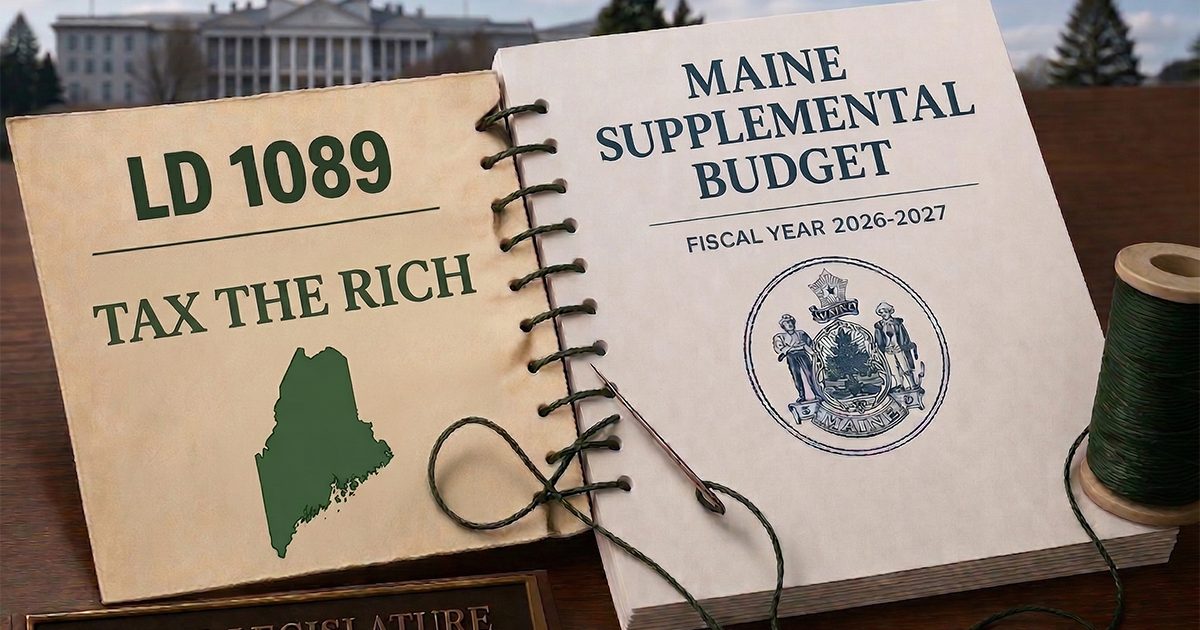
Over the last several months, Maine Policy Institute has repeatedly pointed out the many problems that exist in Governor Mills’ 2026 supplemental budget. Maine lawmakers had an opportunity to fix serious flaws in the budget. Instead, the Legislature’s Appropriations Committee has taken an already problematic proposal from Janet Mills, doubled down, and made it worse.
Rather than showing fiscal restraint, lawmakers are signaling that higher taxes and greater complexity remain the default approach in Augusta.
Backdoor Tax
The inclusion of LD 1089, the so-called “millionaire’s tax” is the most damaging and misguided change lawmakers added to the already flawed supplemental budget. For months, MPI has warned that this proposal would move Maine in exactly the wrong direction, punishing income, investment, and economic success at a time when the state can least afford it.
While proponents frame the tax as targeting only the wealthy, the reality is that it will have a much larger effect. This tax would fall on many small business owners, investors, and job creators who report income through the individual tax code and would be directly impacted. By singling out high earners, LD 1089 discourages in-state investment, increases the incentive for outmigration, and ultimately threatens the long-term stability of Maine’s tax base.
Beyond the substance of the policy itself, the process should raise serious concerns. Embedding a consequential tax increase like LD 1089 into a broader budget package, rather than allowing it to stand on its own and receive full, transparent debate, undermines public accountability and limits meaningful scrutiny. Major changes to Maine’s tax code deserve careful, standalone consideration, not inclusion in massive budget legislation where they can be advanced with minimal visibility and debate.
At the same time, the decision to include LD 1089 in the supplemental budget raises questions about the broader strategy behind its inclusion. Governor Mills had previously vetoed or expressed concerns about significant tax increases, suggesting there may have been uncertainty about whether a standalone version of this policy would ultimately be approved by the Governor. So embedding it within a massive budget package may have reflected an effort to increase the likelihood of enactment of this unpopular bill.
If that was the case, it appears the strategy has paid off. Governor Mills has since announced that she will support the tax increase as part of the broader budget plan. That is a significant move as it removes one of the biggest remaining obstacles to enactment and suggests that including the policy within a larger package may have ultimately influenced the outcome.
Further Federal Tax Deconformity
Lawmakers also compounded the damage by further chipping away at Maine’s conformity with the federal tax code, creating a ripple effect of complexity, uncertainty, and hidden costs for taxpayers. Tax conformity allows individuals and businesses to rely on a single, consistent set of rules when calculating income, deductions, and liabilities. By selectively decoupling from federal tax changes, Maine is forcing taxpayers to effectively operate under two different systems, requiring additional calculations, recordkeeping, and professional assistance just to remain compliant. That means higher accounting costs for small businesses, more confusion for families filing their taxes, and greater administrative burden across the board.
At the governor’s recommendation, the state chose not to conform with federal provisions that would have exempted tips and overtime pay from taxation, provided relief on certain car loan interest, and expanded deductions for seniors, policies that would have delivered direct, tangible tax relief to working Mainers and retirees.
Not only did certain lawmakers accept these recommendations, but they went even further and rejected additional federal provisions such as enhanced deductions for charitable giving, an expanded exemption for business stock, and the continuation of the opportunity zone incentive program.
Each of these decisions carries real consequences. Failing to adopt tax relief on tips and overtime means Maine workers will continue to be taxed more heavily on income they are earning through extra effort. Rejecting senior deductions ignores the financial pressures facing retirees on fixed incomes. Turning away charitable deductions risks discouraging giving to local nonprofits. Even if critics debate the effectiveness of specific programs, the broader pattern is clear, instead of equipping Maine with more tools to attract investment and ease the tax burden, policymakers are narrowing those options.
The result is a tax code that not only diverges from the federal system, but does so in a way that increases complexity while denying Mainers access to widely available tax benefits. Families and businesses must now navigate a growing mismatch between their federal and state returns, all while receiving fewer deductions and incentives in return. In practice, that means more confusion, higher costs, and a less competitive economic environment – exactly the opposite of what Maine should be striving for.
Conclusion
For months, Maine Policy Institute has been sounding the alarm on both the flaws in the governor’s supplemental budget and the harmful impact of LD 1089.
Each proposal on its own raised serious concerns about higher taxes, increased complexity, and a less competitive economic environment. Now, lawmakers have made a bad situation worse by combining them and layering a controversial income tax hike on top of an already problematic budget framework. This approach not only compounds the economic damage, but also reinforces a troubling pattern of advancing major policy changes with limited transparency.
MPI will continue to oppose these efforts and advocate for a tax and budget approach that prioritizes simplicity, competitiveness, and economic growth for all Mainers.