On Tuesday afternoon, the Senate Higher Education Committee heard SF 3754 and SF 4692 — two bills that would expand free college education in Minnesota.
SF 3754 would extend eligibility for the North Star Promise — a program created in 2023 to provide extra assistance with tuition and other higher education expenses — to students with family incomes of up to $100,000. Currently, only students with an income under $80,000 are eligible for the program.
In the 2023 session, the legislature appropriated $49.5 million a year for this program. But fiscal notes indicate that, after the expansion, the program would cost $87 million in 2027. Base appropriations could reach $92 million in 2028, nearly double the original cost.
SF 4692 has no fiscal estimates, but would eliminate the $80,000 income cap for students at state and tribal colleges, making everyone eligible. The bill would also extend eligibility assistance to students at two-year colleges.
On why expanding North Star Promise is necessary (and feasible), Senator Omar Fateh pointed to Tennessee, which created a similar program in 2014. Drawing parallels between Tennessee’s relatively conservative government, Fateh explained,
…we’ve seen and heard about the successes of the Tennessee Promise in the “socialist” state of Tennessee, right? then I think that we can be okay over here as well.
But would Minnesota taxpayers be okay?
Although it spends more money on higher education compared to Minnesota, Tennessee has a significantly smaller government.
According to data from the National State Budget Officers (NASBO), without accounting for federal dollars, Minnesota spent an estimated $8,360 per resident in 2025. This is 84 percent more than Tennessee spent ($4,547) during the same year, indicating that the state offsets higher spending on college education with lower spending in other areas.
Indeed, NASBO data shows that Minnesota spent the equivalent of $1,504 on Medicaid per resident in state funds. Tennessee, on the other hand, spent $983 per resident, 65 percent less than Minnesota.
Looking only at general fund revenues, which include major state taxes like the income and sales tax, NASBO estimates that Minnesota collected $5,435 in taxes per resident in 2025 — 66 percent higher than Tennessee’s levy on its residents ($3,283 per person).
Simply put, Minnesota taxpayers will not “be okay” if legislators increase education spending without significant cuts elsewhere, as this will only further raise the already high cost of government on households.
Even more concerning, there is a high probability that increased subsidies could incentivize students to enroll in low-value programs that would otherwise not make financial sense with private funding.
The state budget is already strained
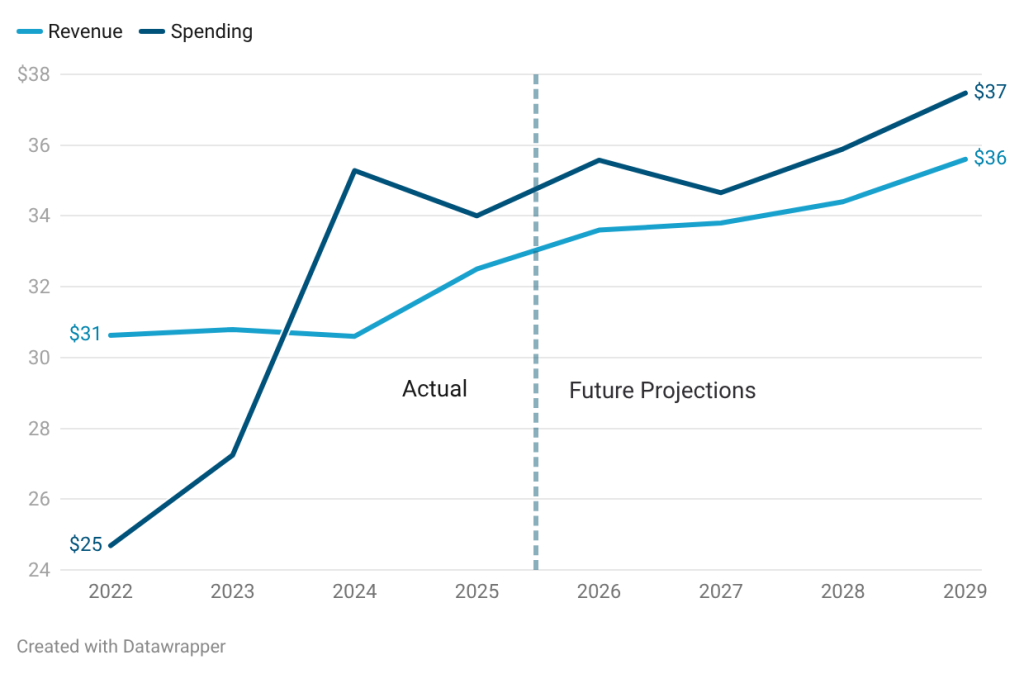
During the historic 2023 session, the DFL-controlled legislature created several new government programs and expanded existing ones, increasing Minnesota’s budget by over a quarter between 2023 and 2024. Consequently, the Minnesota state government has spent more money than it collects in revenue every year beginning in 2024 — a trend that will persist for the foreseeable future.
According to the February 2026 Forecast, Minnesota Management and Budget (MMB) expects general fund spending to top $37.5 billion in 2029. The state will collect $35.4 billion in revenue that year, leaving a gap of nearly $2 billion.
Figure 1: Current Revenues vs. General Fund Spending (Current $)
This concerning trend should inspire reform, not more spending.