The legislature returned to work on Tuesday after their Easter/Passover break. According to the Minnesota Constitution, they must adjourn on the first Monday after the third Saturday in May, which means May 18, 2026. As we wrote before the break, only four bills have passed both bodies and been signed into law. If anything important is going to happen, it will happen in the next five weeks. With the final committee deadline occurring Friday, April 17, all attention will turn to the House and Senate floor.
Most of the floor action in the House so far consists of Democrats and Republicans taking turns forcing votes on their favorite political issues, and then issuing press statements and social media posts saying, “Can you believe Democrats/Republicans voted against [fill in the blank]? Before the break, Democrats forced a vote on gun control legislation. This week, Republicans forced votes on boys competing in girls’ sports. Both votes failed due to the 67-67 tie in the House.
The parties in the House also traded ethics complaints against each other, with Democrats filing against Rep. Elliot Engen and Rep. Walter Hudson for LUI (Legislating Under the Influence) and Republicans filing against Rep. Alex Falconer for sponsoring legislation to help his employer. Since the Ethics Committee is divided equally, expect both complaints to die in committee.
House Democrats want to tax wealth
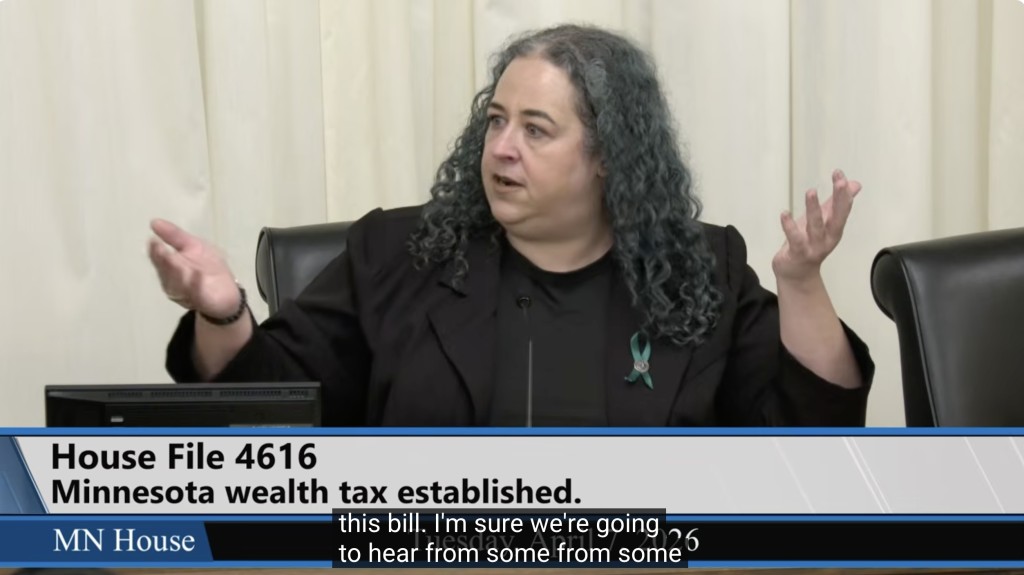
Rep. Aisha Gomez, the DFL Co-Chair of the House Tax Committee, introduced a bill that attempts to tax the wealth of Minnesotans. You can read the entire bill here (it’s only one page). The money line, so to speak, is this:
Subd. 2. Tax imposed. A tax is annually imposed equal to one percent of the taxable wealth of an individual or trust in excess of $10,000,000.
The bill defines wealth as “the value of all of a taxpayer’s property, real or personal, tangible or intangible, but excluding property with a situs outside of Minnesota; minus the sum of all debts and financial obligations owed by the taxpayer.”
Rep. Gomez admitted no other state has attempted to tax wealth and she doesn’t know exactly how it will work in Minnesota. “How does the state asses the value of somebody’s wealth? It’ll be a new thing. We’re going to have to work that out,” she told the committee. Imagine how many new state workers it would take to figure out everyone’s wealth.
Her argument for the bill included references to Mark Twain, robber barons, financialization, big tech and “buy, borrow die.” She told a story of her rich friend who avoided capital gains taxes by borrowing against his “assets” to buy a family lake cabin, as if those assets appeared out of nowhere and were never taxed. She made the novel argument that middle class Minnesotans already pay taxes on the “wealth” in their homes. And she gaslit the committee telling them that taxes pay for things we all use like the post office, ignoring the waste fraud and abuse Minnesotans have experienced lately.
The biggest problem with Gomez’s wealth tax legislation is its focus on revenue. The Minnesota legislature should focus on spending reductions instead of inventing new ways to raise revenue. Minnesota’s budget problems are the result of excessive spending, not revenue shortfalls.
The Swamp shows up in favor of wealth taxes
The list of testifiers in favor of Gomez’s bill provided a great example of everything that’s wrong with Minnesota politics.
First up was Nan Madden of the Minnesota Budget Project, a liberal group funded by the Minnesota Council of Nonprofits. She testified that more revenue was needed to address federal cuts to Medicaid programs, and taxing the rich was the best solution. Forget for a moment that Minnesota nonprofits have been stealing federal Medicaid money for the last six years — they need more money!
The nonprofits were followed by public employee unions. Their message? Raise taxes from the rich so public employee unions can get a raise. It’s Minnesota’s unvirtuous circle: More workers, higher wages, more union dues to fund campaigns. Erica Mumm from the Minnesota Association of Professional Employees (MAPE) told the committee the bill was a “step forward in creating meaningful revenue needed to support state agencies and programs Minnesotans depend on.” She blamed the Trump administration for creating job uncertainty for current state workers.
Then came a teachers’ union leader from Columbia Heights who urged the committee to raise taxes on “those who have profited most from our productive economy so we can use the money to continually sustain the teachers and classrooms that enabled that wealth in the first place.”
Other testifiers for the bill included Service Employees International Union (SEIU), Kids Count on Us, Minneapolis Families for Public Schools and two different representatives of We Make Minnesota, a front group for more public employee unions.
This happens daily at the Minnesota Capitol. Public employee unions and nonprofit organizations testify on behalf of bills to redistribute wealth and fund the bureaucracy that takes away our freedom. Private organizations like American Experiment, the Minnesota Chamber of Commerce, Business Partnership and National Federation of Independent Businesses are outnumbered by the professional class of special interest groups. It’s Minnesota’s version of the swamp.