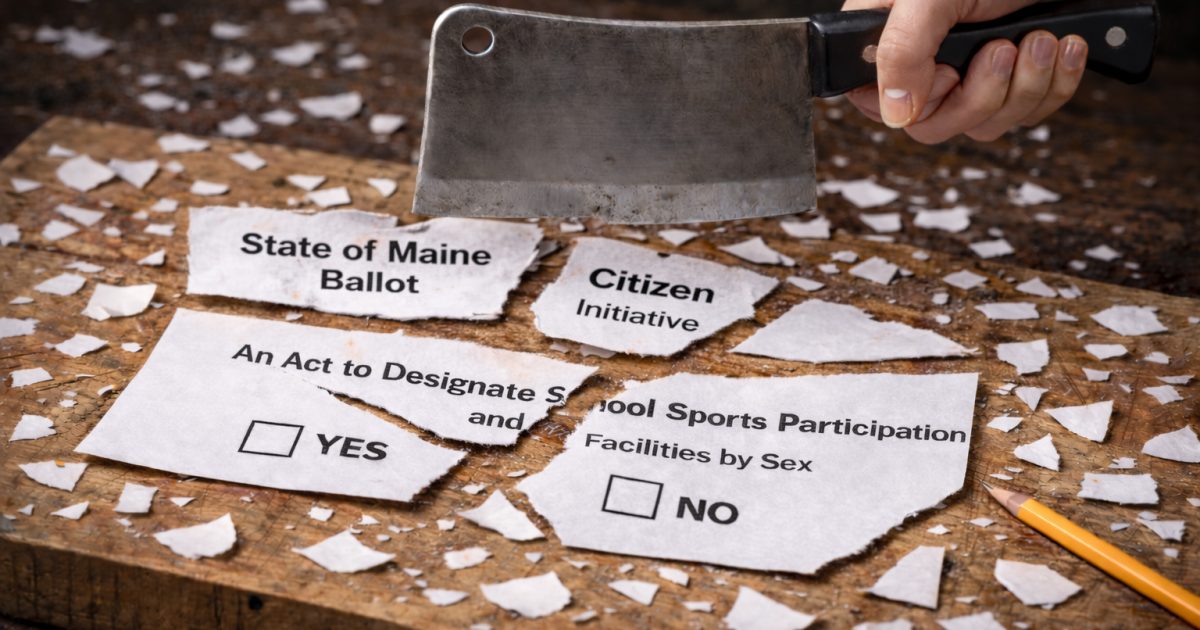
Maine voters will soon be asked to weigh in on a referendum aimed at protecting women’s sports by requiring schools to separate athletic teams and certain facilities based on biological sex as recorded at birth. Before they ever get the chance to vote on the policy itself, however, there is a critically important step that often receives far less attention: the wording of the ballot question itself.
In Maine, that responsibility falls to the Secretary of State (current gubernatorial candidate, Shenna Bellows), who must translate the legislation into a single, concise question that voters can easily understand.
This particular referendum stems from a high-profile dispute over how schools handle participation in sports and access to sex-separated spaces. In response, supporters of the initiative gathered enough signatures to bring the issue forward as a statewide referendum. Now, with the proposal officially moving through the process, the draft ballot language has been released for public comment, marking the first time voters can see how the question will actually be presented.
That is where the real concern begins. The wording of a ballot question is not a minor technicality. For many voters, it is the only description of the policy they will ever read. Because of that, Maine law requires that ballot questions be clear, concise, and neutral. The current draft, however, falls short of that standard. Rather than simply explaining what the referendum would do, the language is loaded, overly complex, and framed in a way that risks shaping voter perception instead of informing it.
What the Draft Language Actually Says
The draft ballot question attempts to summarize the referendum by asking voters:
“Do you want to change civil rights and education laws to require public schools to restrict access to bathrooms and sports based on the gender on the child’s original birth certificate and allow students to sue the schools?”
At first glance, this may appear to be a straightforward description, but a closer look reveals that the wording is doing far more than simply explaining the policy.
The question is structured as a single, dense sentence that bundles together several distinct policy changes. It begins by framing the proposal as a broad change to “civil rights and education laws,” a phrase that carries significant weight but offers little specificity about what is actually being changed. It then moves into the substance of the policy, referencing restrictions on participation in sports and access to bathrooms and other facilities. From there, it introduces the standard that would govern those decisions, tying them to a student’s sex as reflected on their original birth certificate. Finally, it adds yet another layer by noting that the proposal would allow students to bring legal action against schools under certain circumstances. Each of these components reflects a real part of the underlying proposal, but combining them in this way with this wording creates a confusing and cluttered question that could affect how people vote on this common sense referendum.
Loaded and Leading Language
The most immediate issue with the draft ballot question is that it is not written in neutral terms. Instead, it uses language that subtly guides voters toward a particular interpretation of the policy before they have a chance to evaluate it on its merits. Ballot questions are supposed to describe what a proposal does, not characterize it in a way that predisposes voters to support or oppose it. Here, the wording crosses that line.
The opening phrase, which frames the proposal as a plan to “change civil rights laws,” is a clear example. That language carries a strong and often negative connotation, suggesting that existing protections are being stripped away. This is not the case with this referendum but even if it were, the role of a ballot question is not to summarize perceived consequences, but to explain the actual policy change in neutral, descriptive terms. By leading with this phrasing, the question primes voters to view the proposal with suspicion from the outset.
This framing continues throughout the question, which emphasizes restrictions rather than the underlying structure of the policy. Instead of explaining that the referendum would establish sex-based classifications for sports teams and facilities, the language focuses on what it would limit or prohibit. That choice of emphasis shifts the focus away from what the law would do and toward how it might be perceived, which is precisely what neutral ballot drafting is meant to avoid.
The proposed language also improperly introduces terms that do not appear in the bill. Secretary Bellows’ version uses the word “gender,” but the initiated bill does not use that term. Instead, it consistently defines and relies on “sex” as biological status recorded at birth. Substituting different terminology risks confusing voters and obscuring the actual policy being proposed. Bellows language also refers to a “child,” even though the bill applies to “students.” This is not a trivial distinction. An 18-year-old high school senior is legally an adult, yet would still be subject to the initiated bill if approved by the Legislature or passed at the ballot box. Using the term “child” is legally inaccurate and rhetorically loaded. It is not a clear and concise description of who is affected.
Finally, the ballot question claims the law would “allow students to sue schools.” This is another mischaracterization. Students already have the ability to bring legal action against schools under existing law. The initiated bill simply clarifies a cause of action in a specific context; it does not grant students or families any new ability to sue schools beyond what already exists under current law. Framing it otherwise suggests a dramatic legal change that, in reality, does not exist.
What Clear and Neutral Ballot Language Should Look Like
If the goal is to present voters with a fair and understandable description of the proposal, the ballot question should focus on clearly explaining what the policy does in straightforward, neutral terms. It should avoid loaded phrasing, eliminate unnecessary complexity, and focus on the core mechanism of the law rather than secondary effects or characterizations. In short, it should allow voters to evaluate the proposal on its merits without being steered toward a particular conclusion.
A more neutral construction of the question would look something like this:
“Do you want to define sports participation and access to private facilities in schools by biological sex as recorded on a student’s original birth certificate?”
This formulation succeeds where the current draft falls short. It uses neutral, commonly understood terms which describe the policy without editorializing. It presents the key components of the proposal in a logical and organized way, allowing voters to easily follow what the law would do. Just as importantly, it keeps the focus on the actual structure of the policy, rather than framing it through broad or emotionally-charged language.
Most importantly, this language accurately reflects the purpose of the referendum. Rather than forcing voters to infer the intent from vague or one-sided descriptions, it states plainly what the law would require. That clarity is essential to a fair ballot process.
Maine voters deserve to understand exactly what they are being asked to decide. Language like this meets that standard by being clear, neutral, and directly tied to the substance of the proposal.
Conclusion
At the end of the day, this issue goes beyond the specifics of any one policy. It is about whether Maine voters are given a fair and accurate description of what they are being asked to decide.
Ballot questions are not supposed to persuade or obscure; they are supposed to inform voters of the issue in front of them. The current draft language falls short of that standard by introducing unnecessary complexity, emphasizing certain effects over others, and failing to clearly state the proposal’s core purpose. That is especially concerning given that the Secretary of State’s office, led by Shenna Bellows, is expected to act as a neutral and nonpartisan arbiter in this process, providing objective language that allows voters to evaluate proposals on their merits. But that has clearly not happened here.
By contrast, clear and neutral wording, like the alternative outlined here, demonstrates that it is entirely possible to present this issue in a way that is both accurate and understandable. Maine voters should not have to decode a ballot question to figure out what it means. They deserve language that simply and honestly explains what the law would do so they can make an informed choice.