A year ago, I wrote: “It’s official: Minnesota is now a below-average GDP per capita state.” Then the Bureau of Economic Analysis (BEA) went and revised their data — which is standard practice — and we weren’t, quite, anymore. This month, however, the BEA released its data for 2025 which show that Minnesota is now, officially, a below average Gross Domestic Product (GDP) — or income — per capita state.
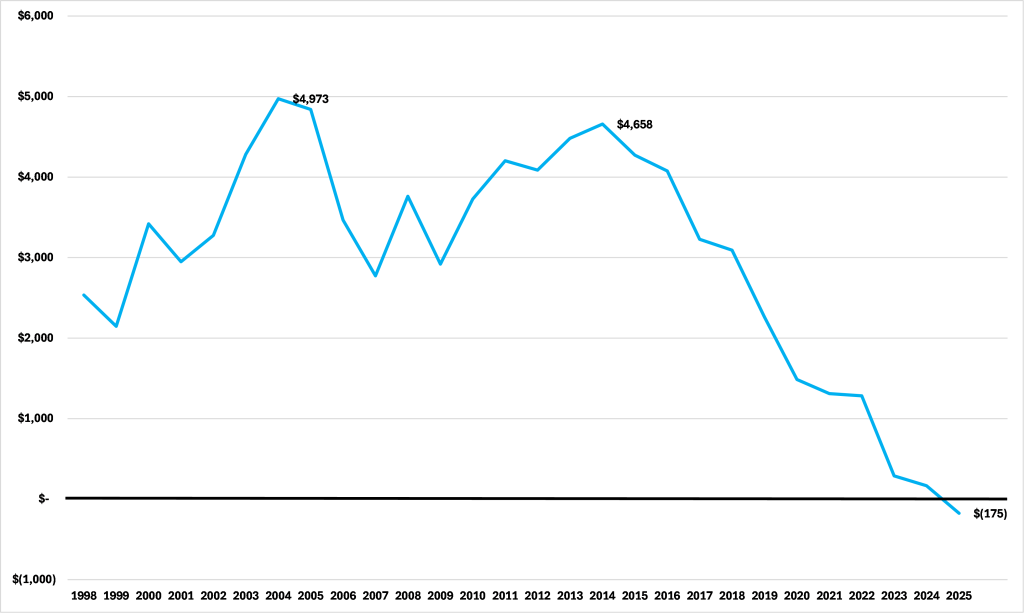
Minnesota has long been able to offer a “premium” for living in the state in terms of a level of GDP per capita which was above the national average. The weather might be brutal and the sports franchises likewise, but higher than avereage per capita incomes made up for that. As Figure 1 shows, as recently as 2014, GDP per capita in Minnesota was $4,658 above that of the United States generally, or $18,632 for a family of four. In every year since 2014, that permium has fallen until, last year, it vanished completely and Minnesota became, for the first time on record, a state with below average per capita GDP.
Figure 1: GDP per capita in Minnesota minus GDP per capita for the United States, 2017$
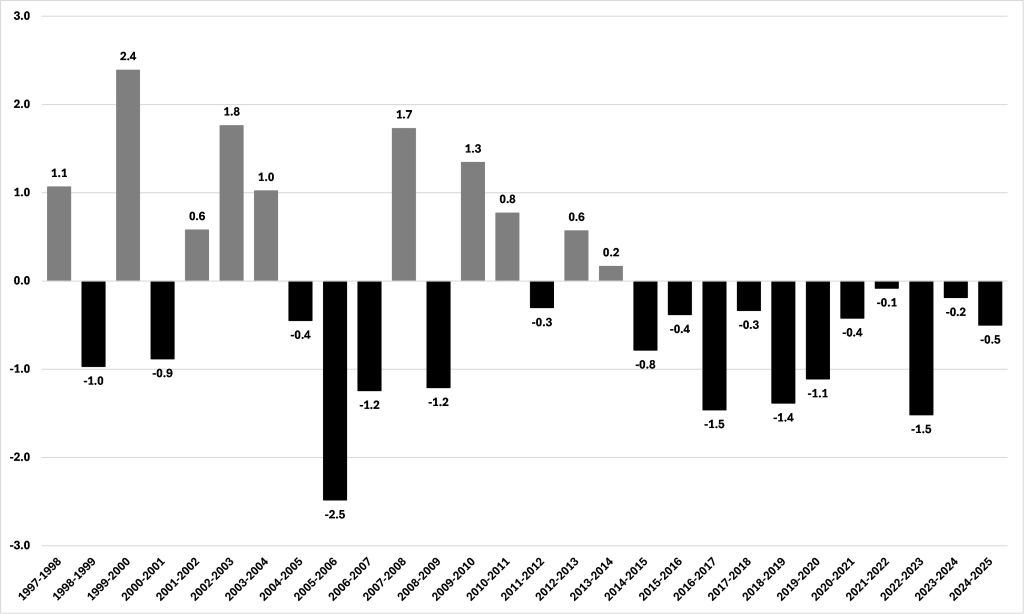
This happened because Minnesota’s per capita GDP growth has lagged that of the United States generally in every single year since 2014. As Figure 2 shows, over the 17 years from 1997 to 2014, our state recorded a growth rate higher than the United States generally in ten (highlighted in gray). In the eleven years since, by contrast, Minnesota’s rate of per capita GDP growth has lagged that of the United States generally in every single one (highlighted in black). Only Wisconsin shares this dubious distinction.
Figure 2: Growth of real per capita GDP in Minnesota minus growth of real per capita GDP for the United States, percentage points
What explains this persistent underperformance?
Obviously, something like tariffs which apply nationwide cannot explain Minnesota’s poor performance relative to the United States generally, especially given our state’s average share of imports or exports as a share of GDP. Neither can something like Metro Surge, which struck in January, explain a problem which goes back eleven years.
Minnesota’s below average economic performance is a long standing problem which must have deep rooted causes. In an upcoming report I will will dig into the data to see what these are.