As the legislative session approaches its May 6 conclusion, a new national report underscores what many residents already feel: the state’s affordability challenges remain deeply entrenched.
Despite acknowledging cost reduction as a top priority heading into the 2026 session, lawmakers are advancing policies that risk moving in the opposite direction — potentially worsening the state’s already high cost-of-living and weak economic outlook.
According to Rich States, Poor States, Connecticut ranks 46th in the United States for its economic outlook and 48th for economic performance. The outlook ranking represents a decline from the previous year and continues a troubling long-term trend.
Over nearly two decades, Connecticut has consistently placed in the bottom tier, averaging around 38th overall. Its highest placement was 32nd in 2009, while it fell as low as 47th in both 2015 and 2016.
These findings are not an outlier.
Other national assessments, including the Tax Foundation’s State Business Tax Climate Index, Wallethub’s rankings for for business environment and costs, and CNBC’s 2025 “America’s Top States for Business” report, show similar results.
Across these measures, Connecticut consistently underperforms in areas tied to economic competitiveness, including tax burden, regulatory climate, and labor policy.
The state imposes high personal and corporate income taxes, maintains one of the heaviest property tax burdens in the nation, and ranks poorly in structural indicators such as estate taxes and labor flexibility.
Connecticut did post strong GDP growth in 2025, ranking 12th nationally. But that short-term performance masks longer-term challenges. From 2014 to 2024:
- GDP growth ranked 41st
- Domestic migration ranked 43rd
- Non-farm employment growth ranked 45th
These indicators suggest that while the state can experience periods of growth, it continues to struggle with attracting residents, retaining workers, and expanding its economic base.
Even within New England, a region known for higher costs, Connecticut trails most of its neighbors: See Table One
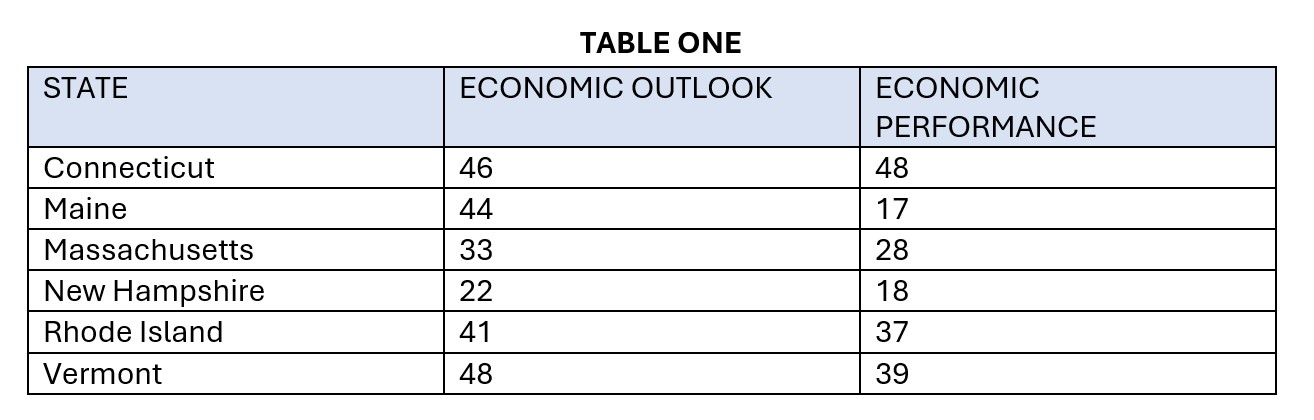
While other states in the region face similar structural challenges, Connecticut’s relative performance remains among the weakest.
There has been progress.
Since 2017, Connecticut’s fiscal guardrails have introduced spending discipline, bond rating upgrades, helped reduce pension liabilities, and contributed to the buildup of a $4.1 billion Rainy Day Fund. These reforms also enabled the largest income tax cut in state history.
However, the state still carries one of the highest debt burdens in the nation, particularly when measured on a per-capita basis. In recent years, adjustments to the guardrails have also raised concerns about maintaining their long-term effectiveness.
Preserving the core principles of these reforms, disciplined spending, predictable budgeting, and continued progress on long-term liabilities, remains critical to improving the state’s fiscal outlook.
Strengthening Connecticut’s economic outlook trajectory will require addressing structural challenges in taxation, spending, and regulation.
Instead, lawmakers are considering proposals that would increase taxes on high earners and businesses, including a potential statewide property tax, higher income tax rates, and a capital gains surcharge.
These policies carry risks. Connecticut already relies heavily on a relatively small group of high-income taxpayers (2.5%), who account for a disproportionate share of income tax revenue (41%). Increasing that burden further may influence decisions about where individuals live, work, and invest.
A shrinking tax base would have broader consequences, affecting revenue stability and the state’s ability to fund services.
Connecticut’s challenges are not new: they are structural and well-documented.
High housing costs, rising energy prices, and a heavy tax burden continue to drive concerns about affordability. Surveys consistently show residents considering relocation to states with lower costs and stronger economic growth.
At the same time, population growth in lower-cost states across the South and Southeast reflects a broader trend: individuals and businesses are responding to policy environments that support affordability and opportunity.
Reversing course will require more than incremental adjustments.
It will require a renewed focus on fiscal discipline, structural reform, and policies that improve competitiveness, including controlling spending, maintaining effective guardrails, and reducing tax and regulatory burdens.
Connecticut has seen what works. The challenge now is sustaining and building on those reforms.
As the legislative session enters its final weeks, the direction is becoming clear: without meaningful structural change, the state risks continuing the same pattern of high costs, slow growth, and persistent outmigration that has defined its economic trajectory for decades.