Minnesota public school enrollment is expected to decline between 2022 and 2031, according to projections from the National Center for Education Statistics (NCES).
The NCES predicts that only nine states — Alabama, Florida, Idaho, Montana, North Dakota, South Carolina, South Dakota, Tennessee, and Utah — will see public school enrollment grow over that time period, as first reported by Jude Schwalbach of the Reason Foundation.
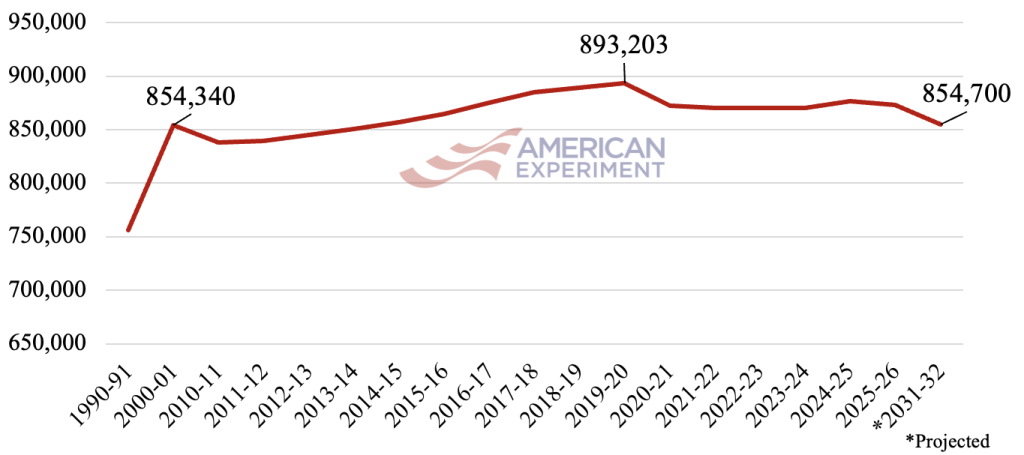
As I have previously written, enrollment in Minnesota public schools has already fallen by nearly 3 percent since the 2019-20 school year. By fall 2031, NCES projects enrollment will sit at about 854,700 students, essentially returning the state to where it was in 2000 (854,340 students). From fall 2021 to fall 2031, that amounts to a roughly 2 percent decline. (Statista, a data gathering and visualization platform, projected a similar decline across this time period back in fall 2023, which I wrote about here.)
Minnesota Enrollment in Public Elementary and Secondary Schools
Selected Years, Fall 1990-Fall 2031 (projected)
Minnesota’s projected decline may be smaller than in other states, but the factors behind it are significant — ranging from migration to low birth rates to changing family preferences.
The most significant driver appears to be demographic. Birth rates in Minnesota have been declining for roughly a decade, mirroring a national trend.
But families are also making different choices. According to a 2025 Gallup poll shared by Schwalbach, “public schools have yet to fully regain parents’ trust to pre-COVID-19 pandemic levels, with 74% of parents — eight percentage points less than in 2019 — saying they were satisfied with their public schools.” In Minnesota, American Experiment’s Thinking Minnesota Poll shows a similar shift in satisfaction: Most residents now grade the state’s public schools a “C” or worse.
In a system where funding follows students, how districts respond to these enrollment projections matters.
“With forecasts of fewer students in the years to come, school districts can’t keep doing the same things they’ve been doing if they want to successfully compete in a more robust education marketplace,” writes Schwalbach. And flexibility alone, such as open enrollment policies, “isn’t enough.”
If school districts want to attract and retain students, they have to give students a reason to stay or choose them.
…[P]ublic schools should get back to basics: teaching kids how to read and do math. The 2024 National Assessment of Educational Progress results showed that one in three 12th graders’ reading level scored below basic, and 45% of them scored at the same level in math, the worst results in two decades.
Additionally, “state policymakers should take steps to identify underutilized school buildings to help districts and taxpayers reduce costs,” Schwalbach continues.
The Minneapolis school district, for example, long plagued by financial challenges, should consider consolidation and a more strategic allocation of building use.
Even though Minnesota’s projected decline is modest, the trend points in one direction. Districts cannot continue operating as if enrollment is guaranteed and must find ways to adapt and innovate in a more competitive education environment.