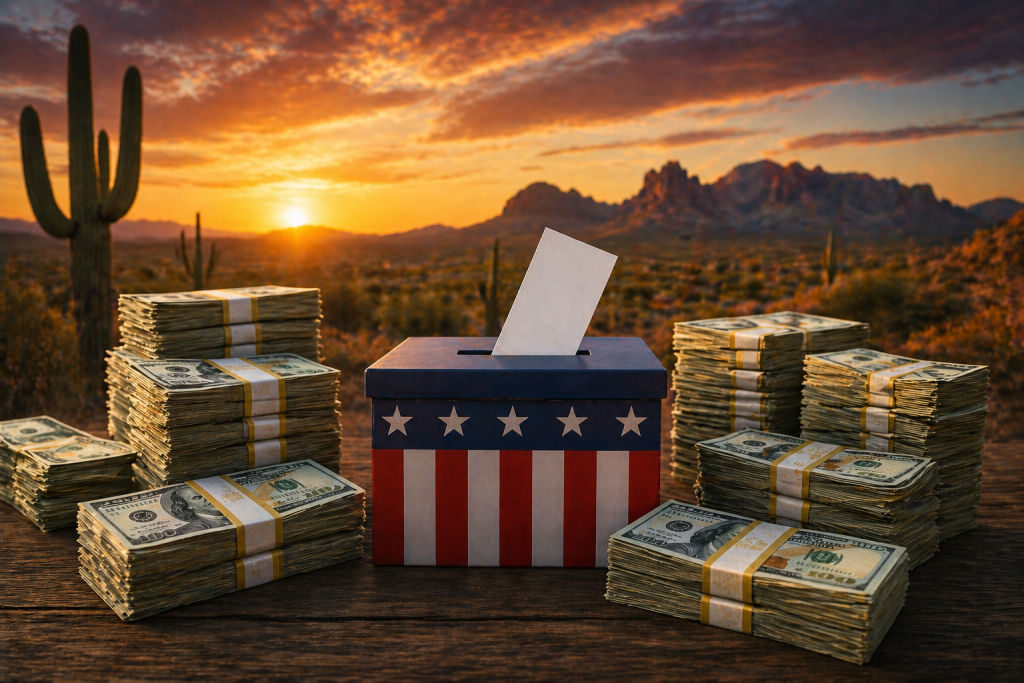
On Election Day, millions of Americans turn out to vote for their representatives in state government, Congress, and the White House. But in Arizona—and indeed, across the country—local governments routinely place billions of dollars in spending on the ballot during lesser-known off-cycle elections when they know most voters won’t participate. As a new Goldwater Institute report finds, that system allows organized interests to claim “voter approval” without facing a broad electorate, and the costs are enormous.
In the report “Off-Cycle Voting in Arizona: Economic and Democratic Costs?,” political economist and Arizona State University Associate Professor Henry Thomson, Ph.D., uncovers how state law allows cities and school districts to hold elections throughout the year, outside the regular general election cycle, separating major fiscal decisions from the high-turnout elections most voters participate in. Those off-cycle elections—contests held outside traditional November Election Days on even-numbered years—consistently produce sharply lower turnout, averaging just 26.9% participation, more than 40 percentage points below on-cycle elections. That results in a smaller, less representative electorate that is older, wealthier, and more closely aligned with groups that have a direct financial stake in government spending.
Real-world examples underscore the disparity. In Phoenix, a 2023 bond election authorizing hundreds of millions in spending drew just 22% turnout, compared to 77% turnout in the city’s 2024 general election. Similar gaps exist across Arizona cities and school districts, where major fiscal decisions are routinely made by a fraction of the electorate.
“Off-cycle elections convert community decision-making into a procedural rubber stamp, providing a democratic varnish of approval to policies pushed by special interests that benefit from growing local governments and ballooning municipal budgets,” Thomson writes. “They allow a small, unrepresentative electorate to decide enormous public spending commitments at the local level and should be reformed.”
Lower-turnout elections amplify the influence of organized groups, particularly public-sector unions and others who benefit from expanded local budgets. When fewer people vote, those groups make up a larger share of the electorate and their preferences carry more weight.
The scale of the decisions made under these conditions is staggering. In November 2023 alone, more than $4 billion in school district spending was placed on the ballot in Maricopa County, an amount almost equal to the county’s annual budget. Yet most of those decisions were made by a fraction of voters.
The economic consequences extend far beyond election day. If that $4 billion in spending is financed over time, the resulting tax burden is equivalent to the economic output of roughly 85,000 jobs, 50,000 small businesses, or 28,000 high-wage semiconductor jobs—illustrating the magnitude of decisions being made by such a limited electorate.
While the direct costs of running off-cycle elections can amount to millions of dollars, the larger cost is indirect. Billions in long-term tax burdens are approved in elections where most voters do not participate.
A 2018 law passed by the state legislature sought to require nearly all Arizona elections—except special and recall contests—to be held on-cycle with major general elections. But the measure was challenged by the City of Tucson in 2020, setting up a legal dispute over whether the state could regulate local election timing. The Arizona Supreme Court ultimately ruled that city charters, which are authorized under the state Constitution, cannot be overridden by the legislature except in matters of statewide concern.
Election timing is not neutral. It shapes turnout and outcomes. In Arizona, that frequently leaves major fiscal decisions in the hands of a narrow, organized electorate rather than the broader public.
As the report concludes, off-cycle elections are not an accident. They are a governing choice that predictably narrows participation, concentrates power, and weakens democratic accountability for decisions involving billions in public spending. Reforming election timing would expand participation, improve transparency, and ensure that decisions with long-term consequences are made by the voters they affect.
You can read the full report here.