A spring teacher survey finds strong support for education savings accounts (ESAs) among K-12 educators, including 74 percent of public school teachers, which is consistent with last year’s results.
Conducted by Morning Consult on behalf of EdChoice, the April 2026 national survey asked over 1,000 teachers their opinion of ESAs first without any explanation of the policy and then again after providing this description:
An “education savings account” in K-12 education — often called an ESA — establishes for parents a government-authorized savings account with restricted, but multiple uses for educational purposes. Parents can then use these funds to pay for: school tuition; tutoring; online education programs; therapies for students with special needs; textbooks or other instructional materials; or save for future college expenses.
Support increased after the policy description, though it was already strong without one.
Teacher Support for Education Savings Accounts (ESAs)
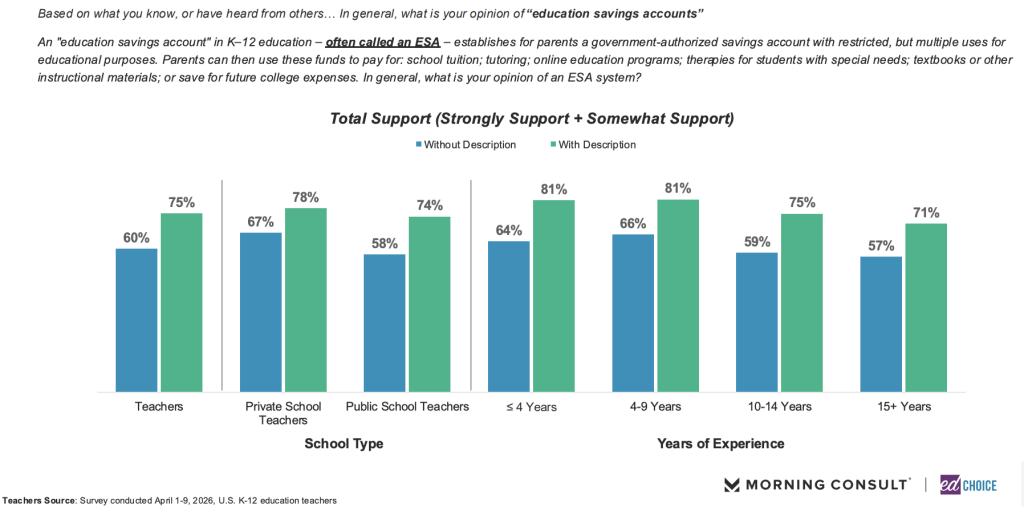
The cross tabs reveal other interesting groups where support is high, including among union members (76 percent), teachers who identified as liberal/progressive (78 percent), black teachers (87 percent), Hispanic teachers (74 percent), and teachers in rural areas (74 percent) and the Midwest (76 percent).
The support among union members is particularly striking, given that teachers’ unions have been among the most vocal opponents of choice policies, including ESAs. But unions also have a tendency to frame ESAs incorrectly (such as, calling them “vouchers”) and only negatively. The neutral and more complete description provided by the survey gives members room to analyze the policy without the influence of union leadership positions.
Why do public school teachers support ESAs?
Teachers with children of their own may want the same flexibility and customization for their kids that ESAs would provide to other families. ESAs can also fund tutoring outside of school hours, which previous surveys have shown public school teachers are interested in pursuing.
Teachers who work with students with disabilities may also see ESAs as a helpful tool, one that helps families access resources better equipped for their child’s needs than a traditional public school can provide. (A number of the original ESA programs were specifically designed for special education students.)
Frustration with top-down mandates and bureaucratic constraint could also be a factor. “I think one of the things we forget is that this one-size-fits-all dominant education model stifles teacher creativity and curiosity just as much as it can stifle learner creativity and curiosity,” said Kerry McDonald, a senior education fellow with the Foundation for Economic Education.
“Education savings accounts are unbundling education and schooling,” McDonald added. “We are getting toward a consumer-driven education market that mimics what we see in other parts of our lives. We have so much choice and personalization and innovation in every other part of our lives, and yet education has remained largely standardized and stagnant. I think that is changing.”
There are currently 21 ESA programs in 18 states: Alabama, Arizona, Arkansas, Florida (2), Georgia, Indiana, Iowa, Louisiana, Mississippi, Montana, New Hampshire, North Carolina, South Carolina, Tennessee (3), Texas, Utah, West Virginia, and Wyoming. Thirty-four states plus Washington, D.C. and Puerto Rico offer some form of private school choice program.