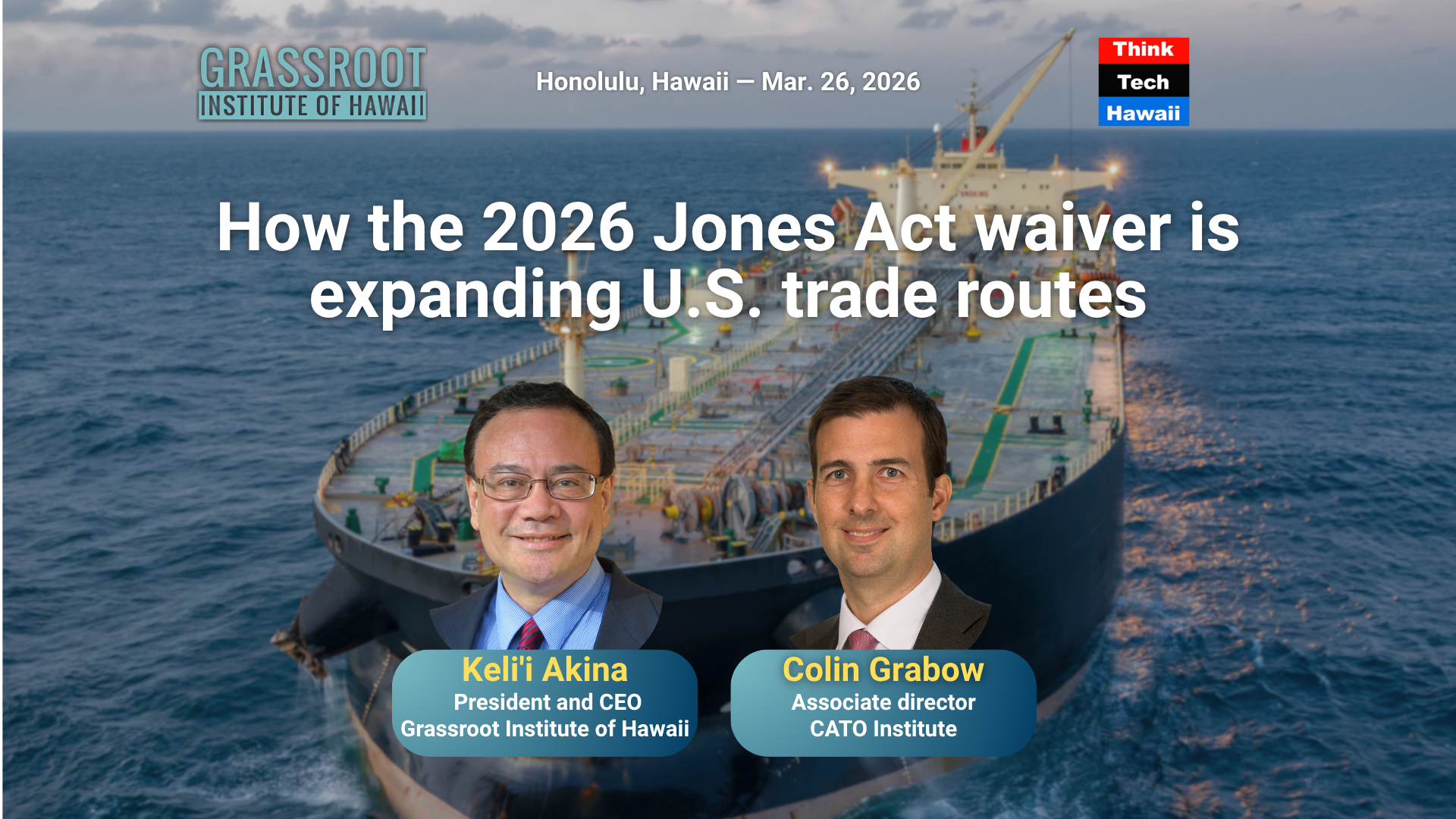
Grassroot President Keliʻi Akina hosted a national Jones Act expert on his new ThinkTech Hawaii program “Talk Story with Keliʻi Akina” April 28 to discuss President Donald Trump’s historic waivers of the Jones Act for fuel and fertilizer shipments, and the century-old maritime law’s impact on American consumers.
His guest, Colin Grabow, is an associate director at the Cato Institute’s Herbert A. Stiefel Center for Trade Policy Studies and a Grassroot scholar. Grabow said that Trump’s 60-day waiver, which started March 17 and will be followed by a 90-day waiver, has already started showing “that when you make transportation less expensive within the United States, you can better connect Americans and make it easier for Americans to access American goods.”
In particular, the Jones Act mandates that goods be shipped between U.S. ports on vessels that are registered and built in the U.S. and crewed and owned by mostly Americans.
Grabow explained that even though the protectionist maritime law went into effect in 1920, restrictions on foreign shipping in the U.S. date back to 1789. But, he said, “the context was entirely different back then — these are the days of wooden ships, where Americans were some of the world’s best and most competitive.”
The intent, Grabow said, was to ensure America had a large fleet of merchant ships and mariners who could be called up in times of war.
“But as time went on, certainly by the second half of the 1800s, America fell behind,” he said. “This protected industry became very uncompetitive.”
And the situation has only gotten worse. Grabow said U.S. shipyards are badly outdated, and the ships built here cost “anywhere from typically four to five times as much to build.” Those costs, he said, get passed on to consumers as a sort of “de facto Jones Act tax.”
The conversation also revealed how the Jones Act’s restrictions create bizarre trade patterns that undermine both economic efficiency and national security goals.
For instance, Grabow pointed out that “Hawaii buys its asphalt from Spain, halfway around the world” instead of from America, which is a major exporter of asphalt. He also noted that Hawaii has had to buy liquified natural gas from as far away as Equatorial Guinea in West Africa “even though we have it in abundance here in the United States, because the ships to transport it don’t exist in the Jones Act fleet.”
Outside of Hawaii, Grabow said, “East Coast refineries will import oil all the way from the Middle East or Africa instead of Texas because once you factor in the cost it doesn’t make sense to buy American. … So let’s not make the mistake that this is purely a Hawaii or a noncontiguous states and territories problem.”
Grabow said that following Trump’s recent waiver, new shipping routes have emerged that “you never see” under normal Jones Act restrictions, such as tankers traveling from Louisiana to Alaska.
“If better options were there, no one would be using this waiver,” he said. “And every time the waiver gets used is additional proof of the Jones Act shortcomings.”
Click the image below to listen to the full 27-minute conversation.