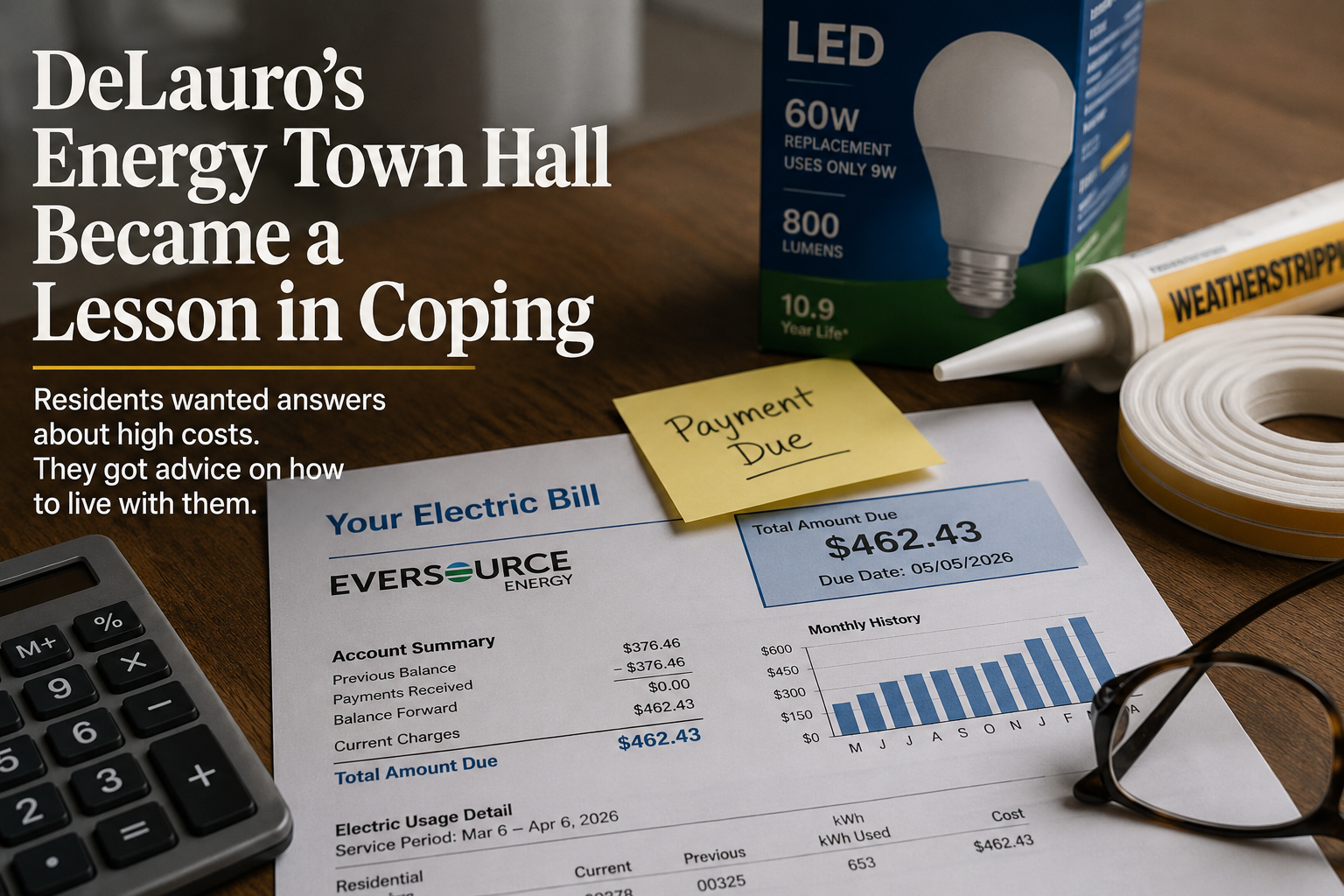
Congresswoman Rosa DeLauro held a tele-town hall on April 6 to address rising energy costs and soaring gas prices. Connecticut residents called in with concerns about skyrocketing electric bills and the growing cost of simply keeping the lights on.
What followed was less a conversation about why electricity is so expensive in Connecticut and more a discussion about how residents can cope with it.
The event was billed as a conversation about affordability. Residents described real financial strain: seniors on fixed incomes struggling to pay utility bills, renters unable to control energy costs, small business owners watching expenses climb year after year, and families wondering why electricity in Connecticut feels increasingly unaffordable.
But instead of focusing on the root causes of Connecticut’s high electricity prices, the town hall quickly drifted into discussions about Iran, foreign policy, climate change, offshore wind, rebate programs, and energy conservation tips.
To be fair, global events do affect energy markets. Oil prices react to instability overseas. Natural gas markets are increasingly tied to international demand. Severe weather and aging infrastructure are real challenges. None of that is imaginary.
Still, several callers raised a more uncomfortable point: Connecticut’s electricity costs were already becoming unaffordable long before the latest tensions in the Middle East.
That question never truly received an answer.
Instead, the conversation repeatedly shifted toward programs designed to help residents manage expensive electricity rather than reduce the underlying costs themselves.
One renter asked what ordinary people could realistically do to lower their bills. The response included lowering shades, weatherizing homes, caulking windows, and switching to LED bulbs. Another elderly caller on oxygen described overwhelming electric bills on a fixed income and was directed toward discount programs and utility protections.
Those programs may genuinely help some households. Energy efficiency matters. But the broader message was difficult to ignore: policymakers increasingly sound less focused on lowering costs and more focused on helping residents endure them.
That is an important distinction.
Over the past decade, Connecticut has layered energy mandates, procurement requirements, infrastructure spending, public benefits charges, and long-term transition policies onto ratepayers. Officials continue promising that today’s costs will eventually produce tomorrow’s savings. During the town hall, state officials repeatedly pointed to offshore wind projects as future sources of relief.
Department of Energy and Environmental Protection (DEEP) Commissioner Katie Dykes argued that renewable energy lowers costs because “the wind is free.” Connecticut ratepayers opening their monthly electric bills may reasonably wonder where those savings are going.
Even the projections discussed during the town hall were difficult to reconcile. DeLauro said Revolution Wind — an offshore wind project being built off the coasts of Rhode Island and Connecticut — would save New England customers “as much as $500 million by 2028.”
Later, Dykes said the same project would provide roughly “$100 million dollars per year of savings for Connecticut consumers over the life of that project.”
Perhaps both projections are technically accurate under certain assumptions. But those assumptions were never explained. No one clarified how the savings were calculated, what costs were included, or why Connecticut residents continue to face some of the highest energy pricesin the nation after years of promised “energy transition” savings.
That disconnect hung over the entire event.
The most revealing moment may have come when energy consultant and former Michigan utilities commissioner Tremaine Phillips remarked that “electricity is the new price of eggs.”
He likely meant it as a warning about inflation. But the comment unintentionally captured something larger: electricity is increasingly being treated as another basic necessity families are simply expected to struggle to afford.
And that may be the central problem with Connecticut’s current energy conversation.
Too many policymakers no longer speak as though affordable electricity should be the goal. Instead, the focus has shifted toward managing the pain through subsidies, rebates, assistance programs, and conservation advice, while promising larger structural benefits somewhere down the road.
Residents joined the town hall hoping to hear why Connecticut’s energy costs remain so high.
What they mostly received was advice on how to live with them.