The newest iteration of the Minnesota Principals Survey, conducted in November 2025 and newly released in Spring 2026, can give policymakers a glimpse into the perspectives of principals, assistant principals, and other school leaders around the state. Although the 2025 survey had a relatively low response rate (1,130 of 2,461 eligible school leaders in Minnesota, or 46 percent, took the 2025 MnPS) it still acts as a helpful gauge of principal thought.
Day-to-Day
Principals agree in a high majority (71 percent) that their primary goal as an administrator is to be an instructional leader. Yet, most principals spend far more of their time on administrative tasks like scheduling or paperwork than on the core work of overseeing curriculum development and educator coaching.
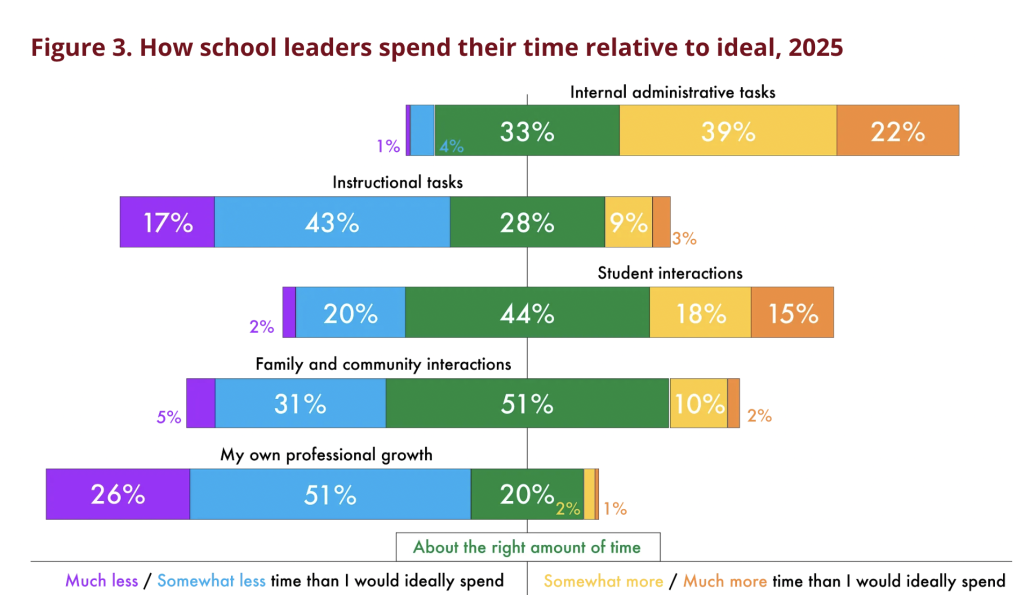
It’s no surprise that nearly half (48 percent) of principals feel their workload is unsustainable. While the paperwork piles up, principals report that they spend an average of 43 percent of their workday (26 minutes out of every hour) responding to challenging student behavior. One survey respondent reported,
“Being a principal in today’s world is significantly different than when I started 16 years ago and the challenges for leaders are enormous. We are supposed to be instructional leaders and we spend a majority of [our] time on significant disciplinary issues and parent complaints that never stop.”
Big Picture Concerns
The executive summary of the survey provided broad survey responses about student behavior that featured questions that were not available in the Tableau granular data visualizer. Survey administrators should consider publishing all data for researchers to analyze.
A majority of principals (68 percent) agree that challenging student behavior has become more prevalent over the past 3 years.
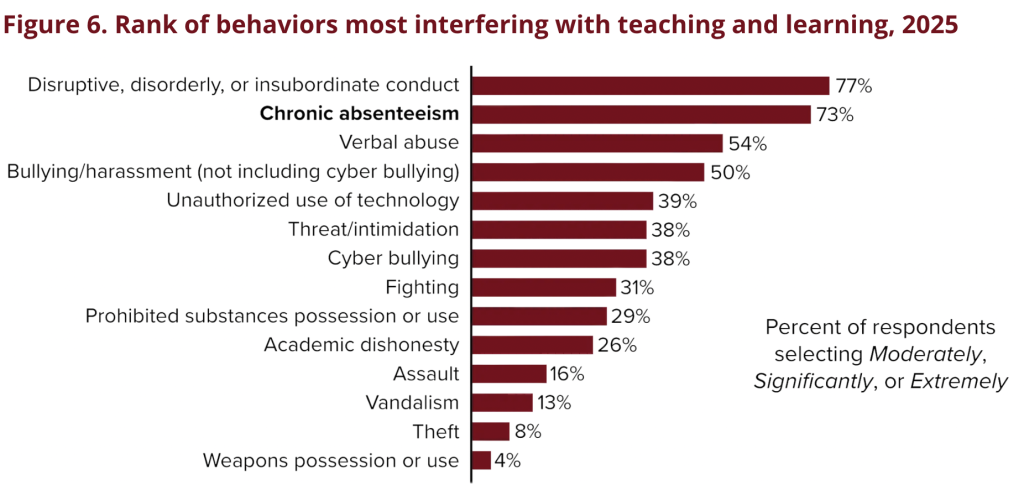
Among challenging student behaviors, the top three concerns were disruptive, disorderly, or insubordinate conduct, chronic absenteeism, and verbal abuse.
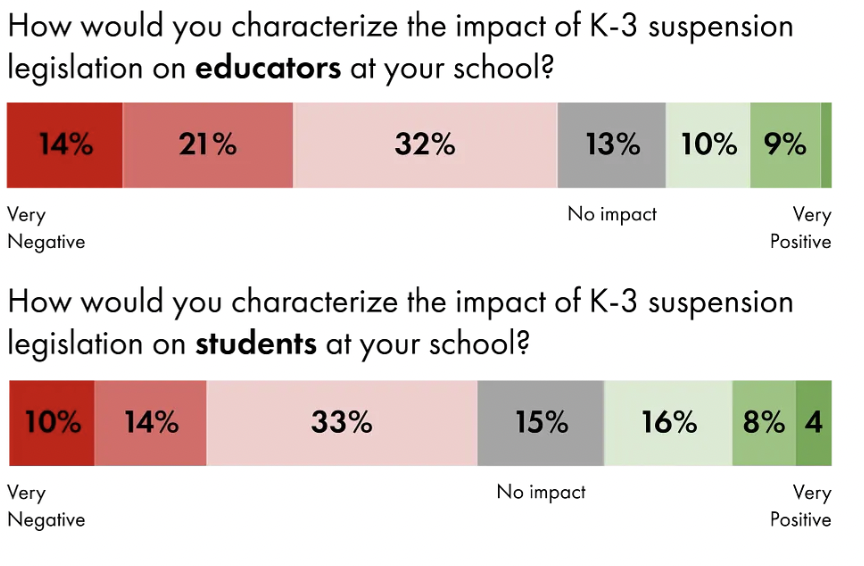
One fresh source of disruptive conduct may have be Minnesota’s new K-3 suspension ban, which many principals expressed negative feelings towards. A majority characterized the impact of the suspension ban as negative for both educators and students. One survey participant said that the new rule contributes to administrative overload, saying
There are times a student can’t be in [a] learning environment because of their behavior and its impact on other students. However, I do not have employee capacity to ensure the kids stay in school AND be provided with restorative options for rebuilding relationships.
Another survey participant framed their dislike of the policy through a concerns about healthy school environments.
The intent of the K-3 suspension law is good, but it’s creating very unsafe situations! Many general education students have extreme behaviors, and we must keep returning them to class.
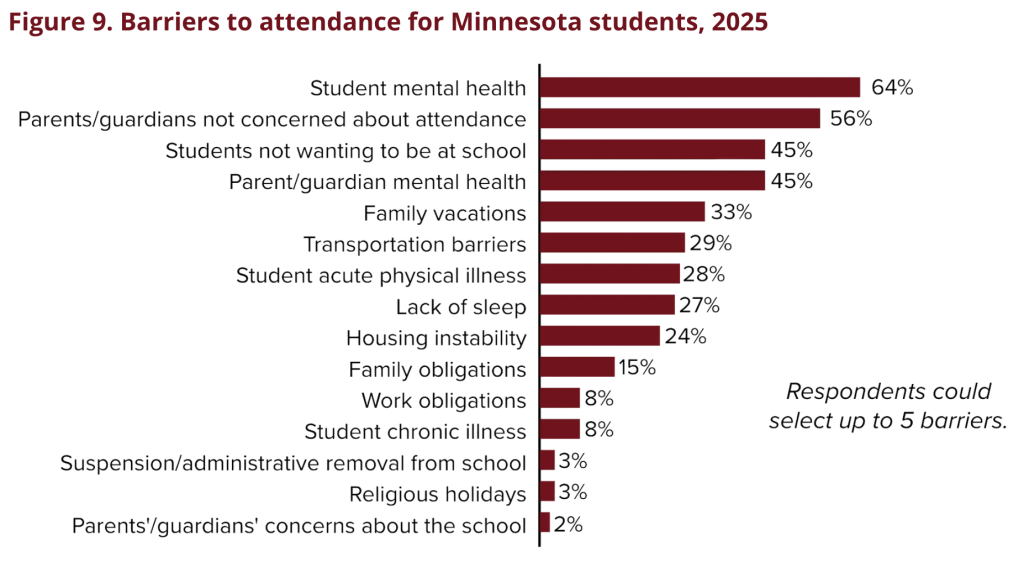
Principals saw chronic absenteeism, the second most widely cited concern about student behavior in Minnesota, as having many different sources. As I have written elsewhere, chronic absenteeism is a significant problem in Minnesota that has received little to no legislative attention. In their free responses, principals mentioned a desire for attendance policies that place the primary responsibility for attendance on families, including tougher solutions like truancy court. One principal wrote,
To be honest, I have no idea [what we need]. No one seems to have any suggestions or their answer is ‘build relationships’. Our kids are equal opportunity truants: kids who love us, kids who don’t… it doesn’t matter. There seems to be no teeth or repercussions for students or families if they do not attend after 12 years old.
Shifting Tides
While most principals (88 percent) express satisfaction with being a school leader at their current institution, many have concerns about the sustainability of their work. Principals expressed in free responses that they are often asked to “do more with less”, as unfunded statewide mandates siphon away district resources like funding and time. They also expressed that the social attitude of families towards the school system has shifted dramatically for the worse. Tossing ideas around like mandatory parent classes or involvement, principals worried about the rapidly draining levels of parent support. One wrote,
I believe we need to have more accountability from families for behavior issues and support. Trust in education and unkind interactions with families has been a huge change in the past couple years.
Readers should consider serving in their local community as a parent volunteer, a school board parent advisory member, or running to serve as a school board member.
Conclusions
These highlighted survey responses show that Minnesota’s crop of dedicated professional school principals share the same concerns as many onlookers. High levels of chronic absenteeism, dwindling parental involvement and community support, and top-down legislative mandates present significant challenges. There is still time in this year’s legislative session to pass bipartisan legislation that prioritizes the timely release of data about chronic absenteeism and school discipline.
The next Minnesota Principals Survey will hopefully have a higher number of respondents. Researchers should consider publishing all granular data points, asking more questions about parental involvement, and requesting more precise information about the types and root causes of disruptive behavior in the classroom.