Critics of private school choice have long contended that such policies drain public school budgets. A new analysis of two decades of federal spending data says otherwise.
Marty Lueken and Colyn Ritter with EdChoice analyzed National Center for Education Statistics federal financial data from 2004 to fiscal year 2024 to assess whether adopting private school choice correlates with reduced public school spending.
Over the 20-year window, they find that real public school spending per pupil rose substantially in many of the largest choice states, even as those states expanded private educational options. When states are lined up by the year their choice program launched, the data shows the same: average real per-pupil spending climbed from roughly $15,895 the year before launch to $16,664 five years later — a 4.8 percent increase. Lueken and Ritter are careful to note that neither trend proves “that choice caused spending to rise,” but argue this data does make it “hard to square with the claim that choice programs lead to a collapse in public school spending.”
As does enrollment data. Public school enrollment decreased on average in non-choice states and increased on average among choice states over the same time period.
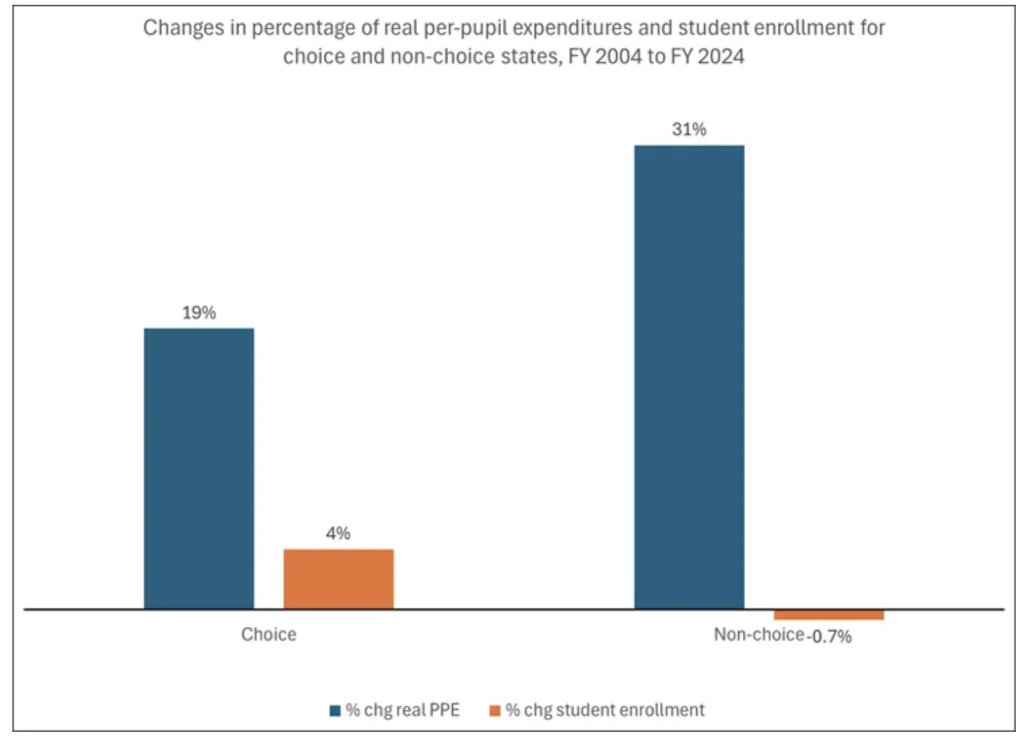
“After choice began, the average choice state had higher real PPE [per-pupil expenditures] and higher public school enrollment than it had just before launch,” conclude Lueken and Ritter.
Minnesota districts already experience attrition even without the presence of a private school choice program. And per-pupil dollars increase. Why? Because under public school finance systems, “districts that lose students do not lose a proportional share of their local, state, and federal funding,” explains Ben Scafidi in his report “The Enrollment Decline Windfall.” When a Minnesota district experiences attrition, for whatever reason it occurs, most federal funding stays put, local revenue not tied to enrollment (like property taxes) is retained, and declining enrollment revenue kicks in with a partial funding guarantee.
Lueken and Ritter do note that none of this means choice has no fiscal effects whatsoever — short-term fixed costs don’t immediately vanish when enrollment shifts, regardless of the cause. But the catastrophe critics promise? Twenty years of data say it hasn’t shown up.