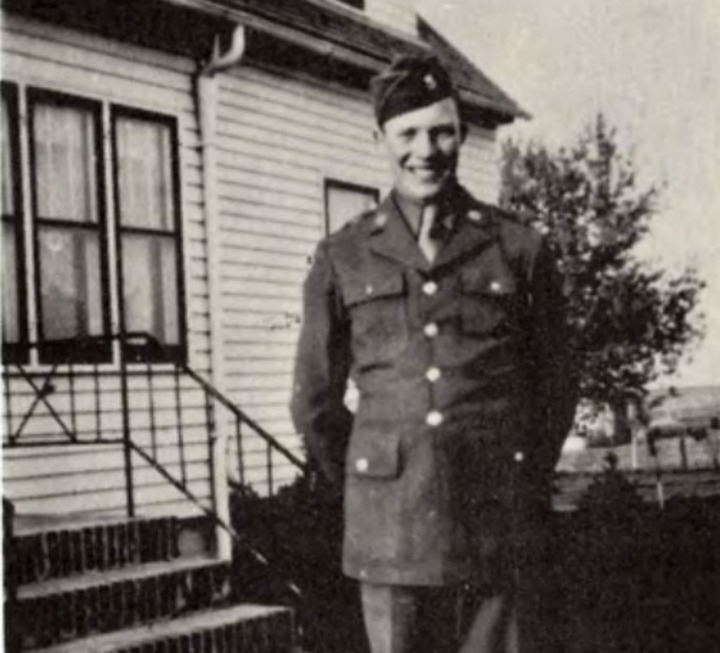
When the journalist Ernie Pyle was killed on April 18, 1945, during the battle of Okinawa, President Truman said: “No man in this war has so well told the story of the American fighting man as American fighting men wanted it told. He deserves the gratitude of all his countrymen.”
In one of his articles collected in the book “Last Chapter,” Pyle encountered Norbert Springman, the son and oldest of the eight children of Charles and Ida Springman from Wilmont, in Nobles County. He entered the armed forces in November 1942 and, after extensive training, was sent overseas as a radar operator. Flying out of Saipan, he took part in 24 combat missions over Iwo Jima, Truk, Nagaya, and Osaka, totaling 290 combat hours. He received the air medal and cluster. Springman was flying bombing missions in the Pacific in a B-29 when Pyle met him.
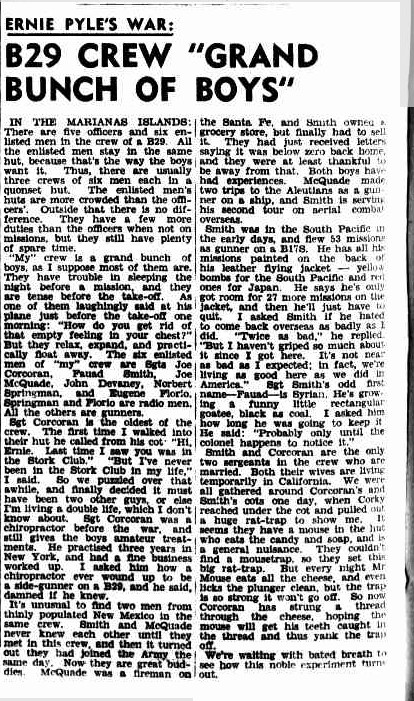
In a subsequent column, Pyle wrote:
Maj. Robinson, the airplane commander of “my” crew, has been leading his boys through almost two years of training before they came overseas.
“That means a lot to have been together so long, doesn’t it?” I asked.
“It means everything,” one of the sergeants said. “We’re a team.”
So far, the crew has been lucky. They’re all intact except for the bombardier, who had his leg almost blown off, and is now back in Hawaii in a hospital.
To show how they feel about their being a team, the enlisted men asked especially if I would put the bombardier down as still part of the crew, even though he isn’t here anymore. They’d been together so long, and they liked him so much. He is Lt. Paul O’Brien of Dayton, Ohio.
My crew has a superstition, or rather just a tradition. They all wear the same kind of cap when they start in a mission. It’s a dark blue baseball cap, with the figure “80” on the crown in yellow numbers.
Caps were prize
They got the caps a couple of years ago in Minneapolis when they were there on a weekend trip for winning some kind of merit prize. The “80” was their unit number then, and although it had long since ceased to exist, they insist on keeping it.
Once in a while Maj. Robinson used to forget his cap, and the enlisted men would send somebody back after it before the mission started.
But they’ve lost two of the caps now. One was Lt. O Brien’s, and he took it with him when he was evacuated. The other was Maj. Robinson’s. His cap got so bloody from Lt. O’Brien’s wound that he had to throw it away.
My crew lost their first plane right on the field when a Jap bomb got it. It was named Battlin’ Betty after Maj. Robinson’s wife, so now he’s changing the name of his newly inherited ship from Small Fry to Battlin’ Betty II.
Post-war project
Maj. Robinson carries a movie camera with him on every mission. He has already taken about 1,500 feet of color movies, but can’t have them developed until he gets back to America. He’s got them sealed up in moisture-proof cloth for safekeeping against the tropical climate.
The other night when he came into the hut after a 14-hour mission over Tokyo, he held up his movie camera for me to see, and said:
Now I’m satisfied to quit. I got the picture today that should end it.
There was a Jap fighter diving at the squadron ahead of us. He apparently didn’t see us at all, for he pulled up and turned his belly to us and just hung there, wide open. Every gun in our squadron let him have it. He just blew all to pieces. And I got the whole thing. So now I’m ready to lay it aside.
Aged 23, Springman looked forward to life after the war. In a letter to his parents, he wrote: “I’m hoping to be home for my birthday & may make it sooner, of course that’s my opinion now so don’t get too anxious until you hear from me.”
This was his last letter.
On 24 May, 1945, he was on the crew of the “Battlin’ Betty III,” flying from Saipan to hit an industrial area south of the Imperial Palace in Tokyo, along the west side of Tokyo Harbor. Springman’s plane had been designated one of the pathfinders, whose job it was to fly ahead of the formation and “light up” the target for the other 560 planes. This was the largest B-29 raid of the war.
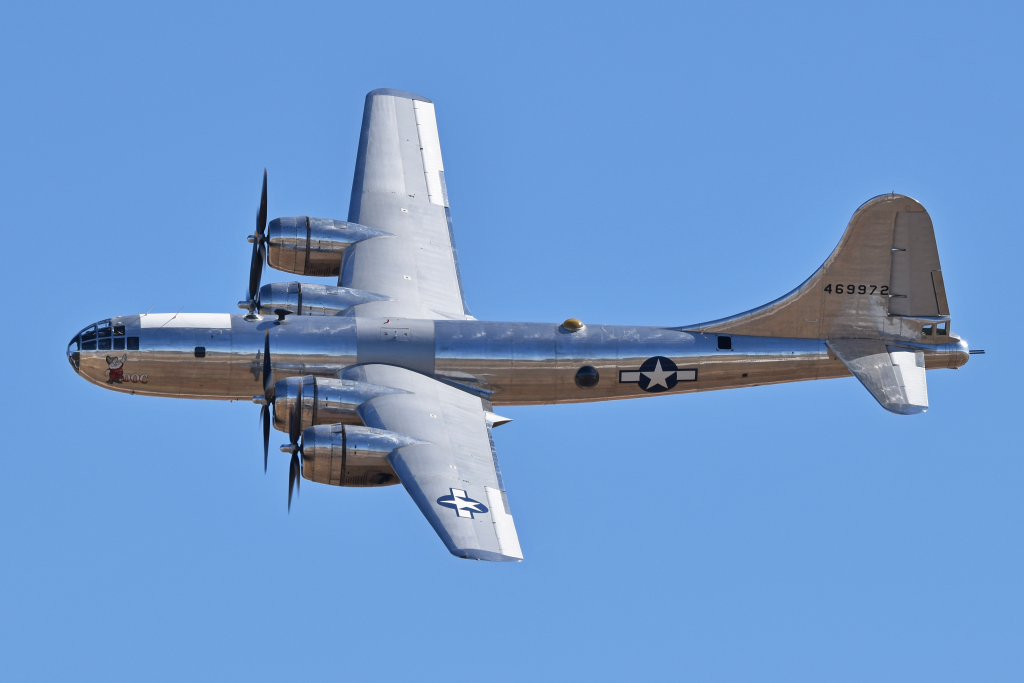
Pathfinders attracted particular attention from Japanese ground defenses, and four of the eight on this raid were shot down. After dropping their bombs, the “Battlin’ Betty III” received multiple hits to its left wing from 20mm anti-aircraft guns, went into a spin, and crashed into Tokyo Bay. Although many crew members bailed out, only one man survived. Springman’s body was never recovered.
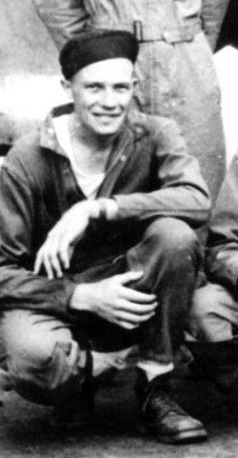
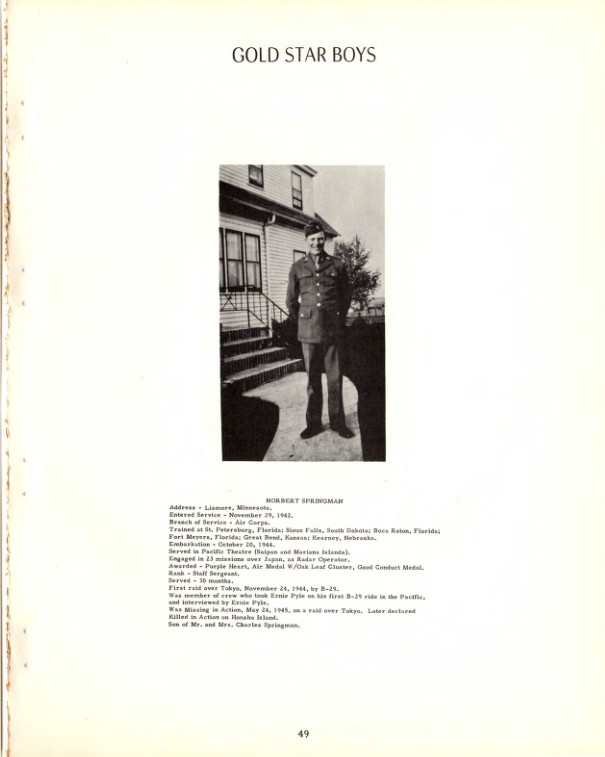
Norbert Springman is memorialized in Calvary Cemetery in his home town.