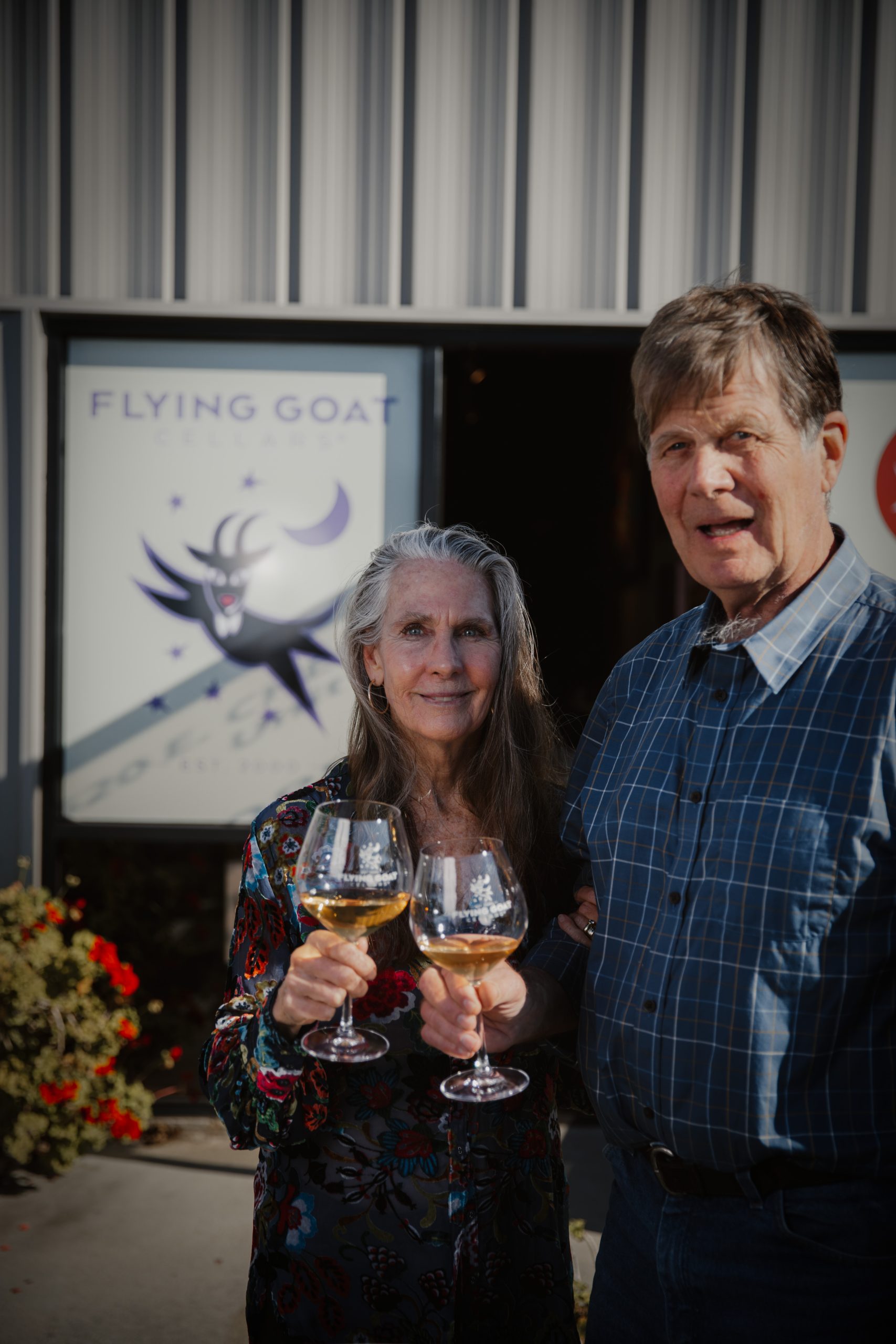
It’s a bedrock constitutional principle: the government can’t compel a private business to fund speech it disagrees with—but that’s exactly what’s happened to Flying Goat Cellars, a small Santa Barbara, Calif., winery. Now, with the help of the Goldwater Institute, Flying Goat is fighting back and suing the Santa Barbara County Board of Supervisors for forcing it to fund a trade association that doesn’t have Flying Goat’s best interests at heart.
For more than two decades, Flying Goat founders Norm Yost and Kate Griffith have built their family-owned winery into one of the region’s most innovative and celebrated producers—pursuing their own vision of what their winery should be along the way. But last year, county officials and the leaders of the local vintners’ association decided that they know what’s best for Flying Goat.
In February 2025, the board created a wine “Business Improvement District,” or Wine BID, requiring all local wineries to pay a 1% assessment on sales to fund regional marketing efforts. The ordinance also forces wineries to become members of the Santa Barbara County Vintners’ Association, which controls how the money is spent.
The vintners’ association has long sought to force local wineries to join its ranks—its lobbying efforts to establish the Wine BID and to compel membership date back to 2019. Prior to the creation of the Wine BID, most Santa Barbara wineries were not members.
The problem is, Norm and Kate don’t want anything to do with the Wine BID because they don’t agree with its marketing or lobbying activities—including paying for overseas trips for its leaders.
“Flying Goat’s success is built on building direct relationships with the customers who walk through our winery’s doors, not on international markets and the kinds of broad campaigns the vintners’ association favors,” Norm said. “Our vision for Flying Goat and the vintners’ association’s vision for the Santa Barbara wine industry are not the same.”
The good news—the law is on Flying Goat’s side.
“The Supreme Court has made clear that the government cannot force Americans to subsidize speech they disagree with,” said Goldwater Institute Senior Staff Attorney Adam Shelton, who represents Flying Goat Cellars. “It has also recognized a fundamental right not to be compelled into private associations. Santa Barbara County’s mandate violates both principles.”
In addition to the First Amendment concerns, the mandated fee also violates the Fifth Amendment’s Takings Clause by redirecting Flying Goat’s revenue to a private organization without a legitimate public use.
In February, the Goldwater Institute sent a letter to the Santa Barbara County Board of Supervisors urging officials to make the 1% fee and vintners’ association membership voluntary. The board has not responded, leaving Flying Goat and Goldwater with no choice but to pursue legal action.
Flying Goat’s lawsuit comes as many California wineries are at a tipping point—rising production costs, increased competition, and shifting consumer habits have made this the most challenging time for the wine industry since Prohibition. Flying Goat Cellars says the county’s mandate could accelerate the squeeze on smaller, independent producers.
“On the 250th anniversary of the founding of our country, I’m proud to defend the First and Fifth amendment rights that my Patriot ancestors fought hard to establish,” Kate said. “I will do whatever I can to prevent the government from forcing our affiliation with an organization we don’t want to join, as well as from taking money from our coffers for that organization.”
Flying Goat’s lawsuit has been filed in the U.S. District Court for the Central District of California against the Santa Barbara County Board of Supervisors and the Santa Barbara County Vintners’ Association.
The Goldwater Institute is proud to fight for Flying Goat’s First and Fifth Amendment rights and won’t stop until the county ends its unconstitutional ordinance.
Read Flying Goat Cellars’ lawsuit here.