In just five years, Minnesota’s education system has fallen from #7 nationally to #21, according to the Annie E. Casey Foundation’s 2026 Kids Count Report.
The highly regarded nonprofit Annie E. Casey Foundation releases a yearly report ranking states’ education systems, taking into account scores from the National Assessment of Educational Progress (NAEP), how many young children are not in school, and how many students graduate high school on time. Previously, Minnesota education was ranked #7 in 2021, #9 in 2022, #18 in 2023, #19 in 2024, and #17 in 2025.
This year, Minnesota saw strong drops in the rankings provided by the Kids Count Report. The state saw the fifth largest drop in the nation for overall childhood well-being, (dropping from #1 to #5) and dropped to #21 nationally within the education category.
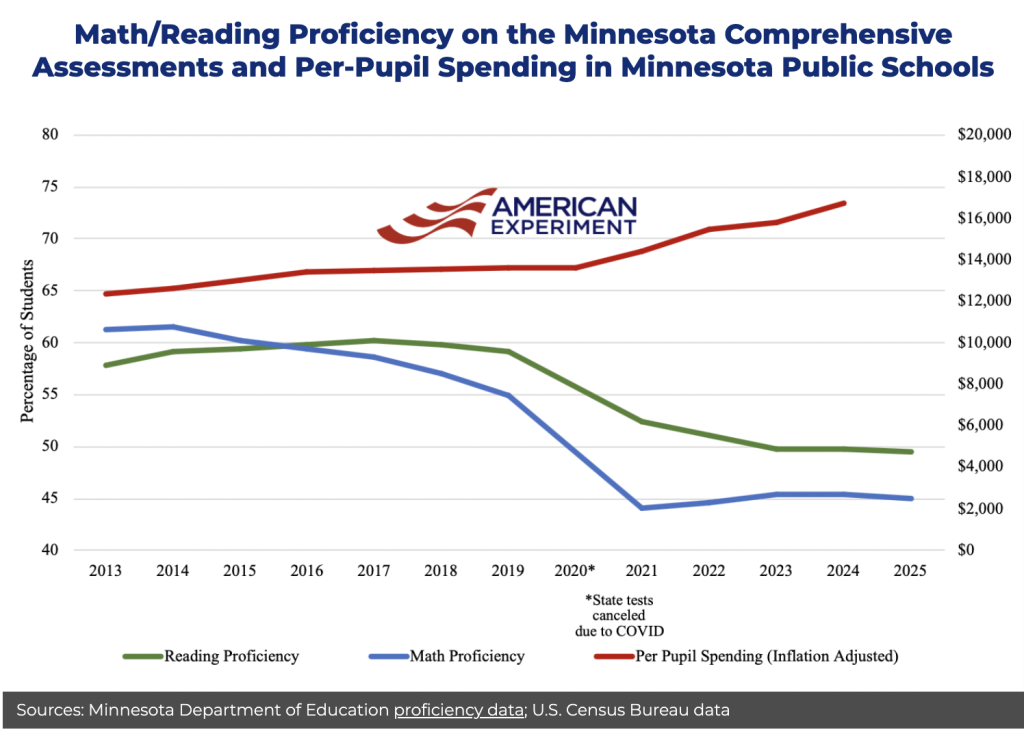
The steep national declines come as no shock to many state education advocates, which have sounded alarm bells as student academic proficiency (measured on state tests and ACT scores) has declined for years. ACT scores and real academic knowledge for the class of 2025 was at an all-time low, even as graduation rates soared to record-setting highs. (One questions if the high graduation rate, which boosted Minnesota’s national ranking in the Kids Count Report, accurately reflected student achievement.) Last year (2025), less than half of all students tested as grade-level proficient on either math or reading state tests. Those academic declines on state assessments began a decade ago.
It is exceptionally difficult for average Minnesotans and elected officials to stare the problem of declining academic achievement in the face. For too long, well-meaning people have played “Minnesota nice” and refused to take the initiative towards real policy reform and renewal.
One simple alternative to Minnesota accountability is to compare Minnesota, favorably, to other states that have historically struggled significantly with poverty, slavery, or other forms of hardship. Minnesota may not be perfect, the argument goes, but at least the state ranks higher academically than “backwater” states like Mississippi.
That’s not acceptable. A different state’s loss isn’t Minnesota’s gain. While historically low-ranking states like Mississippi and Louisiana have been spending real time on reform and policy renewal, Minnesota has been casting doubt on their success, refusing to put equal time and effort into education policy overhauls. Those states certainly aren’t perfect, but one thing is statistically true: at this point, a young, poor black boy in Mississippi will score higher on his tests than a similar student in Minnesota.
It hurts, but this slide downward in the education rankings can be a good thing for Minnesota. Will the state accept decline? Or will this be the wake-up call for parents and policymakers?
Minnesota is a wealthy state, with engaged students and passionate policymakers. There’s no reason for our students to stagnate under a system that resists reform and renewal. It’s time for us to have the political and social will to invest in our schools, choosing smart policies instead of pretending that the education budget line item is the only metric that matters.
One easy way to begin is by asking all gubernatorial candidates (red and blue) how they will prioritize education reform. Once in office, they should be reminded of their campaign promises — and be pressured into sticking to them.