
Federal regulation has grown into something almost impossible to fully grasp. The U.S. Code of Federal Regulations now runs over 180,000 pages, compared to just 10,000 pages in 1950. States have not fared any better. Ohio’s code recently surpassed 17 million words. At that scale, checking every rule against current law to see what is outdated or contradictory is not realistic. Therefore, almost nobody does, and the rules keep piling up.
In the past some states have attempted to arduously tackle the problem by hand. For example, former Massachusetts’ Governor Charlie Baker launched a “regulatory review” effort in 2015 that ran through 2017. Many other states have attempted similar reviews over the years. Reviewing an entire regulatory code, however, is slow and labor-intensive, and many of these earlier efforts ended up incomplete.
Figure 1: Growth of Federal Regulations Over Time, 1950-2026
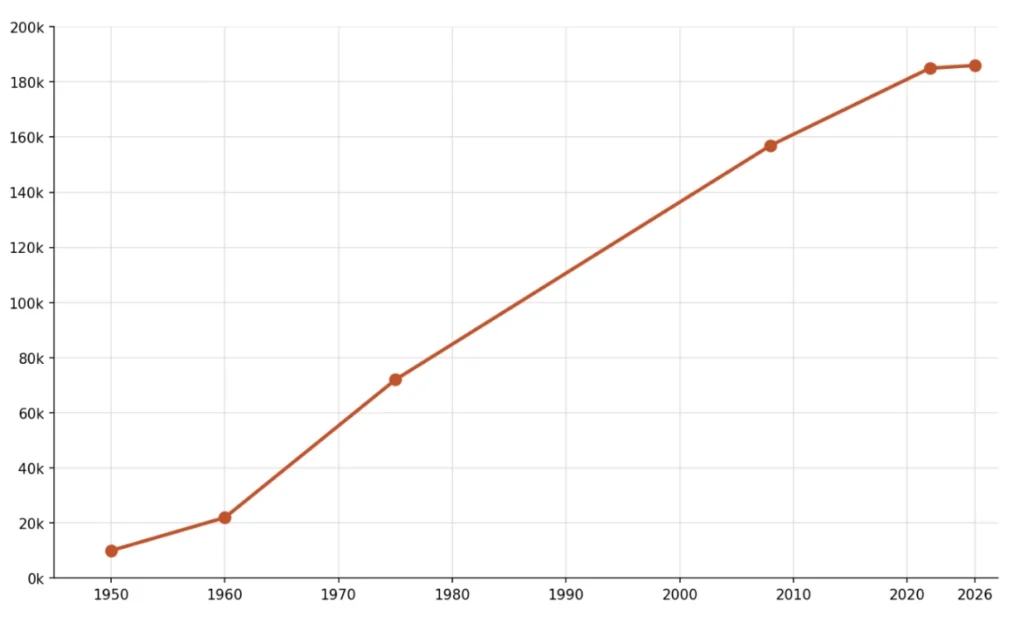
Source: National Archives and Records Administration, Office of the Federal Register, via Competitive Enterprise Institute, Ten Thousand Commandments (2025), and Mercatus Center. This graph is highlighting the exponential growth of regulations over time.
Technology has created new possibilities. In recent years, several states have begun using artificial intelligence (AI) to identify outdated regulations for revision or repeal. These efforts operate within existing laws and rulemaking processes and are often part of broader deregulatory initiatives. AI tools can identify candidates and recommend changes, but any revisions must still go through the standard regulatory process before taking effect. As AI becomes more common in everyday life, this is one of its more concrete applications in government.
The Hidden Cost of Overregulation
The problem begins with the size and cost of regulations. Federal regulations now contain more than one million regulatory restrictions. Research from the Mercatus Center estimates that the effect of this regulatory growth has reduced U.S. economic growth by roughly 0.8 percent annually since 1980. While that may seem negligible at first, its long term impact is substantial. The U.S. economy could be approximately 25 percent larger today had regulatory burdens remained at 1980 levels.
Figure 2: Comparing Regulatory Restrictiveness Across States
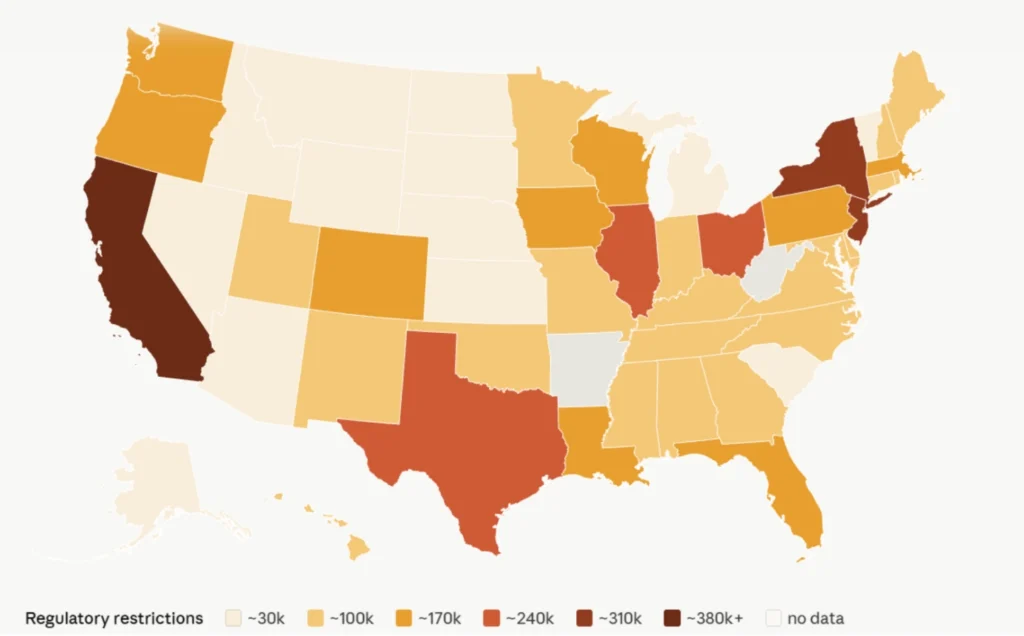
Source: Mercatus Center, Snapshots of State Regulations, 2024 Edition (state administrative code restriction counts, 2023 data). Arkansas and West Virginia are not yet covered by State RegData. This is a map determining which states have the greatest number of regulatory restrictions.
A Regressive Burden
The burden is also not equally distributed. Regulation tends to have a regressive effect, as the burden of compliance costs fall most heavily on small businesses and lower-income people who have fewer resources to absorb them. Studies show that a 10 percent increase in regulatory burden is associated with about 2.5 percent increase in the poverty rate. Recent survey data from The U.S. Chamber of Commerce further emphasizes this point with nearly 69% of small businesses reporting higher compliance costs per employee than larger firms.
From Counting Pages to Quantifying Code
The benefit of using AI for regulatory review is intuitive. Where it had once taken weeks or months to diligently cross reference dense legal codes, AI can now process in minutes – and capture their full scope. The Mercatus Center’s RegData project, for example, uses machine learning text analysis to convert legal code into structured data, allowing researchers to count regulatory restrictions and identify which industries they affect. The results help illustrate how extensive the regulatory system is considering that the federal code contains roughly 103 million words and over 1.08 million restrictions.
There is also significant variation across states, with California having more than 420,000 restrictions, compared to fewer than 65,000 in Arizona. The important point is not the ranking itself, but the fact that meaningful reform depends on being able to measure the system in the first place. Without that visibility, large scale regulatory reduction is nearly impossible. Studies also suggest that states that have successfully reduced regulatory burdens tend to experience stronger economic growth.
States Implement AI
Some states have moved beyond measuring regulations and begun using AI to support reform efforts. Ohio was among the first, adopting an AI-powered tool called RegExplorer to identify duplicative or outdated provisions. Lt. Governor Jon Husted, who led the initiative, argued that regulations accumulate over decades because no one is tasked with regularly reviewing them. Over five years, the effort has put Ohio on track to reduce its regulatory code by roughly one-third, eliminating about 5 million words while saving an estimated $44 million and 58,000 staff hours over a decade. So far, it has flagged roughly 900 obsolete rules and 2 million words for review, including 600,000 words from the state’s building code. The software does not remove regulations itself; it only identifies potential candidates for review, leaving final decisions to policymakers.
Virginia has pursued a similar but more expansive approach, directing AI across its entire administrative code and all executive agencies simultaneously. In 2025, the state launched the first statewide AI-assisted regulatory review, using tools to compare regulations with their authorizing laws, conduct cost-benefit analyses, examine other states’ approaches, and scan “incorporated” documents referenced in regulations. That last category proved particularly significant: about 240,000 of Virginia’s roughly 335,000 regulatory requirements are contained in incorporated documents, many of them behind copyrighted paywalls, meaning businesses sometimes must pay to read rules they are legally required to follow. The initiative builds on earlier reforms that reduced regulatory requirements by about 27 percent and saved an estimated $1.2 billion annually, though those gains came from a multi-year manual review rather than AI, which Virginia only adopted in 2025. A federal Senate proposal introduced in 2025 seeks to apply a similar model to the federal regulatory code.
Other governments are testing similar approaches. San Francisco partnered with Stanford Law School’s RegLab to build a custom AI tool that scanned roughly 16 million words of the city’s municipal code, surfacing hundreds of outdated or duplicative reporting requirements across city government and ultimately producing a 351-page ordinance proposing the deletion or consolidation of 174 separate mandates. Texas has also announced an AI-assisted regulatory review modeled on Ohio and Virginia’s work, starting with the state’s occupational licensing rules.
The potential benefits of these initiatives are significant. AI can process millions of words in minimal time compared to traditional reviews, allowing governments to more effectively remove outdated provisions. Lower compliance costs can also promote economic growth and reduce barriers faced by small businesses, which often struggle the most with regulatory burdens.
Where AI Falls Short
At the same time, AI’s limitations deserve consideration. While it can identify patterns and flag potentially problematic regulations, it cannot determine whether a rule serves an important public purpose. A regulation that appears redundant may still provide valuable protections, which is why states such as Ohio and Virginia rely on human review rather than allowing software to make regulatory decisions independently. Furthermore, measures such as counting restrictive terms provide only a partial picture of regulatory impact, and policymakers must consider how AI systems are designed and how their recommendations are evaluated.
A civic-tech perspective adds another layer of caution. Researchers have described the accumulation of confusing or outdated rules as “policy sludge” and argue that efficiency alone is not reform. One emerging approach seeks to move “from red tape to green tape” by pairing AI’s ability to identify redundant rules with structured public input, ensuring that reforms reflect public judgment rather than algorithmic pattern-matching.
AI should be viewed as a tool for identifying problems rather than a complete solution. Even successful reviews of existing regulations do not address the incentives that produce new rules, making broader structural reforms necessary. AI may also complement regulatory sandboxes, which allow businesses to operate under supervised conditions while policymakers evaluate whether existing regulations remain appropriate.
Conclusion
Overall, AI is becoming a valuable tool for regulatory reform. It helps governments better understand the scope of accumulated regulations and review them far more quickly than traditional methods allow. However, successful reform still depends on human judgment and transparency to ensure that important protections are preserved. As more states adopt these technologies and federal policymakers consider similar initiatives, the question is no longer whether AI has a role in regulatory reform, but how it can be used responsibly.
Shriya Buche is a rising senior at the Georgia Institute of Technology majoring in Economics with minors in Public Policy and AI/Machine Learning. She is interested in the intersection of economic policy, technology governance, and law, and plans to attend law school after graduation.