
IFT represents educators in more than 200 districts across Illinois. But teachers’ zip codes dictate how much support they actually get from the union.
The Illinois Federation of Teachers is supposed to represent educators in more than 200 districts across the state.
But it is controlled by the Chicago Teachers Union, and IFT spending shows it favors CTU disproportionately over other affiliates.
In 2025, more than 70% of IFT spending was on CTU, even though CTU makes up just one-third of IFT’s membership.
The rest of IFT’s affiliates got the less than 30%, despite making the majority of its membership.
What’s more, the majority of IFT’s spending is not on representing teachers. That’s according to its own reporting.
Here are seven things educators should know about IFT:
- CTU controls IFT.
- IFT spends a disproportionate amount of money on CTU over other affiliates.
- Less than 28% of the union’s spending is on representing teachers.
- IFT and its affiliates were the No. 1 funder of Chicago politics in the last municipal election.
- IFT lies about its membership numbers.
- IFT lavishes six-figure salaries on its own employees.
- Teachers can opt out, keep their benefits and get liability insurance elsewhere.
Ready to opt out of the union? Visit LeaveIFT.com.
1. Chicago Teachers Union controls IFT
IFT and CTU share a president: Stacy Davis Gates.
When Davis Gates took over as IFT president in 2025, she did not step down from her position as president of CTU. The two entities became practically inseparable, with CTU’s agenda becoming IFT’s agenda.
CTU admitted as much. “The fight for Chicago Public Schools just got more aligned and more unified with the fight for all school children all across our state,” the union said after Davis Gates became IFT president..
What does this “fight” include? CTU prides itself on “bargaining for the common good,” a euphemism for demanding social justice and other progressive provisions during negotiations rather than sticking to typical wage and benefit demands.
In recent years, that has included CTU’s demands for police-free schools, cash to asylum seekers and expensive carbon neutrality in the district, among other things.
This radical agenda has come at a cost to the teachers CTU allegedly represents. Just 18% of the union’s spending went toward teacher representation in its fiscal 2025. Its political spending has quadrupled since Davis Gates took the reins.
2. IFT spends a disproportionate amount of money on CTU over other affiliates
IFT receives money from a variety of sources, including members’ dues. It then redirects some of the money back into its local affiliates. But the way it allocates that spending isn’t representative of the districts where its members work.
Just one-third of IFT’s members are in Chicago Public Schools, yet CTU receives the majority of IFT’s affiliate funding. In 2025, more than 70% of local affiliate spending was on CTU, with less than 30% on the remaining locals.
That’s according to the union’s own annual reporting to the U.S. Labor Department.
IFT’s favoritism of CTU isn’t new. For more than 20 years, CTU has received the majority of IFT’s affiliate spending.
3. Less than 28% of the union’s spending is on representing teachers
IFT’s reporting also shows it spent little last year on “representational activities,” which should be its main focus. The Labor Department defines representational activities as the negotiation of a collective-bargaining agreement and the administration and enforcement of the resulting contract.
IFT spent a total of $52.3 million in 2025. Just $14.4 million of that was on representing teachers — not even 28% of the total.
The rest went to politics, overhead and other union leadership priorities.
4. IFT and its affiliates were No. 1 funder of Chicago politics in the last municipal election
IFT spent over $1 million on politics in 2025, according to its reporting.
That’s nothing new. IFT and its affiliates – CTU and the American Federation of Teachers — were the biggest spenders on Chicago politics in the 2023 municipal election, which put CTU organizer Brandon Johnson in the mayor’s office.
Altogether, IFT, CTU and AFT funneled nearly $6.5 million to Chicago mayoral, city council, city clerk and city treasurer candidates between Feb. 28, 2022, and May 4, 2023.
Just one-third of IFT’s members are in Chicago. Yet it’s pouring money into Chicago politics.
5. IFT lies about its membership numbers
IFT has claimed to have 105,000 members in multiple recent press releases.
But the union tells the Labor Department something drastically different. It’s most recent federal filing — signed in late March 2026 under penalty of perjury — said it had just 89,372 members.
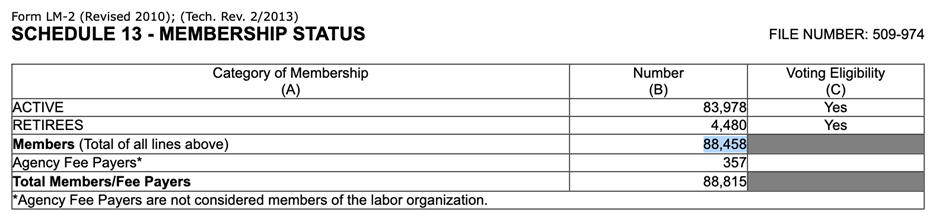
That’s 15,600 less.
Either IFT misrepresented its member numbers to the Labor Department — under oath — or the union is lying to its members, the media and the public on its website.
Notably, IFT’s membership rolls have never hit 100,000, according to its previous filings with the Labor Department. Membership peaked in 2016 at just over 96,000.
6. IFT lavishes six-figure salaries on its own employees
IFT employed 144 officers and other staffers in 2025, and 65 of them made over $100,000. That included former IFT President Dan Montgomery, who made over $274,000 between January and when he left in October.
It also included newly elected IFT President Davis Gates. The union reported that she received $100,607 in 2025. That’s likely to increase substantially this year when she has a full year of pay as president. She was previously IFT’s executive vice president and made $78,150 in that position in 2024.
That’s in addition to the nearly $200,000 Davis Gates made last year as CTU president.
Meanwhile, the average teacher salary in Illinois was less than $79,000.
In total, IFT spent $13.4 million on officer and employee salaries.
Teachers are sending their hard-earned money to IFT, which is taking advantage of them. IFT is using their union dues to prop up its own expensive employees while spending not even 28 cents of every dollar on representing those teachers.
7. Teachers can opt out, keep their benefits and get liability insurance elsewhere
Teachers don’t need to be union members to keep their employer-provided benefits. And they can get liability insurance and job protection coverage elsewhere, at a fraction of the cost of member dues.
Under state law, school districts can’t treat nonmembers any differently than members. Any raises, hours and other benefits promised in a collective bargaining agreement apply to all teachers, regardless of membership status.
Teachers also don’t need the union for liability insurance or job protection coverage. They can get that elsewhere, and much cheaper.
Interested in opting out? Here’s the bottom line:
- Teachers can opt out of union membership and stop paying dues.
- Teachers who opt out retain all benefits in the contract with the school district.
- Teachers can get liability insurance for legal protections elsewhere, at little or no cost from groups such as the Association of American Educators or the Teacher Freedom Alliance. The alliance is donor-funded and free to teachers.
But time is of the essence. IFT provides only a short window, typically in August, when teachers can alert the union they want to stop paying dues.
Those who want to opt out of the union can get the paperwork they need at LeaveIFT.com.