Many Kansas public school districts are struggling with budget deficits they attribute to declining enrollment. That’s only part of the reason, however, as districts in 27 counties have collectively increased employment even as enrollment has declined.
Enrollment declined each of the last three school years statewide, and employment increased each year. Since the 2019 school year, public school full-time equivalent enrollment fell by almost 23,000 students, but school districts added more than 5,000 employees. Now here’s the real headscratcher: there are 569 fewer teachers and 5,900 more non-teaching jobs.
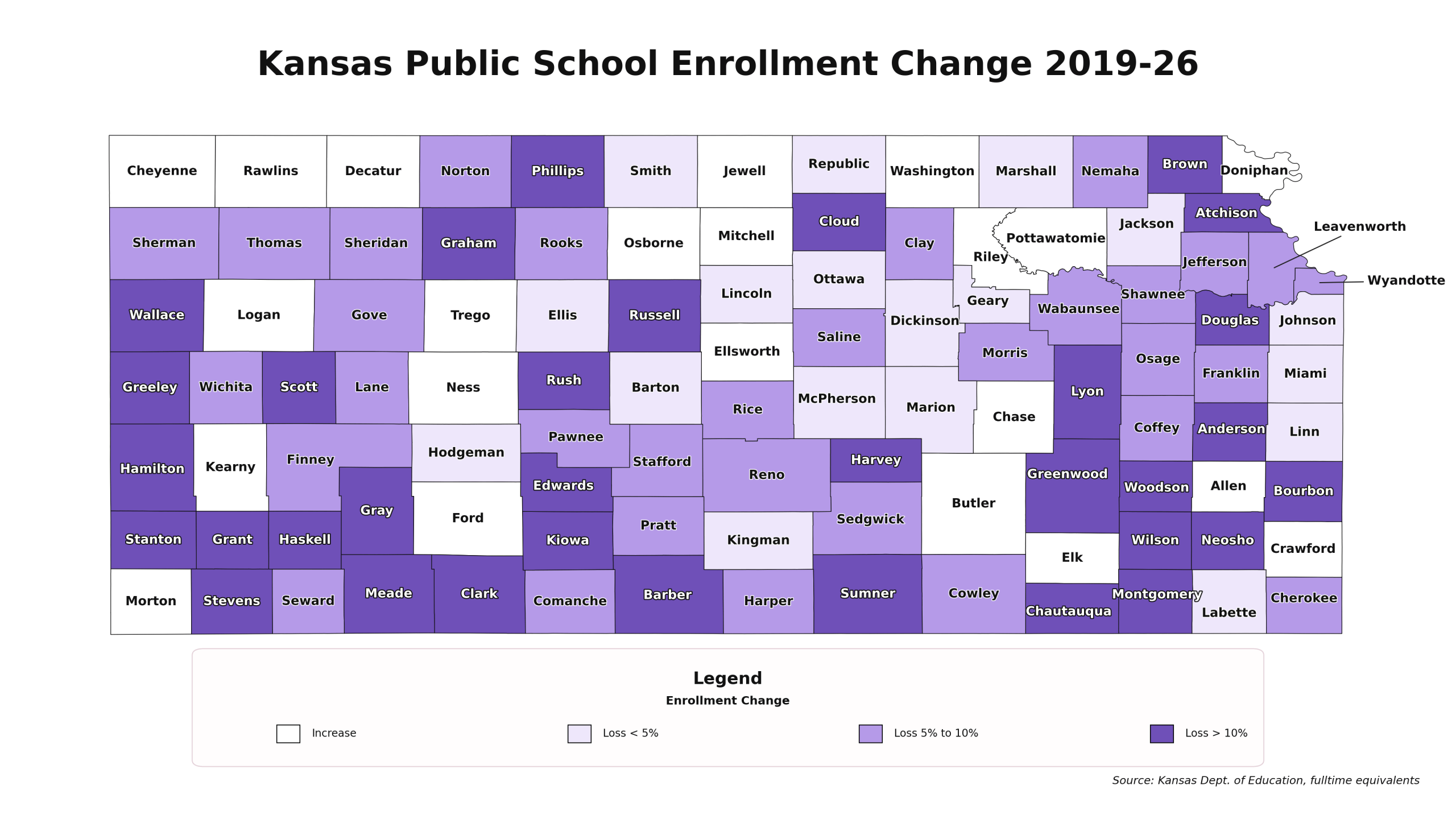
The map below shows enrollment changes for each county since 2019.
Surprisingly, enrollment is higher in the 22 counties shaded white, but not in any of the state’s largest counties (Johnson, Sedgwick, Wyandotte, Douglas, and Shawnee). The counties with higher enrollment increases are scattered around the state. There are 18 counties with declines of less than 5%, shown in the lightest shade of purple.
Enrollment dropped between 5% and 10% in 32 counties, and the 33 counties with the darkest shading have declined by more than 10%.
By contrast, some of the counties with the largest enrollment declines added more employees.
For example, Wallace, Bourbon, and Chautauqua counties lost more than 10% of their students but increased employment by more than 25%. Scott, Graham, Edwards, Cloud, and Lyon counties also lost more than 10% of their students but show employment increases ranging from 15% to 25%.
Statewide, 27 counties lost students and added employees. The worst variance is in Wallace County, with a 20% enrollment loss and 50% more employees.
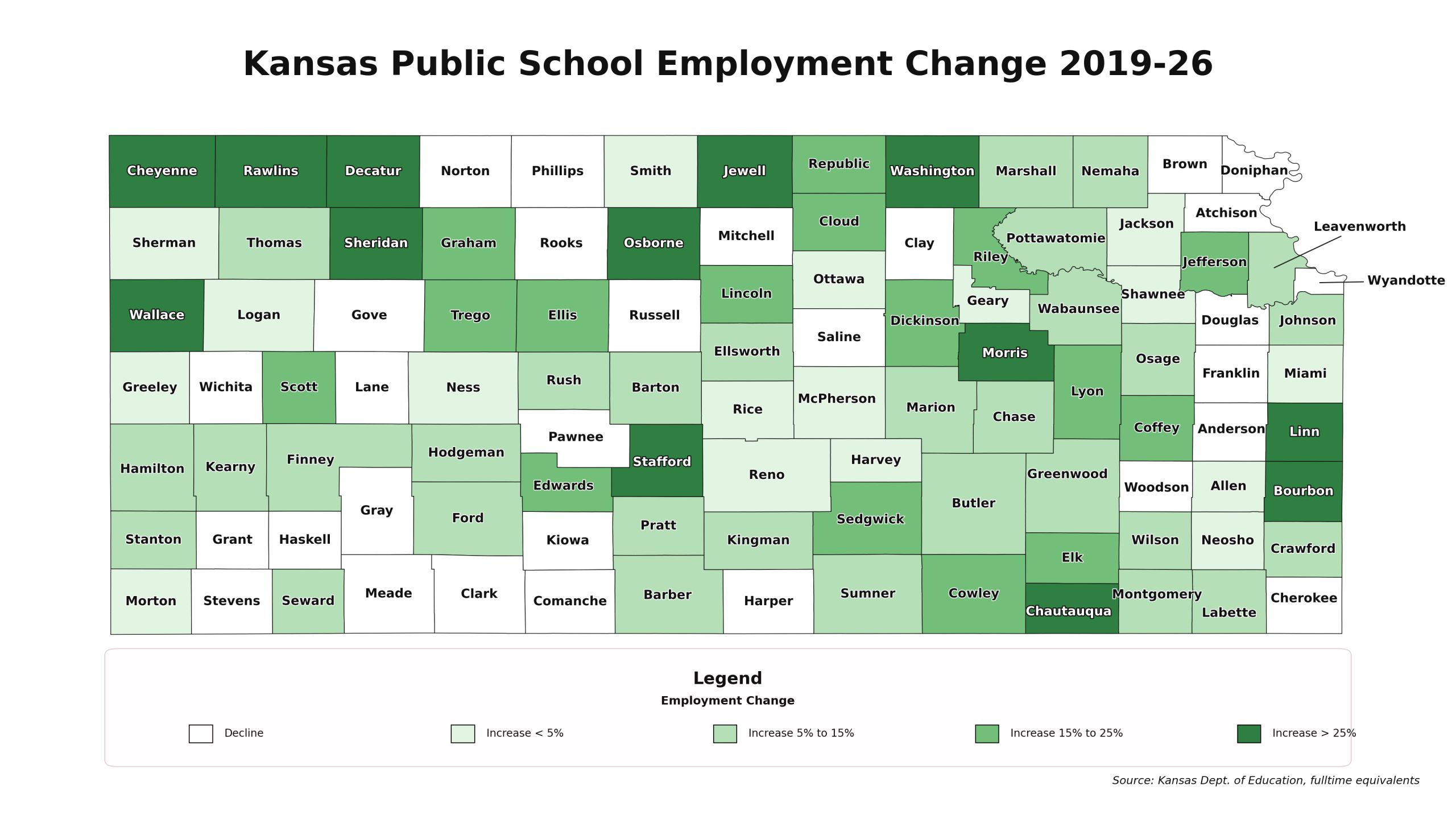
Statewide, 29 counties decreased employment since 2019, and 76 added more staff. Of those that added staff, 16 counties increased employment between 15% and 25%, and 13 counties (in the darkest green) boosted employment more than 25%.
Of course, many counties have more than one district and enrollment changes may vary widely across districts within a given county. The maps above and below represent the cumulative change for each county.
School funding, which likely exceeded $19,000 per student last year, is largely based on enrollment, so adding staff when enrollment is falling is a recipe for budget shortfalls.
Balancing budgets with declining enrollment
School districts across the nation are struggling to balance their budgets due to falling enrollment. According to a recent Washington Post article, “the number of school closures rose nationally last year” for the fourth consecutive year.
Closing schools is the last thing most local school boards want to do, and they need help prioritizing their budgets.
Prioritizing spending is essential, and school board members should give clear direction on how they want the process to work. Community members and staff need to know that improving student outcomes is the #1 priority; any instruction cost reductions will be efficiency-related and will not detract from quality.
It’s helpful to emphasize that the board won’t entertain spending cuts that eliminate a service or program unless staff says it isn’t essential and is a lower priority than improving student outcomes.
Marc Woofter, Project Lead at our Kansas School Board Resource Center, has extensive budget experience, having recently retired from USD 268 Cheney as superintendent. He says there are many opportunities to cut costs without compromising service.
“During my time in Cheney, we audited health insurance and subsequently made changes which saved hundreds of thousands of dollars every year. An energy audit was completed, and changes were implemented with the potential to save millions of dollars over the course of several years. Also, an internal transportation audit resulted in saving the district thousands of dollars.”
Woofter also recommends that districts losing enrollment should identify the main reasons for the decline and take appropriate action. Look at everything from the community’s perspective; this is about giving parents what they want rather than defending what the district is offering.
“A curriculum / instructional audit is essential. High-performing schools attract families and students, which will certainly help districts avoid school closures.”
Engaging the community gets the word out to parents in adjacent districts who may be looking for a better opportunity, and the state’s open enrollment law allows students to attend another district without moving there.
The transition won’t be easy, but done well, some districts could turn a budget challenge into an opportunity to grow over time.