The current moratorium on school closures ends after the 2026-27 school year. There’s a path forward for the next school board.
With a moratorium on Chicago school closures soon to end, the first fully elected school board will have the opportunity to address the district’s over 250 underused schools.
More than half of Chicago Public Schools’ buildings were underutilized in the 2025-2026 school year, defined by enrollment below 70% of their ideal capacity, with classroom spaces “unused and/or inefficiently programmed.”
Chicago is home to the emptiest big-city school in the country, according to the Chicago Policy Center: Frederick Douglass Academy, with a capacity of 1,008, had just 27 students in 2025-2026.
A series of moratoriums on school closures in Chicago have been in place for years. The current ban was extended by the partially elected school board to end at the end of the 2026-2027 school year.
The current board could launch a blue-ribbon commission for facilities planning to address what’s best for both students and taxpayers. If it doesn’t, the first fully elected school board should take that step.
The CPS board should convene a commission for CPS facilities planning
The Chicago Policy Center has put together a “CPS Excellence Agenda” for school board candidates. It’s built on three pillars: academic excellence, financial excellence and board excellence.
One of its recommendations: Convening a Blue Ribbon Commission for CPS facilities planning that should:
- Assess the facility footprint.
- Establish an ongoing framework to optimize facilities for student success, including core principles of utilization, neighborhood coverage and model staffing.
- Set consistent minimum enrollment and performance standards and a consistent “high bar” standard that triggers school-model replication.
- Compare CPS’ capital financing ability to other large districts.
Half of CPS schools were underused in 2025-2026
The district measures space utilization annually, labeling schools underutilized, efficient or overcrowded. An elementary school’s ideal capacity is 77% of its maximum capacity and a high school’s is 80%.
In the last academic year, nearly 54% of schools, or 255 buildings, were underutilized, 40% were efficient and about 7% were overcrowded, CPS data shows. The data excludes charter schools in their own buildings and alternative schools.
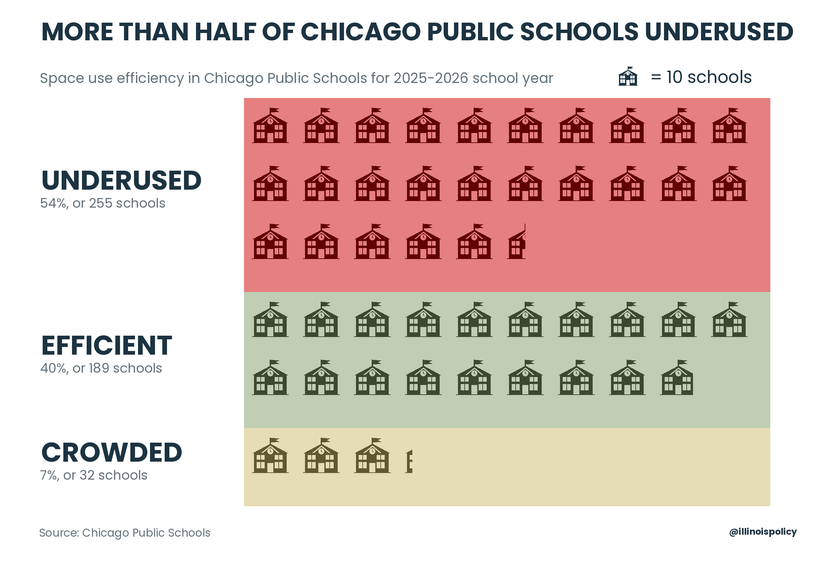
Analyzing district data, the average “space utilization rate” in 2025-2026 was 68% across 476 single-location schools. That means the average CPS school is one-third empty.
Empty schools harm students
The cost of empty schools isn’t just financial, according to a 2025 analysis by ProPublica and Chalkbeat.
“Students in the city’s smallest schools have fewer courses to choose from and often miss out on clubs, extracurricular activities, and sports,” the analysis says. “Chicago’s underenrolled high schools are more likely to have lower graduation and college enrollment rates.”
Indeed, research shows that very small high schools struggle to provide academics and extracurricular activities available at larger schools.
Meanwhile, proficiency data is not yet available from 2025-2026, but figures from the previous school year show that proficiency was low and cost and absenteeism high at Douglass and the other nine emptiest high schools.
In those 10 schools, about 1-in-10 or fewer tested students met grade-level standards in reading on the ACT in 2025. About 1-in-20 or fewer met grade-level proficiency in math.
What’s more, high absenteeism is a warning sign, as research suggests that frequent absences put students at a higher risk of poor outcomes, such as dropping out and lower academic achievement. The lower proficiency scores already seem to be bearing this out.
Then there’s cost. Average spending per student at these 10 schools was nearly $37,500, compared with the district average of nearly $20,000. That means these schools’ much poorer results than the district’s average come despite spending nearly double the average per student.
Chicago students deserve access to quality academics and robust extracurriculars. No one wins — neither students nor taxpayers — when underutilized schools are kept open.
Related articles: