Nearly 13 years after Minnesota scrapped high school exit exam requirements, New York is now doing the same. New York’s famous Regents exams, a tradition since the 19th century, have been rejected in favor of a “Portrait of a Graduate.”
New York is the latest of many states to remove high school exit exams, and similarly isn’t the first to put a graduate portrait in its place. A portrait of a graduate, advocates say, acts as a North Star for a district or state. It’s a document that identifies core attributes of an ideal graduate, such as internal dispositions or social skills. Ideally, school policy shifts after the adoption of the portrait, giving students more opportunities to learn and display the desired traits.
Character-based education has long been a significant part of many academic traditions, from elite European boarding schools to small religious schoolhouses. A portrait of a graduate, however, usually doesn’t identify specific academic feats (like “has passed Algebra II”) or virtues (like “gives generously”). Instead, the vision directs schools to emphasize general abilities and soft skills.
New York’s portrait is a typical example. A high school diploma requires a student to embody six “interconnected attributes”: academically prepared, creative innovator, critical thinker, effective communicator, global citizen, and reflective and future focused.
While New York’s implementation process is yet to be unveiled, other states have integrated their portraits into K-12 instruction. South Carolina, for example, has under their “read critically” competency the statement “I can make meaning from diverse media to better understand the world around me.” South Carolina districts have an implementation guide from the state that is designed to help them align their instruction to this competency-based measure of success. So far, New York’s rollout has left much to be desired.
There’s nothing wrong with states or districts choosing to create a document that highlights the desired attributes of a graduate. Advocates for a graduate portrait often claim that a portrait is a flexible, bespoke document that honors the important ‘soft skills’ aspect of a student’s education. There’s room for creativity; rural districts, for example, could prioritize agricultural knowledge and local business needs in their portrait. However, when portraits usurp or replace academic-based standards, students lose.
Exit exams like New York’s Regents exams have often faced criticism that they perpetuate unfair outcomes. When Minnesota’s exit exams were scrapped, critics argued that the exit exams were ineffective measures of student performance. That’s a misread of the situation: academic standards shouldn’t be blamed for failing systems. Policy writer Meredith Coffey writes this regarding the Regents exams:
As an English language arts (ELA) teacher in New York City in the 2010s, I certainly saw room for improvement on the ELA exam…I also saw real value in the Regents. The graduation requirement set a reasonably high bar for all students throughout the state. And while opponents contended that the exams created an inequitable barrier to graduation, EdTrust and others have rightly argued that such an argument amounts to shooting the messenger, given that the tests simply revealed schools that were failing to educate already disadvantaged students.
Academic standards for graduation (like exit exams) might be a difficult hurdle for some students, but they function as a promise of equitable education. Every would-be graduate has to get over the finish line of the exit exams, no matter how poor or otherwise disadvantaged they may be. Districts, teachers, parents, and students work in tandem to ensure passing grades. No child can graduate without knowing basic math or reading.
Portraits are vague, toothless replacements for those exams. What does it mean for a child to be “reflective and future focused,” especially when that attribute isn’t associated with any specific coursework or final project? If a “global citizen” doesn’t have to display proficiency in any foreign language, it’s worth questioning how globetrotting they’ll become in adult life.
Vague academic standards hurt students. There’s an unwelcome potential future in which a district could easily graduate an otherwise healthy student who cannot read or do math, but justify it by noting that the student is a “creative innovator.”
Minnesota’s portrait?
Minnesota is traveling that road. Graduates in 2025 had the highest graduation rates and the lowest academic proficiency on record. Administrators glossed over the poor showing. Minnesota Department of Education (MDE) Commissioner Willie Jett said, “Our students are succeeding and leaving school prepared for career, college, and citizenship at record rates.”
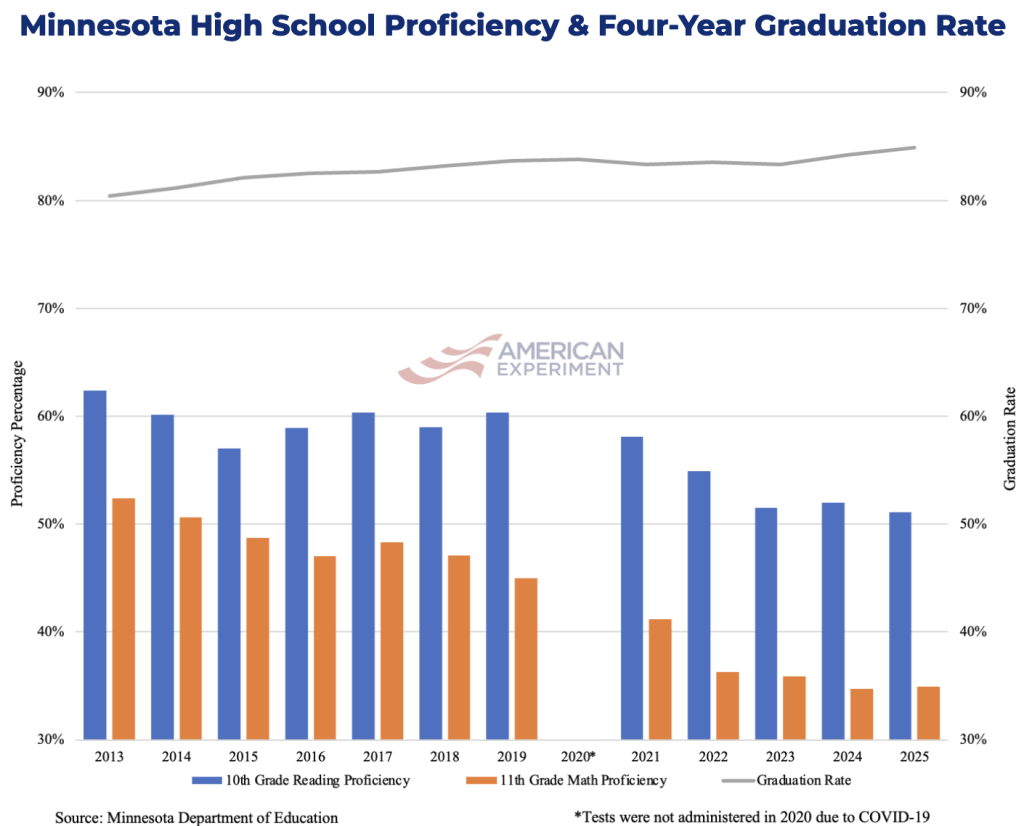
It wasn’t a one-year blip. High school reading and math proficiency has declined significantly since 2013, when high school exit exams were removed from graduation requirements.
MDE hasn’t yet put forth a statewide Portrait of a Graduate. Some districts, like Buffalo-Hanover-Montrose, or individual schools, like Wayzata High, have done so. If communities can make their Portrait of a Graduate a S.M.A.R.T. goal (Specific, Measurable, Achievable, Relevant, Time-Bound), then the vision-casting document may have some worth. Administrators should be careful; placing a portrait as a success metric can simply obscure declining academic norms.
But let’s be clear: Minnesota doesn’t have to return to high school exit exams to have high academic standards. Instead, schools need to be sent clear signals that their district and MDE expects (and supports) rigorous academics.
Those signals can take many forms. The easiest would be district-level grading reform, which should move away from no-zero policies and toward weighted end-of-course final exams in each class. Students wouldn’t be able to pass a course unless they can prove content knowledge on the final, maintaining academic rigor. Yet, overall course grades would also include other indicators of effort, like homework and project grades. The policy wouldn’t simply equate seat time with a diploma, nor would it unnecessarily punish students with high-stakes testing.
There are other pathways. Minnesota could copy North Dakota and experiment with team-taught classrooms, which allow students to receive leveled instruction based on their weekly needs. Students could once again participate in the symbolic gesture of passing a modified version of the US Citizenship examination before their high school graduation. Alternatively, after-school tutoring is a time-honored boost for academic achievement.
And, as my colleague Catrin Wigfall has often advocated, Minnesota could in fact review, revise, and reinstate high school final exams.
There’s no surprise that the majority of the states that have kept their exams (Florida, Louisiana, New Jersey, Ohio, Texas and Virginia) are also the states that are currently prioritizing significant education reform and high academic standards. Exit exams aren’t a panacea, but they are evidence of a state that prioritizes every student’s academic ability.
High expectations aren’t rude or inequitable. As Coffey points out, research shows that high expectations translate into more student learning — and that disadvantaged students are already more likely to receive assignments that aren’t challenging enough. We know that Minnesota’s public school system has a significant racial disparity problem, and erasing the transparency of exams just allows a struggling system to ignore the plight of its most needy students.
Minnesota can create a “Portrait of a Graduate” if it so chooses (education, after all, is about many types of formation) but it shouldn’t make New York’s mistake in believing that a portrait is the same thing as a standard.
A new, aspirational Minnesota portrait could include a statement that many graduates haven’t been able to say in recent years: “I can read and do math at a 12th grade level.”
Minnesota should redesign every classroom, question every assumption, and reexamine every policy until each graduate can say that.