The Becker Friedman Institute for Economics at the University of Chicago updated their landmark paper in July 2024 under the title, “Do Renewable Portfolio Standards Deliver Cost-Effective Carbon Abatement?” The original paper was published in November 2020.
The conclusion, by the two authors of Michael Greenstone and Ishan Nath, of this 77 page working paper, remains the same:
“Using a comprehensive data set…, we find that electricity prices are 11% higher seven years after RPS passage[.]” => Abstract
This is from authors who are not climate change sceptics, at a university who are no longer free marketers. Highlights follow next from this important academic paper, regarding the impact of state Renewable Portfolio Standards (RPS) on electricity prices.
Introduction
The authors expand below, on the conclusion in the abstract above, with their findings that renewables caused not just 11% electricity price increases 7 years later, but also 17% after 12 years. These increases were driven by unreliability, distance and displacement. These figures would be even higher still if not for the fact that, as per page 76: “we adjust for inflation in our dataset.” They rightly focus on prices over costs, as ratepayers pay prices in their bills.
This paper provides what we believe is the most comprehensive evaluation of RPS programs to date. A key part of any evaluation is the impact of RPS programs on electricity prices. The analysis begins with a conceptual framework that shows that simply comparing the cost of electricity generation between renewable and other sources will not capture the full costs of these programs. => Pages 1-2
A key challenge is that renewables are generally intermittent, so their installation must be accompanied by sources that generate electricity when the renewables are unavailable (e.g., when the sun isn’t shining or wind isn’t blowing). Additionally, they tend to be located away from population centers and cause the displacement of existing sources, both of which also introduce system wide costs. => Page 2
There are three key findings. First, electricity prices increase substantially after RPS adoption. The estimates indicate that in the 7th year after passage, average retail electricity prices are 1.4 cents per kWh or 11% higher, totaling about $31 billion of annual additional costs to consumers in RPS states. Twelve years later they are 2.3 cents, or 17%, higher. => Page 2
Context
The authors point out below that a majority of states have RPS, starting from 2000, and accounting for a majority of electricity generation in the US. These RPS start small then climb. Electricity prices start to rise from 2002 onwards, after declining from 1990 until then. I have also found that BLS and EIA data on these prices strongly suggest an inflection point of 2002.
While only Iowa, Nevada, and Connecticut passed RPS between 1990 and 1998, 27 states followed suit over the next 11 years and these programs now [in July 2024] cover 62% of electricity generation in the US. Figure 1 contains a map of the United States that indicates which states have enacted RPS programs, with the colors indicating the years of enactment. => Page 5
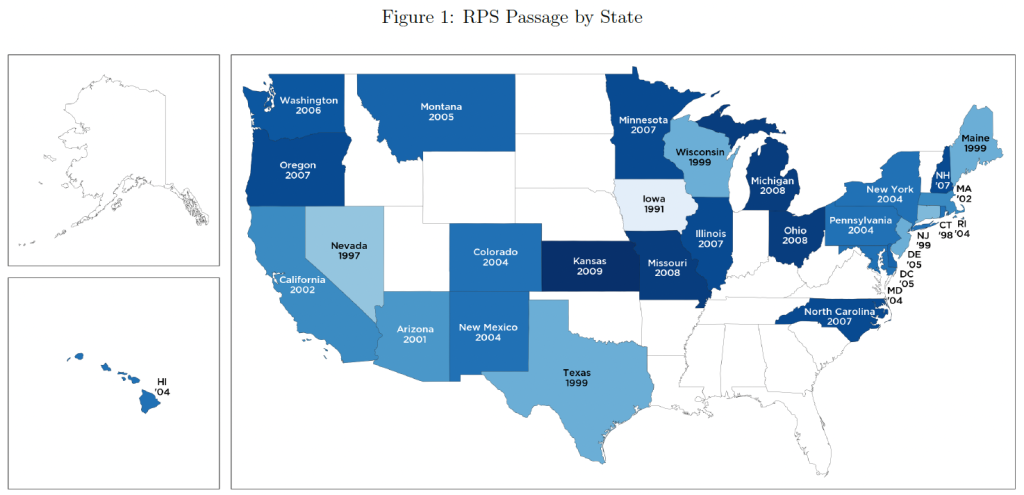
Most RPS programs require that retail electricity suppliers meet a percentage of demand with energy from renewable sources. Once in place, the standard typically increases along a predefined schedule until a specified fraction of renewable generation is achieved. They cover 82% of electric load in a state on average. In practice, the list always includes wind and solar. => Page 6
[T]he majority of RPS programs were enacted after 2000, loosely corresponding with a break in the trend of national electricity prices, which declined from about 14 cents per kWh to 12 cents per kWh from 1990 through 2002 but returned to 14 cents per kWh by the end of the sample in 2015. => Page 6
Framework
The authors confirm below what American Experiment has been saying for the past 8 years, that the Levelized Cost of Electricity grossly understates the economic costs of wind and solar. The key three costs missing from LCOE are intermittency, transmission and displacement. And, as any good economists should do, they focus on output prices over input costs. Plus, unlike most similar studies, they acknowledge these markets are dominated by, cost-padding and risk-passing, franchise monopolies, which are regulated by PUCs, who largely pass these costs and risks on to ratepayers.
Standard “levelized cost of electricity” (LCOE) estimates capturing the direct capital and maintenance costs of various generation sources provide an incomplete measure of the impact of transitioning electricity production to renewable sources on consumer prices. => Page 8
The model demonstrates how intermittency, transmission, and the displacement of existing capacity infrastructure interact to raise total costs. Notably, the model highlights the wide range of parameters and nontransparent data inputs that would be required to calculate these costs directly. The paper’s empirical procedure sidesteps this difficulty by summarizing the aggregate effect of these mechanisms through the reduced-form impact of RPS programs on retail electricity prices. => Page 8
For simplicity, the model assumes a vertically integrated setting with a single utility responsible for both power capacity and retail provision [including] the assumption that ratepayers always pay the full cost of installed capacity. The extent to which owners of capital bear the losses from excess capacity stranded by integrating renewable sources is one factor that contributes to the overall effect on retail prices. => Page 8
Results
The authors observe below that there were no significant policy differences on electricity prior to RPS, and that prices only started to consistently rise after RPS “by roughly 0.17 cents each year.” And that these prices rose as RPS requirements rose, and the former in a way disproportionately more than the latter. I found this too in Minnesota, even when RPS was voluntary from 2001 to 2006, before becoming compulsory from 2007 onwards.
There are two primary points that emerge. First, there is no evidence of a meaningful difference in price trends, either upwards or downwards, among adopting states in the six years preceding RPS program passages. Thus, for example, there doesn’t appear to be any evidence that prior to RPS passage, adopting states were differentially passing unobserved policies that influence electricity prices positively or negatively or facing differential cost shocks. => Page 20
Second, it is apparent that retail prices increased after program passages, but not all at once; the figure suggests that a model that allows for a trend-break describes the data well. It is striking that the trend in prices appears to very closely shadow the trend in net RPS requirements. The estimates indicate that retail prices are higher in RPS states post-passage, and rise by roughly 0.17 cents each year, with statistically insignificant pre-trends…or approximately $140 per person in additional annual electricity costs. => Page 20
This increase is statistically significant and economically substantial. Such a large increase in the retail price of electricity is striking, given the modest net requirements 7 years after passage. Further, these estimates are much larger than LCOE differences alone would indicate, suggesting that the indirect costs of RPS mandates are an important component of their total costs. => Page 20
Interpretation
The authors highlight below three more important issues over time of decreasing stranding risks, increasing intermittency costs, and distortionary renewable subsidies. The third issue is, however, very much understated by them. If not for subsidies and cross-subsidies, both here and abroad, the free market for wind and solar power would be minuscule indeed. As President Reagan once observed, “If you want more of something, subsidize it.”
There are several caveats and implications of the paper’s results that bear noting. First, the analysis is “reduced form” so we cannot assign precise shares of the RPS programs’ full costs to differences in generation costs, intermittency, transmission, and stranded assets. For example, it seems plausible that any stranded asset costs decline over time while intermittency costs increase as net requirements grow. => Page 34
Third, it is often claimed that policies encouraging renewable energy deployment contribute themselves to reducing the cost of future renewable generation. The coincidence of the global proliferation of policies that support renewable energy (e.g., China’s production subsidies and Germany’s embrace of renewable generation) and the decline in solar and wind prices over the last decade is consistent with the possibility of such spillovers. => Pages 34-35
Conclusion
The authors finish up below by pointing out there are still larger indirect costs associated with renewables, that being the negative impacts on market equilibria and grid integration.
A particularly striking finding is that RPS programs meaningfully alter electricity market equilibria. This effect, which has not been possible to comprehensively measure to date, appears to account for the majority of RPS program costs and benefits. => Page 35
It seems likely that the indirect costs, including intermittency, transmission, and stranded asset payments, account for a substantial fraction of RPS program costs. This finding raises the possibility that indirect costs associated with grid integration could represent the more important barrier to substantially increasing renewables’ share of generation than the direct cost of renewable energy. => Page 36
Perhaps this paper’s central contribution to projecting the costs and benefits of future policy is to highlight the importance of understanding the indirect effects of renewable energy and the viability of mechanisms to facilitate their grid integration. => Page 36
In conclusion, the authors show that significantly higher electricity prices are directly attributed to wind and solar renewables, across the country, wherever there is a Renewable Portfolio Standards (RPS). This should be of no surprise, given President Obama proudly warned in 2008 that under such climate plans “electricity rates would necessarily skyrocket.”