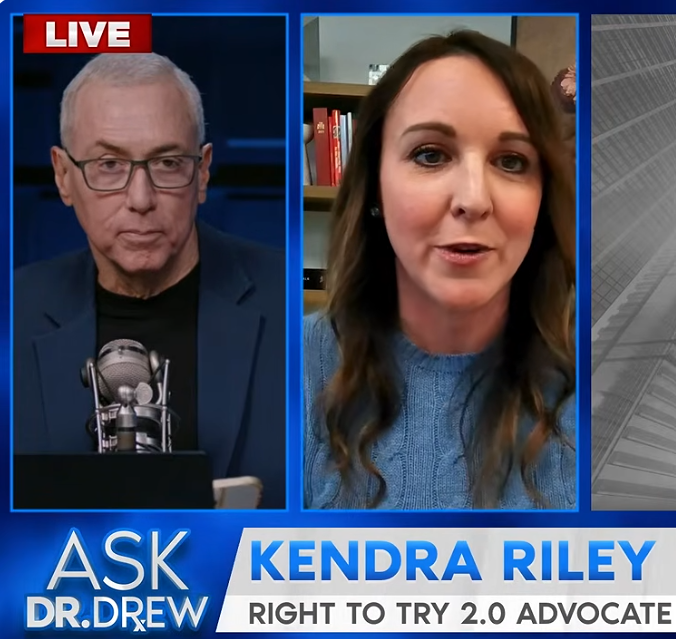
When it comes to offering hope to rare-disease patients, our nation’s “laws need to catch up with science.” That was Right to Try 2.0 advocate Kendra Riley’s message to board-certified internist and renowned media personality Dr. Drew Pinsky during her recent appearance on his livestreamed Ask Dr. Drew podcast.
Few people understand the promise of Right to Try 2.0 legislation quite like Kendra. In 2020, two of her daughters were diagnosed Metachromatic Leukodystrophy, or MLD, a rare and highly progressive genetic brain disease. But while her middle daughter, Livvy, is now in hospice at age 8, her youngest daughter, Keira, is healthy and thriving because they rushed her from Arizona to Italy for a life-saving treatment not available at the time in the U.S. Livvy was unable to receive the treatment.
“Given how fast this disease progresses, they said we need you here in a month or otherwise it’s going to be too late,” Kendra told Dr. Drew about traveling to Europe during the height of the Covid-19 pandemic to save her infant daughter’s life. “Keira was the 32nd kid in the world to have this treatment. She’s happy, healthy, going to school.”
Americans with rare and ultra-rare diseases should never be forced to flee the country to access potentially life-saving treatments. Under Right to Try 2.0, they’ll be able to get the individualized treatments they need right here.
Right to Try 2.0, landmark legislation introduced in Congress earlier this year, establishes a legal pathway for patients—like the Rileys’ daughters—to access gene-based therapies designed just for them without having to beg the government for permission.
Under the Goldwater Institute’s original Right to Try, which was enacted into federal law in 2018, terminally ill patients can access treatments that that are not yet approved by the FDA if they’ve completed initial clinical trials. But medical science has progressed greatly since then, opening the door to individualized, gene-based therapies that by their nature simply cannot get through the FDA’s outdated, one-size-fits-all regulatory framework.
Opening a pathway for rare-disease patients to access those treatments “seems like a reasonable idea in a free country,” Dr. Drew said of Right to Try 2.0.
Dr. Drew called Kendra’s story scary. “It’s got to be like one in 500,000 or something, right?” he asked of the chances that Kendra’s daughters would inherit the genetic mutation that causes MLD. “One in a million, actually,” Kendra replied.
Already, nearly 20 states have protections for accessing personalized medicine. “It’s been, I would say heartwarming, actually, to see the support we’ve had from both sides of the aisle since sharing our family’s story,” Kendra said. She said her fingers are crossed that Congress will soon make Right to Try 2.0 the law of the land.
“I don’t see how it can’t pass given what it could do for American rare-disease patients,” she told Dr. Drew. “It comes down to really just emailing or calling your state representatives and telling them how important this is and why it should pass, for not just children with rare diseases but for any American with rare diseases.”
Click here to learn more about Right to Try 2.0.