Minnesota’s 30th attorney general doesn’t get a lot of love on this website, nor should he. However, Keith Ellison might have done something right for a change last month. According to the Minnesota Reformer on August 24, 2026:
Minnesota Attorney General [AG] Keith Ellison and the Citizens Utility Board of Minnesota [CUB] filed separate petitions saying, in effect, that the Minnesota Public Utilities Commission [PUC] improperly increased Xcel’s authorized return on equity [ROE] this summer following a rate case proceeding that began in November 2024.
Or in the words of the Office of the Attorney General—Residential Utilities Division (OAG):
The OAG respectfully requests that the [PUC] reconsider its decisions to set Xcel’s ROE at 9.6%, create a tracking account and annual true-up for pension expenses, and use the governor’s authorized 2026 salary to cap recoverable executive compensation for both the 2025 test year and 2026 plan year. The fundamental problem with all of these decisions is that they will result in unjust and unreasonable rates.
What follows next are some highlights from, and comments on, the ROE-related aspects of OAG’s “Petition For Reconsideration” to the PUC “In the Matter of Xcel Energy for Authority to Increase Rates for Electric Service in the State of Minnesota.”
Background
Xcel filed a multi-year rate plan for the years 2025 and 2026. The [PUC] heard this rate case on June 11 and June 18, 2026, and issued its order on July 31, 2026. In that order, the [PUC] raised Xcel’s ROE from 9.25% to 9.6%[.]
I attended these two hearings in person on June 11 and June 18, 2026, and then documented my experiences on June 24 in the article entitled The PUC: the ‘black box’ of electricity inflation, where I wrote, amongst many other things, that:
Even though I am an economist, who is a very experienced in public utilities regulation in other jurisdictions (as well as, to some degree, in accounting, finance and law), I found the whole affair a bit of a “black box.” Cambridge English Dictionary: “a system that produces results without the user being able to see or understand how it works.”
Grounds
The [PUC] may grant a petition for reconsideration if it “appear[s] that the original decision…is in any respect unlawful or unreasonable.” [Minn. Stat. § 216B.27, Subd. 3.] The [PUC] has denied petitions for reconsideration if they “do not raise new issues, do not point to new and relevant evidence, do not expose material errors or ambiguities in the…order, and do not otherwise persuade the [PUC] that it should rethink the decisions set forth in its order.” [Docket E-015/GR-16-664 on May 29, 2018]
I am no lawyer, but it seems to me that the relevant law for applying to the PUC for a rehearing is not § 216B.27, Subd. 3 but instead § 216B.27, Subd. 1. If a rehearing is granted then Subd. 3 becomes relevant. These two provisions state as follows.
Subdivision 1. Applying for rehearing. …any party to the proceeding and any other person, aggrieved by the decision and directly affected thereby, may apply to the commission for a rehearing in respect to any matters determined in the decision. The [PUC] may grant…if in its judgment sufficient reason therefor exists.
Subd. 3. Rules; procedural requirements; commission’s authority. … In case a rehearing is granted the proceedings shall conform as nearly as may be to the proceedings in an original hearing, except as the [PUC] may otherwise direct. If in the [PUC’s] judgment, after the rehearing, it shall appear that the original decision, order, or determination is in any respect unlawful or unreasonable, the [PUC] may reverse, change, modify, or suspend the original action accordingly.
Details
Xcel came into this rate case with an approved ROE of 9.25%. Xcel proposed increasing its ROE to 10.3%, whereas intervenors proposed ROEs of 8.96% [Xcel Large Industrials (XLI)], 9.00% [Citizens Utility Board (CUB)], and 9.25% [MN Department of Commerce (DOC)]. The Administrative Law Judge [ALJ] recommended an ROE of 9.8%. The [PUC] rejected all of these numbers, settling instead on an ROE of 9.6% at the June 18 hearing.
Properly forecasting a ROE, be it an allowed regulatory one or an expected commercial one, is no small exercise, be it in MN, the US or around the world. However, the following three publications provide some important context to the rates above.
- NYU published, in January 2026, PUC-relevant industry ROEs of: “Cable TV” 11.06%; “Coal & Related Energy” -2.51%; “Green & Renewable Energy” -7.36%; “Oil/Gas (Integrated)” 9.96%; “Power” 12.40%; “Telecom. Services”19.82%; “Transportation (Railroads)” 29.07%; “Utility (General)” 10.42%; “Utility (Water)” 10.28%; and “Total Market” 17.21%.
- Frontier Economics estimated a range of ROEs, in November 2024, for an electricity transmission company regulated by Ofgem in the UK: 4.57%; 5.49%; 6.35%; and 7.14%.
- Aii released a new report on July 7, 2026 that found that “that both requested and authorized electric utility ROEs have trended downward rather than upward over the past two decades.” Figure 3 from page 5 of that report is reproduced below.
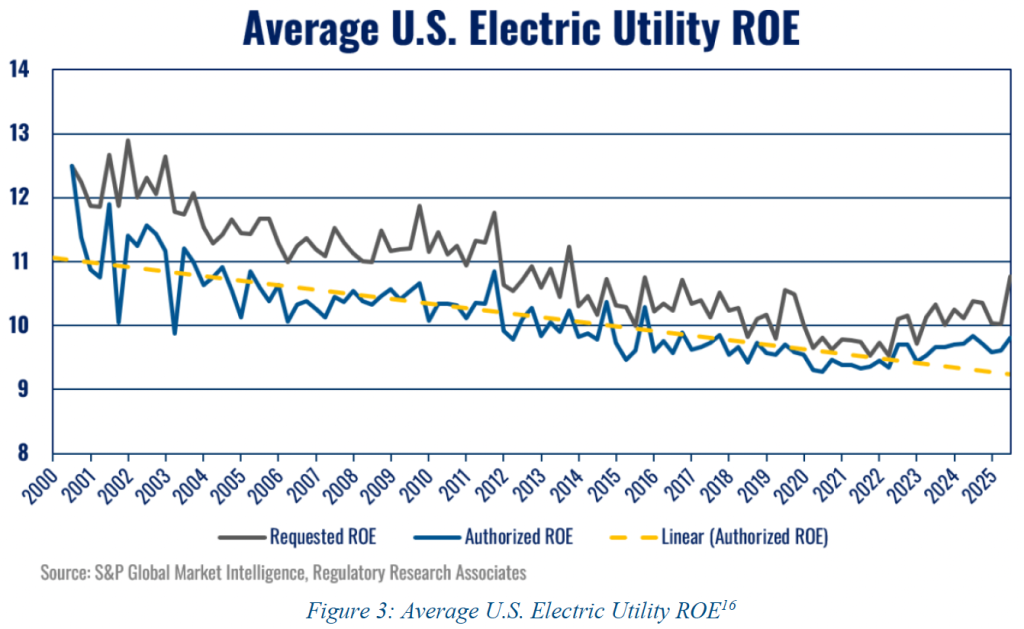
Source: New Aii Report Finds Utility ROEs Have Trended Downward from July 7, 2026
The [PUC’s] order states that an ROE of 9.6% is well-supported by the record but does not explain how [they] arrived at…or what evidence supports this determination. The…decision to increase Xcel’s ROE from 9.25%…is unsupported by substantial evidence[.] Substantial evidence is “1) such relevant evidence as a reasonable mind might accept as adequate to support a conclusion; 2) more than a scintilla of evidence; 3) more than ‘some evidence’; 4) more than ‘any evidence’; and 5) evidence considered in its entirety.” On June 16, [PUC] Staff filed consolidated decision options that included a new proposal for a 9.6% ROE.
The PUC did make publicly available, for the June 18 hearing, a 84 page Staff Briefing Paper on the “Cost of Capital,” with pages 11 to 66 on the “Cost of Equity.” Given this, it is hard to envision the PUC, at first instance, judging that there is “sufficient reason” for a rehearing.
The [PUC’s] decision to set Xcel’s ROE at 9.6% is also arbitrary and capricious because it does not appear to have been the product of reasoned decision-making. First, there were procedural irregularities that led to the determination of a 9.6 ROE. That the [PUC’s] selection of an ROE was based on an 11th-hour proposal that lacked record development…strongly suggests this decision was the product of the [PUC’s] will rather than its judgment. Second, the [PUC] failed to explain how a 9.6% ROE would result in just and reasonable rates. An agency decision is arbitrary and capricious if it does not articulate a rational connection between the facts found and the choice made.
The OAG’s case here for obtaining a rehearing from the PUC, and being successful in that, appears to be stronger. Minn. Stat. § 216B.03 and § 216B.52 are worth noting in this regard.
216B.03 REASONABLE RATE. Every rate made, demanded, or received by any public utility…shall be just and reasonable. … Any doubt as to reasonableness should be resolved in favor of the consumer.
216B.52 APPEAL. Any party to a proceeding before the commission or any other person, aggrieved by a decision and order and directly affected by it, may appeal from the decision and order of the commission in accordance with chapter 14.
Conclusion
Despite Keith Ellison’s terrible record as AG, such is on fraud, crime and terror, I was hoping for a “slam dunk” case for stopping any additional electricity rates inflation in Minnesota. Unfortunately, the AG’s case appears to be a bit weak.
However, the bigger issue is the capital base (Rb) that ROE and depreciation (D) are applied to. The regulated rates formula further below confirms that, as does RMI in the ROE Reform webpage of their Electricity Affordability Toolkit website, which states:
Customers will experience immediate bill savings from the reduction in ROE, but the longer-term cost savings coming from reduced capex bias will take longer to materialize.
The prime mover of “capex bias” in Minnesota electricity rates, since 2002, was the rapid rise in renewables. These are expensive and inflationary, unreliable and unsustainable, as well as increasingly unpopular. Compared to that, ROE is a side show to “longer-term cost savings”.

Source: The PUC: the ‘black box’ of electricity inflation in American Experiment News on June 24, 2026

Source: Minnesota Attorney General Keith Ellison calls his opponent’s supporters “bigots and racists” in Alpha News on September 22, 2026