In 2025, New Mexico became the first U.S. state to offer universal childcare. In Minnesota, the DFL could push for a similar policy during the 2027 legislative session. To illustrate what this could specifically mean for taxpayers, I estimate the program’s cost.
Ultimately, the cost of universal childcare depends on several factors, such as overall enrollment and type of care. However, even under the most conservative assumptions, universal childcare would cost at least $1.7 billion a year for kids under 5. Under a larger Nordic-style program, costs exceed $3 billion a year. Including wrap-around care for school- age kids, Minnesota could spend over $6 billion a year.
Cost estimates: Children under 5
Nordic countries are generally the worldwide model for universal childcare. According to data published by the Organisation for Economic Co-operation and Development (OECD) — a coalition of several developed countries, including the U.S. — in 2023, Nordic countries enrolled over 90 percent of all children between 3 and 5 in early childhood education programs. Among younger children, slightly over half participated in daycare programs.
To achieve a Nordic-style universal program, Minnesota would have to fund at least 70 percent of all children.
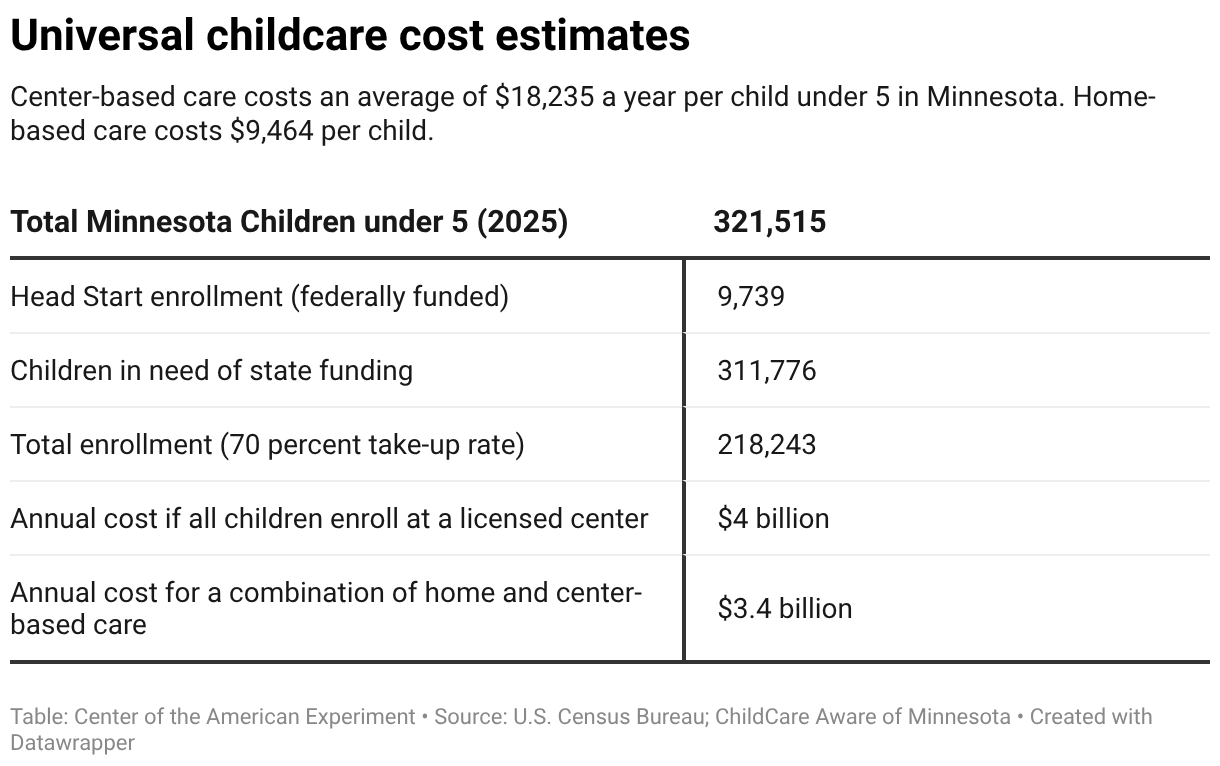
There were 321,515 children under 5 in Minnesota in 2025, according to the U.S. Census Bureau. Excluding the 9,739 children enrolled in federally funded Head Start leaves 311,776 in need of state funding. At a 70 percent take-up rate, 218,243 would enroll in Minnesota’s universal childcare program.
According to ChildCare Aware, center-based care costs an average of $18,235 per child under 5. Licensed centers account for 69 percent of all childcare slots in the state. Home-based care costs $9,464 per child and accounts for 31 percent of all capacity. Splitting total enrollment between these two types of care results in an annual cost of $3.4 billion. If childcare becomes more institutionalized and all children enroll in a center-like setting — which has been a goal of some advocates — costs would rise to $4 billion a year.
Historically, parents of younger children have preferred informal care arrangements. This, coupled with a shortage of slots, could translate into lower enrollment rates, similar to those seen in some developed countries and other U.S. programs.
For instance, New Mexico’s no-cost childcare enrolled an estimated 45,736 children up to age 13 this year. This is slightly under 15 percent of all eligible children. Kids under 5 made up more than half of total enrollment, but only 27 percent of eligible children in that age group are receiving assistance.
Across the OECD, 85 percent of children aged 3 to 5 are in daycare. Only 21 percent of younger children participate in early education programs.
Accordingly, studies that have modelled the cost of a universal childcare program in the U.S. have utilized low take-up rates. A 2021 study by Penn Wharton Budget Model, for example, assumes a 49 percent take-up rate for 3- and 4-year-olds. For children under 3 — where shortages are most evident — the take-up rate is 23 percent.
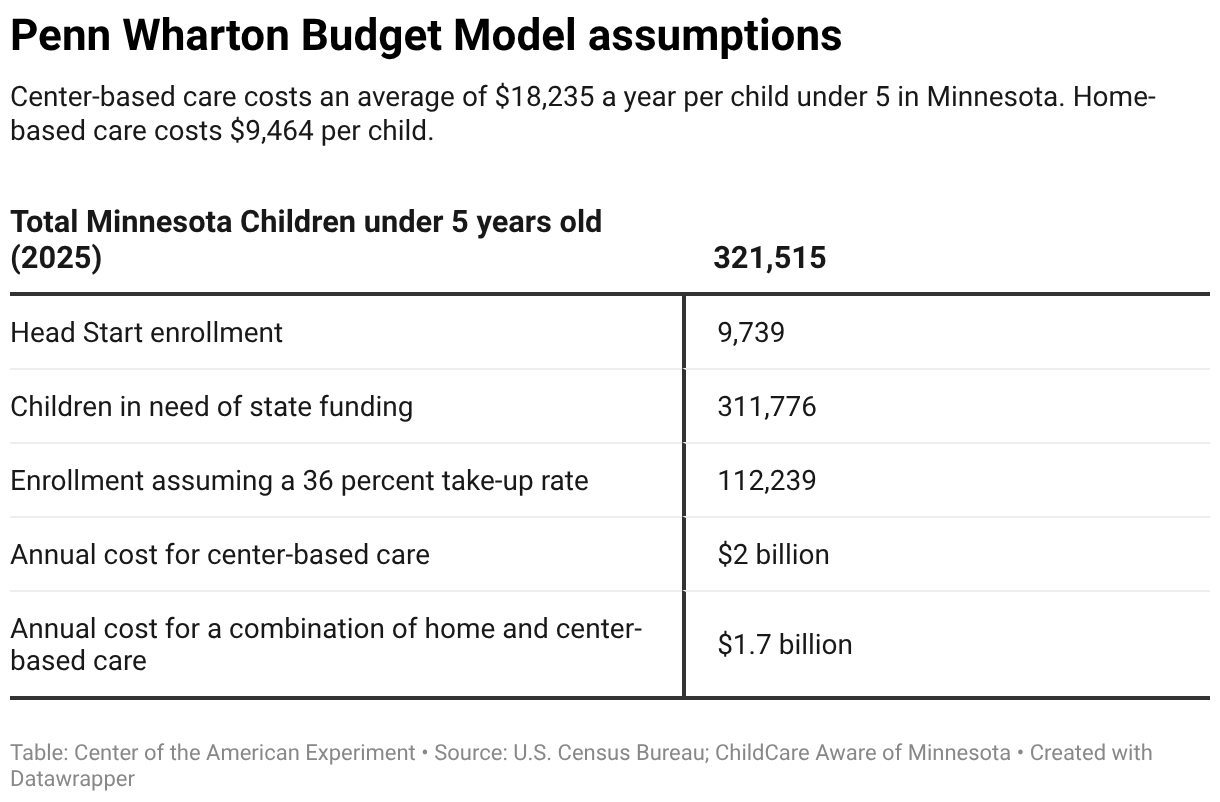
Because New Mexico’s program is new, and peak enrollment is yet to be observed, I use assumptions from the Penn Wharton model to estimate costs under different conditions. Assuming a 36 percent take-up rate (the average of 49 and 23), about 112,239 children enroll in Minnesota’s universal childcare program.
Splitting children between home and center-based care results in a total annual cost of $1.7 billion. Costs rise to $2 billion if children exclusively utilize center-based care.
Cost estimates: children between 5 and 13
School-age children only require childcare before or after school and during the summer holiday. Childcare for school-age children is also generally cheaper due to less stringent child-to-staff ratios. Nevertheless, extending the program to children aged 6 to 13 more than triples the eligible population, adding billions to the program’s cost.
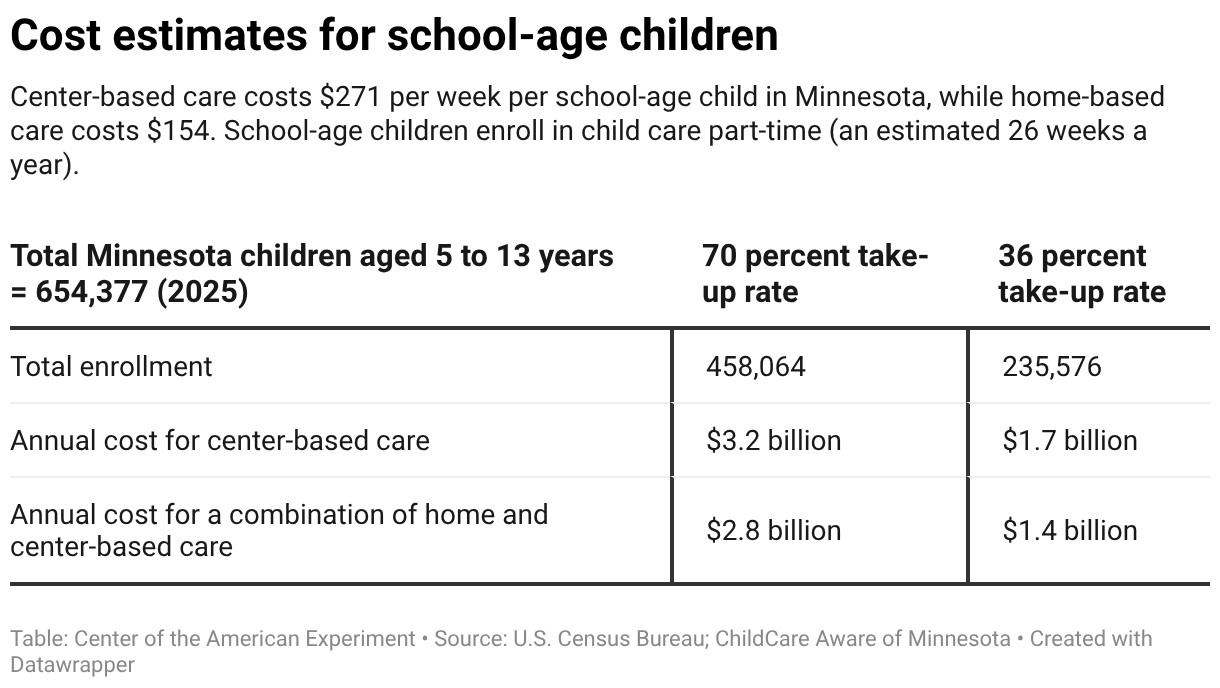
Assuming a 70 percent enrollment, Minnesota would need to fund over 450,000 school-age children. If this group utilizes half as many weeks of childcare per year as younger kids (26 weeks out of 52), it adds an extra $2.8 billion to the program. Assuming a 36 percent take-up rate, 235,576 children enroll, for an annual cost of $1.4 billion.
For center-only care, the school-age population would add $1.7 billion to the program, assuming a 36 percent take-up rate. On the high end, they would add $3.2 billion, assuming a 70 percent take-up rate.
Even oil- and gas-rich New Mexico can’t make the math work
Altogether, a universal program open to all children up to 13 would cost between $3.1 billion and $6.2 billion a year, eating up 9 to 17 percent of the entire state budget. Funding it would require potentially over ten times what the state currently spends on childcare, and trigger massive, damaging tax hikes, especially since the state is already running on a multi-billion structural deficit.
But even states with deeper pockets cannot make universal childcare work.
New Mexico, for instance, is awash with cash given its booming oil and gas industry. In theory, this makes it among the few states that should be able to absorb the costs of an expansive childcare program. Yet the state has not escaped the fiscal difficulties associated with such an undertaking.
As of August this year, two state officials have filed lawsuits alleging they were fired for pointing out that the program was running up to $83 million over budget. Furthermore, an estimate released by the state’s Legislative Finance Committee shows universal childcare could exceed $800 million a year at its peak — nearly $400 million above its initial projection.
According to the Pew Research Center,
in her 2027 budget, Governor Michelle Lujan Grisham (D) also asked lawmakers to raise general fund support for the ECECD, which will manage the universal child care program, to more than $465 million. That would have been a 54% increase from the previous year. Ultimately, the Legislature approved an 8% increase in general funding for a total of $326 million
This suggests that oil and gas trust funds won’t be enough to maintain the program. At the same time, general fund support is limited, putting the program’s future on shaky ground.
Even more telling, lawmakers know that the program’s price tag could balloon. So, they included guardrails to strip away its “universally free” status when fiscal pressures rise. Specifically,
if inflation rises, the price of oil falls below a certain threshold, or demand for child care exceeds the availability of funds, the state will have the option of adding co-pays for families making over 600% of the federal poverty level.
If New Mexico can’t escape the math on universal childcare, Minnesota certainly won’t either.