In Governor Polis’ January state of the state address, he claimed that the Colorado oil industry was thriving. It wasn’t true at the time, and even with the high oil prices seen today, Colorado operators aren’t leaping into the permitting queue for new wells.
Colorado law has fundamentally reshaped the oil and gas industry. In 2019, SB19-181 redefined the mission of the state oil and gas commission from fostering oil and gas development to regulating it. The law gave local governments explicit surface-siting authority. In late 2020, a subsequent 2,000-foot setback from homes, schools, and child-care centers was implemented by the commission. A 2023 law went further, renaming the Colorado Oil and Gas Conservation Commission to the Energy & Carbon Management Commission (ECMC).
Colorado’s oil production peaked at 577,000 barrels of oil per day in November 2019, a mere 10 months after Governor Jared Polis (D) assumed office, and only seven months after SB 181 passed, and hasn’t recovered since. June 2026 production was only 445,000 barrels per day.
Permitting timelines of 230 to 250 days are par for the course in Colorado, versus a required 30-day turnaround time and an average timeline of just two days in Texas. In 2024, the permitting timelines stretched 257 days from submission to a hearing, and 297 days in 2025. According to the Denver Post, almost 15,000 well permits were approved between 2015 and 2018; only about 4,000 were approved from 2022 to 2025. Colorado’s regulations, “considered among the strictest in the nation, have dampened interest in investing in the state and increased the cost of business.”
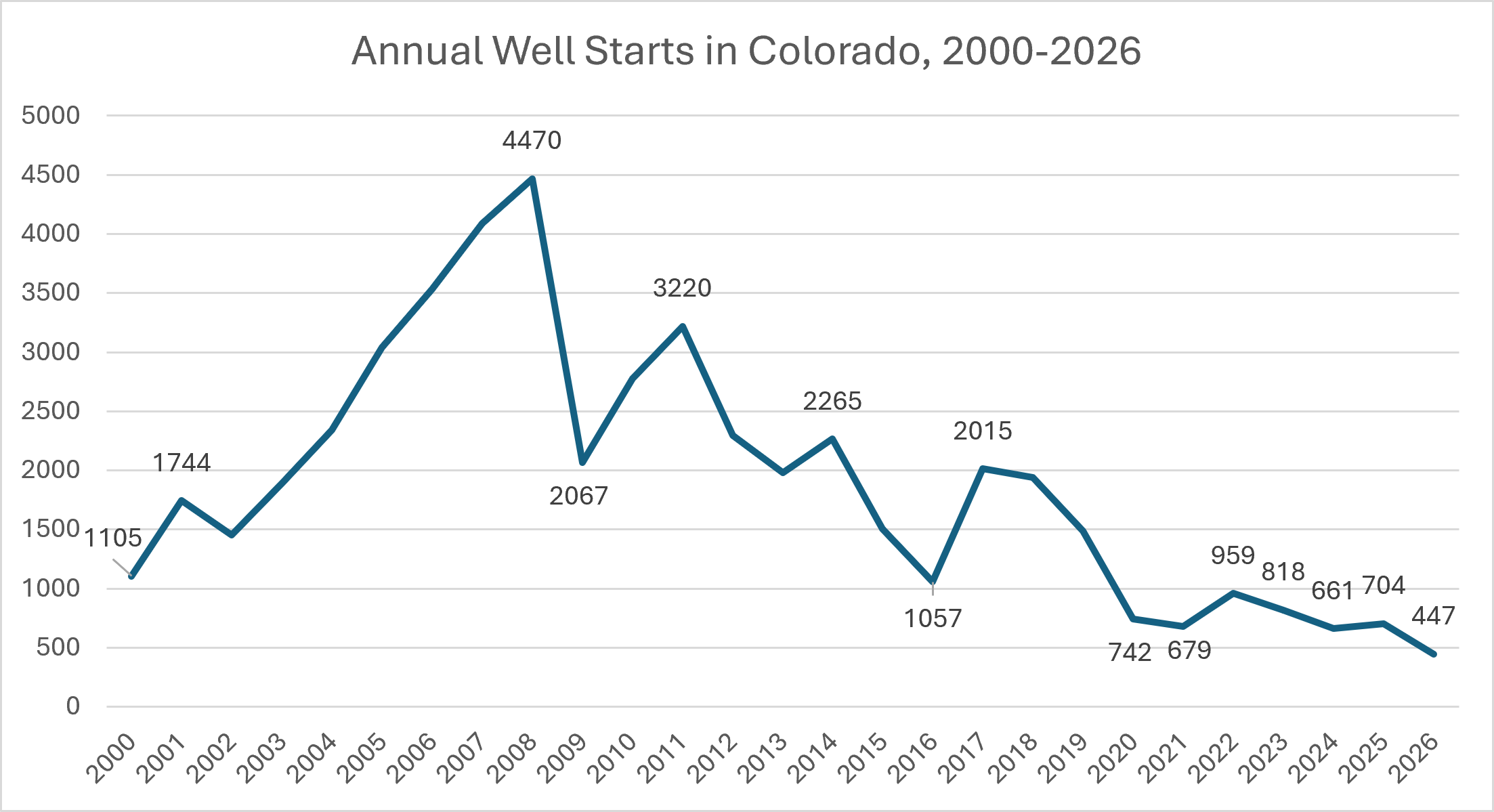
The ECMC website tracks annual well starts by county since 2000. Colorado well starts peaked at 4,470 in 2008 and fell by more than half in 2009, then fell again in the 2015-2016 price crash. In 2025, with Colorado crude averaging $64 a barrel, only 704 wells were started, a third fewer than in 2016, when it averaged $38. The total for 2026 is a partial year current to September 22, 2026.
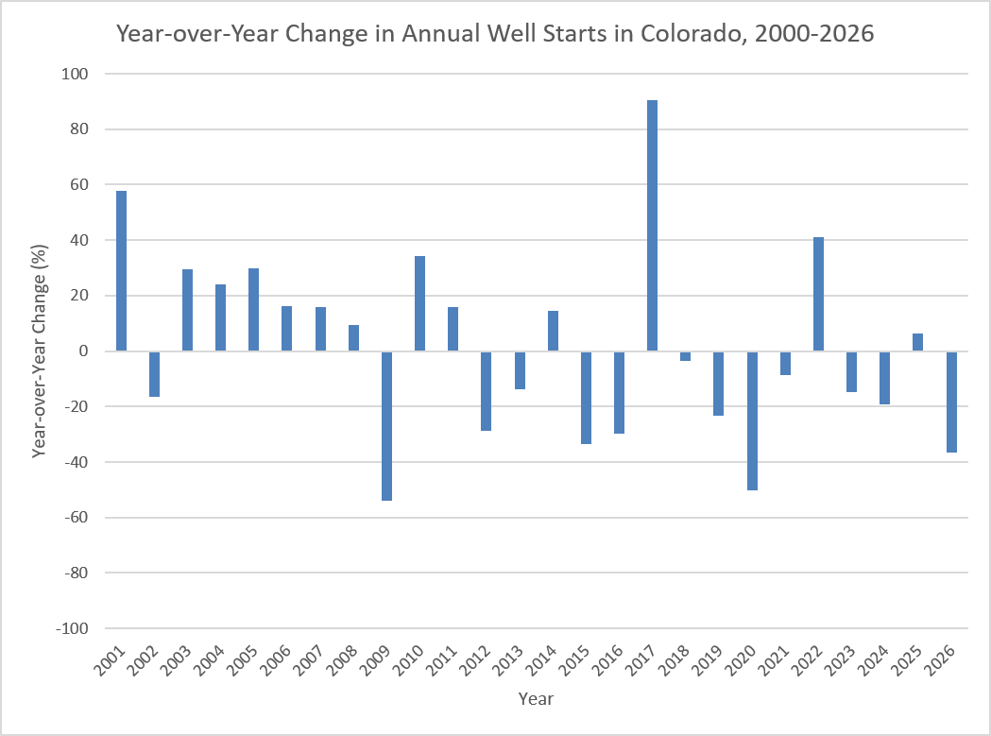
The year-over-year change in annual well starts shows that, for the most part, prior to SB19-181, Colorado drilling rebounded after every downturn. Starts rose 34 percent in 2010, after the 2009 collapse, and 90 percent in 2017 after two years of declines, when Colorado crude traded at $46. Since 2019, the only substantial rebound was a 41 percent increase in 2022, when Colorado crude averaged $92, more than double the 2016 price.
ECMC Director Julie Murphy has argued that declining well counts are in part attributable to longer, fewer laterals; that may be technological advancement, but “Colorado’s strict regulatory rules” is prompting companies to “get creative in drilling wells,” according to Enverus. Longer laterals haven’t kept production from falling 23 percent below its peak.
Increased costs of complying with SB19-181 favor companies large enough to absorb them. Before the law, the major Denver-Julesburg Basin operators were Anadarko, Noble, PDC, SRC, Extraction, HighPoint, Bonanza Creek, Great Western, and Crestone Peak. By 2023, all nine were absorbed into Chevron, Civitas, and Occidental, which made up almost three-quarters of Denver-Julesburg Basin production in 2024. (In January 2026, Civitas was merged into SM Energy Company). According to Enverus, the number of independent companies drilling at least 10 wells a year in the basin fell from about 20 in 2019 to six in 2025. Fewer operators mean fewer bidders for leases, which means less payoff for landowners.
Gov. Polis has said that oil prices, not state laws and regulations like SB19-181, are driving operator decisions. August 2026 overall crude oil prices averaged $84 per barrel, and in the week of September 18, 2026, averaged almost $104 per barrel. Yet the permitting timeline in Colorado means that operators must wait almost ten months to reach a hearing on submitted drilling plans. In Texas, operators have their permits in days. How can companies respond to price signals under these conditions?