
Crystal Taylor, Ph.D., AICP; Isla Riddell; Jose Collantes; and Mark Butler
DeVoe L. Moore Institute, College of Social Sciences and Public Policy, Florida State University
Table of Contents
Overview
The State of Florida, as well as the vast majority of its counties, have trended downward into housing shortages over the past de cade (Florida Housing Data Project 2025). Not having enough housing available to meet local demand has helped contribute to expensive home and rental prices as households compete for a limited supply. Starter homes, or smaller, more affordable homes, tend to be in high demand relative to inventory levels as new home buyers, middle-income households, and aging, downsizing house holds compete for a limited supply. During a housing affordability crisis, higher-income households also feel a financial pinch and may start putting in their bids for smaller, more moderately-priced homes.
Communities across Florida that are experiencing a housing shortage can promote home construction by loosening restrictive regulations and allowing for a broader array of housing types, unit sizes, and more flexible siting of structures on properties. For example, caps on housing development or stipulations concerning minimum or maximum standards have a significant impact on whether a city infills and grows taller in height or stays lower density and starts to sprawl, pushing growth outward toward rural lands. Local land use practices and regulations can serve as starters or nonstarters for expanding local housing supply and promoting affordability.
Florida’s local planning departments at the city and county levels regulate land by determining allowable uses for property, height and density standards, and the process for administering approvals. In Florida, applying for land permits to create new housing is often a “procedural maze” as the process and requirements vary widely by locality (Gardner and Cremer 2024, pg. 2). As the process can be quite complicated, this guide is intended to help clarify some commonly used land use and housing terminology.
This guide is broken into the following sections:
- Section A includes terminology related to the types of development that can be built by use.
- Section B includes terminology related to the height, density, bulk, shape, and size of the structure(s), as well as where a structure can be positioned in relation to the property lines.
- Section C includes terminology related to the local ad ministrative permit application and approval processes.
Specific building codes are not covered in this guide as the Florida Building Commission, and not the local planning departments, lays out the building code for how a developer or property owner can build structures. This guide will be the most helpful for understanding common land use terms and administrative processes related to local planning departments.
Regulating Types of Use
Zoning:
Based on standards passed down from the State (Gray 2022), local governments have the power to regulate local land use and create comprehensive plans along with maps with demarcated zoning districts to guide certain kinds of growth and development into predetermined zones or areas. If you look at most comprehensive planning maps for American cities, you will find that a majority of the map is zoned for housing. These zones group similar types of uses and compatible development together or near each other, such as a residential zone that groups single-family housing into the same neighborhood. Though not as prevalent as residential zoning, cities do incorporate pockets of mixed-use zoning where the first floor of a building is a commercial space and the additional stories serve as apartments or condos. This is more common in or around downtown areas or near universities. Tallahassee, Florida, the state capital and a college town, has 21 residential districts and eight mixed-use districts (City of Tallahassee Zoning Hand book 2022).
Upzoning:
Upzoning creates more flexibility within existing zones by allowing greater building heights and densities, as well as potentially expanding the scope of permitted uses. Due to ongoing housing concerns, the State of Florida enacted the Live Local Act to allow for affordable residential development in commercial zones as well as light industrial zones, and the Act was later updated to include religious spaces (Florida Legislature S.B. 102). This State-level preemption or enforcement of upzoning for commercial and industrial areas, to include residential housing, did not specifically apply to residential zones.
Form-Based Code:
Rather than traditional zoning that emphasizes what is not allowed with discrete land uses, form-based code helps communities paint a clearer image of what the developed structures may look like. Form-based code can help preserve neighborhood character while allowing land use to evolve organically as the city grows and land transitions to higher economic uses (Taylor, Staley, Roca-Paisley et al. 2023). Thus, fear about unknown or undesirable development (commonly referred to in planning as not in my backyard or NIMBY) can be somewhat mitigated with formbased code (American Planning Association 2017).
Starter Homes:
Starter homes generally get their name because of their size and affordability. Starter homes are typically more affordable and smaller than the median-priced single-family homes. The size of the homes are generally under 1,500 square feet (Nesbit et al. 2024) and typically contain two to three bedrooms. As affordable family homes, starter homes help first-time buyers enter the housing market. However, these homes might need fixing up (which can increase the actual overall cost for buyers). The nationwide price of a single-family starter home was $240,000 as of February 2024, but it varies by location (Brooks 2024). In Florida, Realtor.com listed the typical 2024 starter home at slightly over $360,000 (approximately $120,000 more than the national price).
Starter homes can be the first home that families stay in for a few years. However, these starter homes could turn into a forever home if the household stays there for a substantial period of time. Though some households prefer single-family homes, other house holds are not able to afford this type of home or may not have a lifestyle that is conducive to a stand-alone house with a yard. To meet growing housing demands and to accommodate changing preferences, housing can be defined more broadly than the single-family detached home to include the following single-family attached homes: duplexes, triplexes, quadplexes, townhomes, and accessory dwelling units (ADUs). Expanding the scope for types of single-housing structures that can be built is a form of upzoning.
Accessory Dwelling Units (ADUs):
An ADU is short for an accessory dwelling unit. It is an independent residence located on the same lot as a different home. ADUs have different names, such as accessory apartments, secondary suites, or granny flats, and can help affordability by in creasing supply. Examples of ADUs include granny flats located in the backyard or an apartment-style unit over a garage which is independent of the main house but is on the same lot (American Planning Association n.d.).
Planned Unit Development (PUDs):
A Planned Unit Development (PUD) allows developers more flexibility than traditional zoning for large tracts of land for residential and non-residential development. PUDs can incorporate mixed-use land uses and housing clusters in order to take into account the topography of the natural landscape and offer a wider array of housing types (American Planning Association 2009). The use of PUDs to create new housing is quite popular in Florida. However, local governments often charge an array of fees or ask for negotiated concessions related to the impact of the proposed PUD (Gardner and Cremer 2024.
Area Median Incomes (AMIs):
Area Median Incomes (AMIs) are a measure of the midpoint in come distribution of a particular regional area. That area generally includes the metropolitan area, suburbs, and exurbs, which are areas that are farther out but still connected to prominent urban cores (Planetizen Area Median Income). The Department of Urban and Housing Development uses income thresholds of low-income (below 80% of the AMI), very low-income (below 50% of the AMI), and extremely low-income (below 30% of the AMI) to help determine household housing affordability. AMIs are also used to determine eligibility for many local housing programs, including home repairs.
Single-Family Homes (SFHs):
Homeownership is a significant financial milestone for American households, though rising prices and skyrocketing interest rates present major obstacles for prospective single-family home (SFH) homebuyers. Looking at the SFH ownership portfolio across the United States in June 2025, the American Enterprise Institute reported 86.6% of SFH are individually owned, 10.8% are small “mom-and-pop” investors who have 2-9 units, 1.6% are small investors who own 10-99 units, 0.4% are institutional investors who own 100-999 units, and 0.5% are large institutional investors who own 1,000 or more units. Research from the Journal of Real Estate Economics found that institutional investors who owned 100 or more properties did contribute to a small but significant rise in SFH values in surrounding areas when compared to individual homebuyers (Ganduri, Xiao, and Xiao 2023). However, institutional investors are a relatively small part of the SFH market compared to the growing share of small mom-and-pop investors.
Single-Family Rentals (SFRs):
Institutional investors and small mom-and-pop investors can list single-family homes as single-family rentals (SFRs). These SFRs serve an important role for young families and households who do not have the financial resources to purchase a home or may not yet have settled on a long-term location to call home. Whereas small “mom-and-pop” style investors might add one rental property to their portfolio at a time, institutional investors are likely to purchase homes as part of a large batch sale and are in a better position to finish abandoned or incomplete PUD projects than individual households or small investors.
Build-to-Rent (BTR):
Institutional investors may also create build-to-rent (BTR) communities. Instead of purchasing existing housing stock, BTR projects are new housing developments specifically designed to operate as rental communities or may include rent-to-own options. Florida is listed as the leader in BTR projects in the Southeastern United States, with the Orlando metropolitan area currently positioned as the seventh top BTR city in the nation (Hopulele 2026).
Regulating Height, Density, and Positioning
Lot Size:
Lot size, measured in acres or square feet, refers to the total area of a land segment that is developed for a specific property. A minimum lot size refers to the smallest amount of land allotted for development in a zoning district. These minimum-lot-size requirements result in decreased population densities, a lack of variety in lot sizes, and increased housing costs (American Planning Association 2019). Florida’s lot sizes are about 11,043 square feet per home, which is lower than the US average of 25,240 square feet (Moore 2022). Large lot sizes can be used to preserve low density semi-rural or suburban character of an area (American Planning Association 2019).
Density and Height Restrictions:
Density represents the number of developed units within a defined area. Within a parcel, lot, or within a building, developed units can represent a variety of urban zoning categories which include but are not limited to residential, employment, and population. For example, residential density is determined by the ratio of dwelling units per acre (Planetizen Density). In Tallahassee, Florida, R-1 Single-Family Detached Residential Districts caps the maximum density to 3.63 dwelling units per acre (City of Tallahassee Zoning Handbook 2022). Local governments can also put a cap on height by number of stories or number of feet.
Setbacks:
A setback is the minimum distance required between a building and a property line, typically established through zoning ordinances or building codes. This property line can be on the front, back, or side of a lot. Setbacks are intended to ensure space for things like egress, natural resource protection, and overall city planning objectives (Lands For You 2024). Smaller lot parcels require more land to be reserved for setbacks. A criticism of setbacks is forced land overconsumption, in addition to land consolidation and increasing the distance between places (Price 2017).
Floor Area Ratio (FAR):
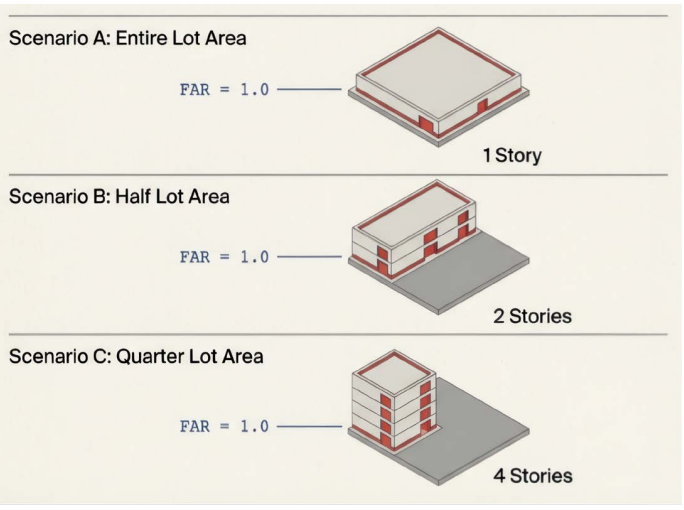
These are essentially a property owner’s development rights or their buildable square footage in relation to their lot coverage. If more of the lot or yard is left open or without a structure, the property owner should, in theory, be allowed to build higher. Figure 1 illustrates the Floor Area Ratio of 1.0 showing lot coverage based on the scenario of a one-story, two-story, and a four-story building. A one-story 1,500 square foot starter home on a 10,000 square foot lot would be 1,500/10,000 = 0.15 FAR. Anything over FAR of one means there will be multiple stories to the structure.
Minimum Parking Requirements:
Parking minimums require developers to include a minimum number of parking spaces; a number that is often arbitrary. Parking minimums force many households to pay for parking facilities that they do not need or use, which increases total housing costs, sprawl, traffic, and environmental problems (Litman 2025). Some cities have implemented maximum parking standards, which set a limit on the number of parking spaces allowed (Hanson, Rosen bloom, and Duerksen 2018).
Figure 1. Floor Area Ratio of 1.0 showing lot coverage for one-, two-, and four-story buildings.
Lot Split or Division:
A lot split is when a property owner divides one piece of property into two lots. In contrast to a split, two adjacent pieces of property can also be consolidated by removing the dividing lot line. Though a lot split specifically creates two separate lots, the term is commonly used to refer to either a) a partition where a lot is divided up into three or fewer lots or b) a subdivision where land is divided into four or more lots (Davidson & Dolnick 2004, p. 242). In addition to dividing and consolidating lots, property owners may also apply for an adjustment as a request to move a lot line as long as no additional lot is created. Streamlining the process for splitting and consolidating lots can create more flexible infill housing opportunities within cities.
Administering Land Use and Zoning Regulation
As part of the zoning code, certain types of uses are listed as permitted, conditional, or accessory uses. Local governments may permit or limit development by-right, by administrative staff review, or by commission. Whether a property owner can build a duplex or townhome next to single-family homes depends on the zoning code, whether duplexes and townhomes are included by right, if the use may be considered as part of a special request, if the use could be compatible with the future comprehensive plan, or if that type of use is prohibited.
By-right or As-of-right:
Permitted uses are the property owner’s rights or privileges related to their use of the land or ability to build on the land. By-right implies that the approval process for development is streamlined. Thus, any project that complies with the zoning code receives approval without a discretionary review process (American Planning Association 2017). By-right development for housing promotes housing production by streamlining the regulatory process, reducing timelines and costs. Most development in the U.S was by-right through World War II (Gray 2022). Though by right zoning can help promote housing production by streamlining the process, communities do push back on the idea of by-right zoning out of concern for the unknown for what could potentially be built. If local governments paint a clearer vision of what can be built (using form-based code), rather than clarifying what is prohibited, by-right permissions could help infill gaps in the housing supply (American Planning Association 2017).
Administrative Staff Approval:
Planning staff may internally review proposals for new development or changes to existing development. If the project fits into an accessory use, no external panel, hearing, or commission meeting may be necessary. Administrative staff review means the permit application review can be completed in-house and a decision can be made based on the discretion of the city or county administrative planning staff. Entry-level planners are often tasked with handling permit approvals and conducting reviews. In fact, a survey of planning agencies published in the Journal of Planning Education and Research from the mid-2000s reported that entry-level planners spend about 50% of their time processing permits and conducting reviews (Anthony & Forkenbrock 2006). New or rotating staff may serve in a help-desk role (Gray 2022) to help demystify the permit approval and review process. Though if the staff is new, the permit applicant may have more experience with the administrative process than the administrative staff. As approvals are discretionary, different staff may offer different guidance, so local governments need to strive for consistent messages and leave detailed notes in an effort to avoid conflicting information. Permit applicants should keep their own logs of interactions with staff and obtain clarifications for any unclear requests. As the process can be time-consuming and therefore cost-prohibitive for development, planning agencies have started to publicly list expected and real-time timelines for processing applications.
Commission Reviews and Public Hearings:
“Florida has never adopted a state law providing a uniform procedural process for processing, approving, and holding hearings on quasi-judicial land development applications or for reviewing the decisions made at those hearings” (Gardner and Cremer 2024, p. 2). Developers or property owners may have to request a rezoning, a variance, or a special permit when land use requirements are restrictive in terms of the type of use, as well as how large or small homes can be in relation to the lot size. This means the request must undergo a commission review and public hearings for any rezoning (e.g. upzoning from single-family only zoning to also al low for duplexes, triplexes, and quadplexes), or a height or setback variance (e.g. waiving setback requirements would allow a house to be located closer to a lot line than the code presently allows), or a discretionary use (e.g. constructing housing as part of a Planning Unit Development. Undergoing a review and public hearings for permits can add months and years to a project timeline (Gray 2022). Sometimes disagreements over land use decisions can escalate between property owners and local governments to the point where these disputes are challenged in court, adding years and expense to potential projects.
Closing
Just as households are unique and vary in size, finances, and preferences; homes do not need to be confined so rigidly to only certain neighborhoods in urban, suburban, or rural areas. Moreover, communities can cater to a broader range of incomes, lifestyles, and ages by including more creative and expansive housing design styles on a wider selection of lot sizes. This may take a shift from looking at land use regulation as merely a way to restrict uses and instead as a tool to help communities paint a vision for the types of structures and designs that are welcome. Providing that clarity would be a step forward towards demystifying the complicated permit review and approval process. As a necessary and expected part of the planning process, cities and counties should continue to revisit and revise land use regulations and policies to consider current and future growth needs. In closing, whether local governments are promoting policies for the expansion of housing supply or discouraging the creation of certain types of housing is often captured within the details of the regulations as design flexibility or rigidity.
Find the full policy brief here.
Bibliography
American Planning Association. n.d. “Accessory Dwelling Units,” accessed December 1, 2025 at https://www.planning.org/knowledgebase/accessorydwellings/
American Planning Association. 2009. “Quicknotes: Understanding Planned Unit Development.” PAS QuickNotes 22, accessed at https://www.planning.org/publications/document/9007619/
American Planning Association. June 2017. “Getting By-Right Zoning Right for Communities in Crisis” The Commissioner, Vol. 23, No. 3, accessed at https://planning-org-uploaded-media.s3.amazonaws.com/publication/download_pdf/commissioner-2017-06-jun.pdf
American Planning Association. 2019. “Minimum Requirements for Lot and Building Size,” accessed at https://www.planning.org/pas/reports/report37.htm
Anthony, Jerry, and David Forkenbrock. 2006. “Land Use Law in Planning: Practice and Pedagogy.” Journal of Planning Education and Research 26:80-9, accessed at https://doi-org.proxy.lib.fsu.edu/10.1177/0739456X0628809
Brooks, Khristopher. 2024. “Here’s How Much You Have to Make to Afford a Starter Home in the U.S, CBS News.” CBS News, accessed at https://www.cbsnews.com/news/home-prices-buying-a-starter-home/
City of Bothell, WA. n.d. “Floor Area Ratios.” Municipal Code, accessed January 5, 2026 at https://bothell.municipal.codes/BMC/12.14.133
City of Tallahassee, Growth Management Department. Nov. 2022. Zoning Handbook, version 1.0. 2022, accessed at https://www.talgov.com/uploads/public/documents/growth/zoning_handbook.pdf
Davidson, M. & Dolnick. F. 2004. “A Planners Dictionary.” American Planning Association, accessed at https://planning-org-uploaded-media.s3.amazonaws.com/publication/download_pdf/PAS-Report-521-522.pdf
Department of Housing and Urban Development (HUD). Office of Policy Development and Research. 2025. “Income Limits,” accessed at https://www.huduser.gov/portal/datasets/il.html
Florida Housing Data Project, “Florida County Housing Data,” DeVoe L. Moore Center Housing Affordability Initiative, College of Social Sciences and Public Policy, Florida State University in partnership with the Florida Policy Project and Reason Foundation, November 13, 2025, accessed at https://florida-housing-data-project.reason.org/report
Florida Legislature, “Live Local Act” SB 102, (2023, modified by S.B. 328 in 2024), accessed November 13, 2025 at https://www.flsenate.gov/Session/Bill/2023/102
Ganduri, Rohan, Steven Chong Xiao, and Serena Wenjing Xiao. 2023. “Tracing the Source of Liquidity for Distressed Housing Markets.” Real Estate Economics, 51(2), 408-440, accessed at https://onlinelibrary.wiley.com/doi/10.1111/1540-6229.12388
Gardner, Charles and Jacob Cremer. 2024.“How to streamline housing permitting in Florida.” Accessed at https://www.mercatus.org/research/policy-briefs/how-streamline-housing-permitting-florida
Gray, M. Nolan. Arbitrary lines: How zoning broke the American city and how to fix it. Washington, DC: Island Press, 2022.
Hanson, Brandon, Jonathan Rosenbloom, and Christopher Duerksen. 2018. “Parking Maximums: Sustainable Development Code.” Sustainable Development Code, accessed at https://sustainablecitycode.org/brief/parking-maximums-7/#_ednref2
Hopulele, Andra. (Feb. 2026). “Florida Among Build-to-Rent Leaders” Florida Realtors, accessed at https://www.floridarealtors.org/news-media/news-articles/2025/02/florida-among-build-rent-leaders
Iannetta, Gabriella. 2025. “Florida Starter Homes Are within Reach, If Your Salary Is over $80k.” Realtor.com, accessed at https://www.realtor.com/advice/hyperlocal/salary-you-need-to-buy-home-florida/
Lands For You. 2024. “Understanding Property Setbacks: What You Need to Know.” Lands for You, accessed at https://www.landsforyou.com/understanding-property-setbacks-what-you-need-to-know/
Li, Sissi, Tobias Peter, and Edward Pinto. August 2025. “Institutional Investors in the US Housing Market: Myths and Realities.” American Enterprise Institute. Housing Center, accessed at https://www.aei.org/wp-content/uploads/2025/08/Reevaluating-the-Role of-Institutional-Investors-in-U.S.-Housing-Market-final-v2.pdf?x14194
Litman, Todd. 2025. “Parking Requirement Impacts on Housing Affordability.” Victoria Transport Policy Institute, accessed at https://www.vtpi.org/park-hou.pdf
Moore, Natasha. 2022. “How Does Florida Compare for Average Lot Sizes?” Live South Florida Realty, Inc, accessed at https://livesouthfloridarealty.com/how-does-florida-compare-for-average-lot-sizes/
Nesbit, Josephine, Bradbury, Dawn, and Liisa Rajala. 2024. “What Is a Starter Home?” US News and World Report, accessed at https://realestate.usnews.com/real-estate/articles/what-is-a-starter-home
New Hampshire Department of Environmental Services. 2008. “Lot Size Averaging: One Size Does Not Fit All, 1.2 Background and Purpose.” New Hampshire Department of Business and Economic Affairs, accessed at https://www.nheconomy.com/getmedia/3448bb05-f0ec-44d9-b475-938457b2de2a/ilupt-chpt-1-2.pdf
Planetizen. (n.d.) “What is Area Median Income?,” accessed December 1, 2025 at https://www.planetizen.com/definition/area-median-income-ami
Planetizen. (n.d.) “What Is Density? | Planopedia,” accessed December 1, 2025 at https://www.planetizen.com/definition/density
Price, Andrew. 2017. “The Problem with Setbacks.” Strong Towns, accessed at https://archive.strongtowns.org/journal/2017/10/23/the-problem-with-setbacks
Taylor, Crystal, Sam Staley, Juanchi Roca-Paisley, et al. June 2023. “Practical Strategies for Addressing Florida’s Crisis in Housing Affordability.” Florida Policy Project. Tampa, FL, accessed from https://floridapolicyproject.com/wp-content/uploads/2023/06/Florida-Housing-Affordablability-Report_FIN.pdf