FOR IMMEDIATE RELEASE
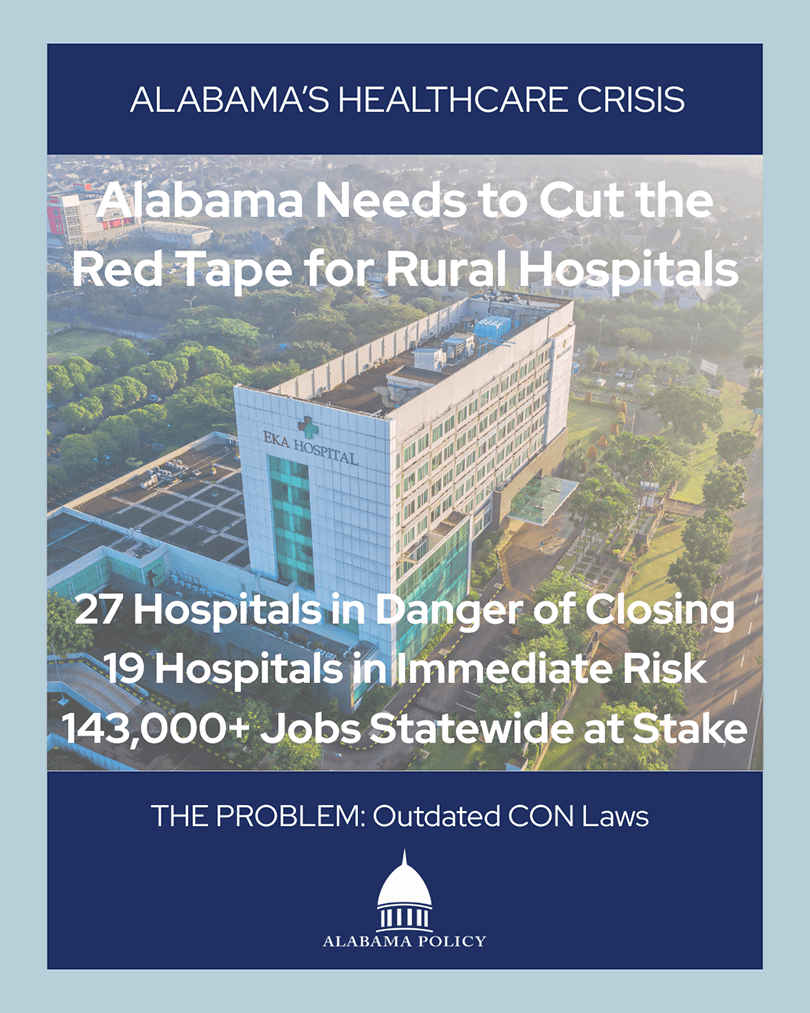
Alabama Needs to Cut the Red Tape for Rural Hospitals
By Justin Bogie, Alabama Policy Institute Senior Director of Fiscal Policy
Alabama’s rural hospitals are struggling, and our state’s bureaucratic red tape isn’t helping. The Alabama Hospital Association reports 27 hospitals in danger of closing and 19 in immediate risk. These community hospitals are lifelines for healthcare and local economies. They collectively support over 143,000 jobs statewide.
Yet under Alabama’s Certificate of Need (CON) law, even a small project, such as a new CAT scan machine or additional ICU beds, requires an approval process that can drag on for years, with opposition usually led by legacy healthcare providers. Hospitals often spend 20–30% of a project’s cost on fees and consultants just to get permission from the state’s CON Board. While our neighbors continue to reduce CON restrictions, Alabama has made little progress towards reform. This must change.
Alabama is increasingly an outlier in its adherence to these rigid regulations. Currently, 12 states have no CON laws at all, having opted for a more competitive, market-driven healthcare environment. Across the country, the momentum is shifting toward liberalization as states realize these laws stifle access rather than protect it.
Mississippi (and other neighboring states) acknowledged the problem and acted. Its legislature unanimously passed CON reforms over the past few weeks. House Bill 3 (and related 2024-2025 efforts) raises the CON review dollar thresholds and directs state officials to allow small hospitals to add dialysis or psychiatric beds without requiring a CON period. Even more critical, Mississippi lawmakers exempted dozens of rural hospitals from CON for any modest campus expansion project. For example, a hospital can now build a new wing or clinic (within 5 miles of its campus) without state approval.
While Alabama stalls, our neighbors have recognized that CON laws are relics of the 1970s. Florida led the way by fully repealing CON for general hospitals, leading to a surge in new facility construction, North Carolina recently passed House Bill 76, which phases out CON requirements for ambulatory surgical centers and MRI machines, Georgia recently moved to exempt new rural hospitals from CON requirements, and Tennessee passed HB 2269 to streamline its process by removing “non-competitive” services from the list of required approvals.
Senator Larry Stutts has been the champion for CON reform in the Alabama Legislature in recent years. The Alabama Policy Institute (API) has also long supported CON reform and the proposal is included in the most recent version of API’s BluePrint for Alabama.
After witnessing the latest reforms in Mississippi, he told the Alabama Policy Institute (API) that “My priority is making sure that Alabama’s struggling rural hospitals have the freedom to grow and adapt right now. Targeted reforms for rural providers are an urgent first step, but they should not be the last. Ultimately, Alabama must move toward eliminating Certificate of Need entirely so innovation and competition can lower costs and improve healthcare statewide.”
Senator Stutts has pointed out repeatedly that lawmakers haven’t updated these rules in decades, even as other states repealed or relaxed CON.
For example, imagine a small county hospital wanting to add an emergency room. Under current Alabama law, the hospital must apply, give public notice, hold hearings, and attend CON Board meetings before even being considered for approval, all at great expense as well as lost time. If the project costs $1 million, the hospital might spend $200,000 or more on permit costs and wait at least a year. As Sen. Stutts said earlier this year, “Why should a community hospital spend half its budget just to follow paperwork?” This is exactly what API and other pro CON reform groups in our state want to change.
The data backs up the problems created by CON. Research from the Mercatus Center shows that CON-controlled states have fewer rural hospitals per capita and higher costs. For example, rural states with CON laws spend about $295 more per Medicare patient than similar rural states without CON. Patients in CON states travel farther for care and use emergency rooms more often because outpatient facilities aren’t readily available. One academic review of 90 studies found that CON laws on average increase healthcare spending and actually raise elderly mortality.
With success in other states and Alabama’s clear need to improve access to healthcare, especially in rural areas, why are lawmakers still clinging to this outdated approach?
Conversely, states without CON saw growth in rural services and reported zero rural hospital closures since at least 2005. Alabama should follow the example of Mississippi and other southern states and make CON reform a priority this session.
Exempt rural hospitals from CON for minor expansions. Senator Stutts’ Senate Bill 82, introduced during the current session, would achieve this by allowing hospitals in rural counties to add new exam rooms or imaging centers without state permission.
Raise the dollar threshold for all CON review. Mississippi more than doubled their limits so that everyday projects can proceed without delay.
Carve out essential services. Senate Bill 285 would have exempted new obstetrics and psychiatric units from CON review. Stephanie Smith, President & CEO of the Alabama Policy Institute stated, “Rural mothers and mental health patients have waited for relief long enough. It is past time for the Alabama Legislature push forward with instituting free markets in healthcare.”
Rural Alabama needs CON relief now. If more rural hospitals close, our metropolitan centers could be overwhelmed. Mississippi’s leaders proved CON reform can be done safely and with broad bi-partisan support. Alabama has one of the most restrictive CON laws in the country. API calls on the legislature to seize the opportunity to cut the red tape, empower all Alabama healthcare providers, and put patients first.
FOR MORE INFORMATION, contact:
Alabama Policy Institute
205-870-9900 or admin@alabamapolicy.org