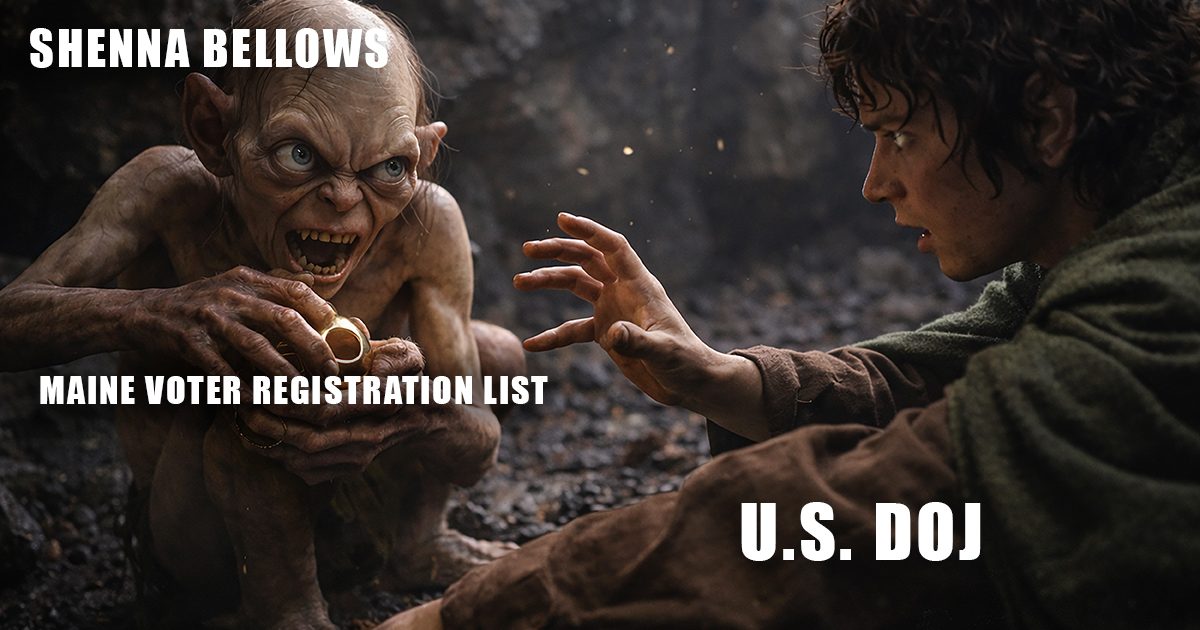
On December 12th, Secretary of State Shenna Bellows asked a federal court to throw out the U.S. Department of Justice lawsuit challenging Maine’s refusal to provide electronic copies of its voter registration list and basic information about how that list is maintained.
This dispute isn’t about ballot secrecy or voter intimidation; it’s about whether states must comply with federal list-maintenance rules designed to keep voter rolls accurate.
What DOJ requested, and why it matters
Under the National Voter Registration Act, states must maintain accurate voter rolls and make list-maintenance records available for federal review. The Trump DOJ requested an electronic copy of Maine’s voter list and an explanation of how the state updates and maintains those records.
This kind of access is routine. Most states provide electronic voter lists, including party registration and past voting history, to the public, not just the federal government. North Dakota is the only outlier because it has no voter registration requirement.
Maine’s legal theory: privacy over accountability
Bellows’s motion raises several objections. In plain terms, the state argues that:
- DOJ lacks the authority to examine Maine’s voter file.
- Providing the list would violate voter privacy rights.
- DOJ must publish additional privacy notices before requesting the data.
- DOJ is secretly trying to build a national voter database.
If these arguments succeed, states could block federal list-maintenance oversight by invoking privacy concerns, no matter how inaccurate their voter rolls become.
Separating the secrecy of the ballot from the transparency of election administration
Maine’s motion conflates ballot secrecy with voter-file transparency. To clarify, the Department of Justice is not asking how individual voters marked their ballots. The federal request concerns routine administrative records: registration status, party affiliation, and voting status. Courts have consistently treated this information differently from ballot choices. The right to a secret ballot does not extend to preventing legitimate oversight of voter-file accuracy.
Routine oversight does not require proof of wrongdoing
Bellows’s motion repeatedly claims DOJ must first justify its request by identifying a specific problem in Maine’s list-maintenance program. That flips compliance enforcement upside-down. Federal agencies routinely request records to verify compliance with federal statutes before true evidence of wrongdoing exists, not after. The law does not require evidence of wrongdoing before checking whether wrongdoing exists.
Raising political stakes under the banner of privacy
Context matters. Bellows already attempted to remove Donald Trump from Maine’s 2024 ballot and is widely believed to be setting up a gubernatorial run. Refusing federal oversight over voter lists allows her to position herself as standing up to Washington while signaling opposition to Trump. This is likely to gain media attention for her 2026 gubernatorial campaign.
Voters deserve better than symbolic fights. Privacy rhetoric should not become a shield against transparency and accountability in election administration.
If Maine can block oversight, every state can
In the slim chance that the state’s theory prevails, federal list-maintenance requirements become voluntary. States could refuse federal access to voter rolls by citing hypothetical privacy concerns, even those based on potential future government actions rather than current ones, no matter how weak those claims are.
That would undermine the NVRA’s purpose: ensuring accurate voter rolls and protecting public confidence in elections.
What should happen next
Maine should comply with lawful federal oversight, provide the requested records, and demonstrate that its voter rolls are accurate and properly maintained. That would serve voters, strengthen trust, and avoid setting a dangerous national precedent. Stop wasting taxpayers’ dollars and time, and stop turning this court case into a campaign platform. We already have an over-politicized court system without Maine leadership making it worse.