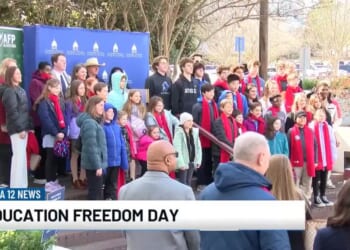
Illinois students would be eligible for money from donors to access support under the Educational Choice for Children Act.
Illinois lawmakers are considering a bill that would opt Illinois into a new federal program providing donor money for students’ educational needs.
Senate Bill 3776, introduced by Sen. Adriane Johnson, D-Waukegan, would opt Illinois into the Federal Scholarship Tax Credit program. The program gives privately donated money to eligible K-12 students while providing a tax credit to the donors.
If the state does not opt into the program, Illinois students cannot receive the money. But donors will get the tax credit anyway.
A recent poll conducted for the Illinois Policy Institute showed that almost 55% of Illinoisans support opting into the program, and only about 22% oppose or strongly oppose doing so. Opting in gained more support than opposition across ages, regions, race and political ideology.
Here’s what the Federal Scholarship Tax Credit program could mean for Illinois students and families:
1) The scholarships benefit public and private school students
Starting in 2027, the scholarship money can be used by students in public, private or homeschools for educational services such as tutoring, additional classes, books or online educational materials, fees for standardized or college admissions exams and fees for dual enrollment.
That means public school students who may be struggling in certain academic areas or need extra help or materials won’t have to leave their local public school for the support or opportunities they need.
The program is good news for struggling Illinois students. Recent test scores show just over half of the state’s third- through eighth-graders were reading at grade level last spring, and just 39% were proficient in math. The scholarship program offers families a way to provide the additional academic support children need.
2) Scholarships take no money from public schools
The program will not divert federal or state money from public schools to fund the scholarships. There is no cost to states — only the benefit of more help for students.
The only cost to the federal government is minimal forgone income tax revenue. The scholarships are donated by taxpayers, who will get an annual dollar-for-dollar federal tax credit of up to $1,700 for a qualified contribution to a scholarship-granting organization. That limited credit will matter little to a billionaire but can encourage donations from middle-income taxpayers.
3) Illinois taxpayers will get the tax credit no matter what, so rejecting the program only deprives kids
If Illinois fails to opt into the federal scholarship program, its residents can still obtain the tax credit by donating to a scholarship granting organization. But that money would go to another state — no Illinois students would be eligible.
It’s not a good look for teachers unions or other opponents of the federal scholarships, who falsely say the program takes money from public education. The program promises to add money from donors to address public, private and homeschool students’ needs.
If opponents succeed, other states’ children will benefit and Illinois children will be left behind.
4) The scholarships provide additional resources to students with disabilities
The money can be used for educational therapies for students with disabilities enrolled in the public school system or in a private or homeschool.
Most students with disabilities enroll in public schools. In the 2024-2025 school year, nearly 375,000 students with disabilities were enrolled in Illinois public schools.
Nationally, 95% of school-aged students with disabilities were enrolled in regular public schools in fall 2022, according to the National Center for Education Statistics. Only 2% were placed in regular private schools by their parents.
Families could gain access to money for additional educational therapies to help their children thrive in their public schools.
5) The funds would help Illinois students stay competitive with students in other states
Illinois shouldn’t put its students further behind other states by denying families donated scholarship funds. If Gov. J.B. Pritzker opts the state into the program, Illinois will join the majority of states that already plan to opt into the program — and it would cost Illinois nothing.
Students in Illinois deserve the same opportunities that those in other states plan to offer their students.
The Federal Scholarship Tax Credit Program is a win-win-win for families and students and for Illinoisans who donate. It provides money for students’ educational needs, it provides a tax credit to donors, and it takes no money from public schools.