Parents have always reached for easy tools to soothe young children. However, the advent of digital media and relatively cheap tablets have given parents a new choice. Will little Timmy be placated by stuffed animals, or by the many apps that can populate his personal tablet?
YouTube, filled with a kaleidoscope of videos that carousel endlessly from colorful stimulus to colorful stimulus, is a popular app for parents to turn to. And a new report suggests that they’re doing so in increasing numbers.
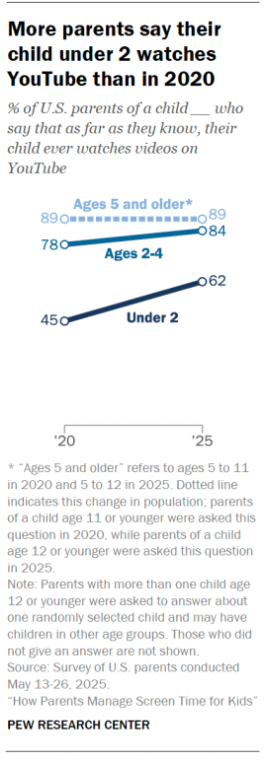
A 2025 Pew Report found that YouTube use by children under two jumped from 45 percent in 2020 to 62 percent in just six years. As a reminder, children usually learn to walk from 9 to 18 months old, and speak from 18 to 24 months. This YouTube usage represents children in a very early, deeply critical stage of development.
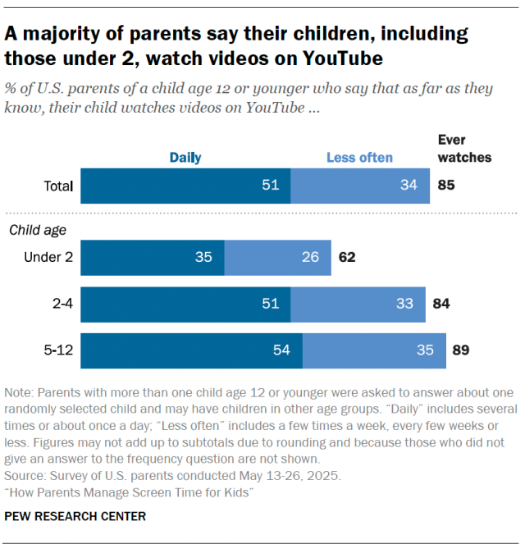
Of these tiny toddlers, 35 percent were reported as watching YouTube daily. For children aged 2-4 years old, 51 percent watched YouTube daily. Among the 5-12 age group, 54 percent of children watched YouTube daily.
This time isn’t spent neutrally. The digital viewing available today is not equivalent to the television programs of yesterday. Short-form videos, AI-generated content, and accelerated content pace all serve to create addictive dopamine hits in the mind of the viewer.
YouTube and other online streaming services have long been accused of acting as poor guardians for their users. Streaming services do not have to adhere to broadcast rules like the Children’s Television Act of 1990, which required broadcast television to air a certain amount of educational programming and reduce ads. Ads may not be age-appropriate, and can hijack “educational” children’s content in favor of marketing. Depending on how tech-savvy parents are, it’s very possible that children could accidentally be exposed to graphic violence or pornography while they use services like YouTube that enable autoplay or search. Experts warn that online video content should be consumed sparingly, and a parent should sit beside young children.
As scholars like Johnathan Haidt have warned, cellphone and social media access can be incredibly damaging to children. Their brains become accustomed to the numbing effect that doomscrolling provides, making children more prone to depression, anxiety, and dysregulated behavior. It also can strongly inhibit their ability to concentrate, to think creatively, and choose their behavior well.
The intense drop the nation has seen in NAEP scores and that Minnesota has seen in state testing scores is partially attributable to poor curricula choices and inefficient administrative strategies. Yet there’s a very real piece that is outside of administrators’ control. When children arrive to class hooked on digital media, attuned to a lifestyle that values cheap thought and quick dopamine hits, it is a Sisyphean task for an educator to ask them to write a well-researched essay.
A culture that values literacy proves it by taking digital distractions away from children and emphasizing reading as a lifestyle choice. Pew’s research is an invitation for us to reflect and re-examine our choices.