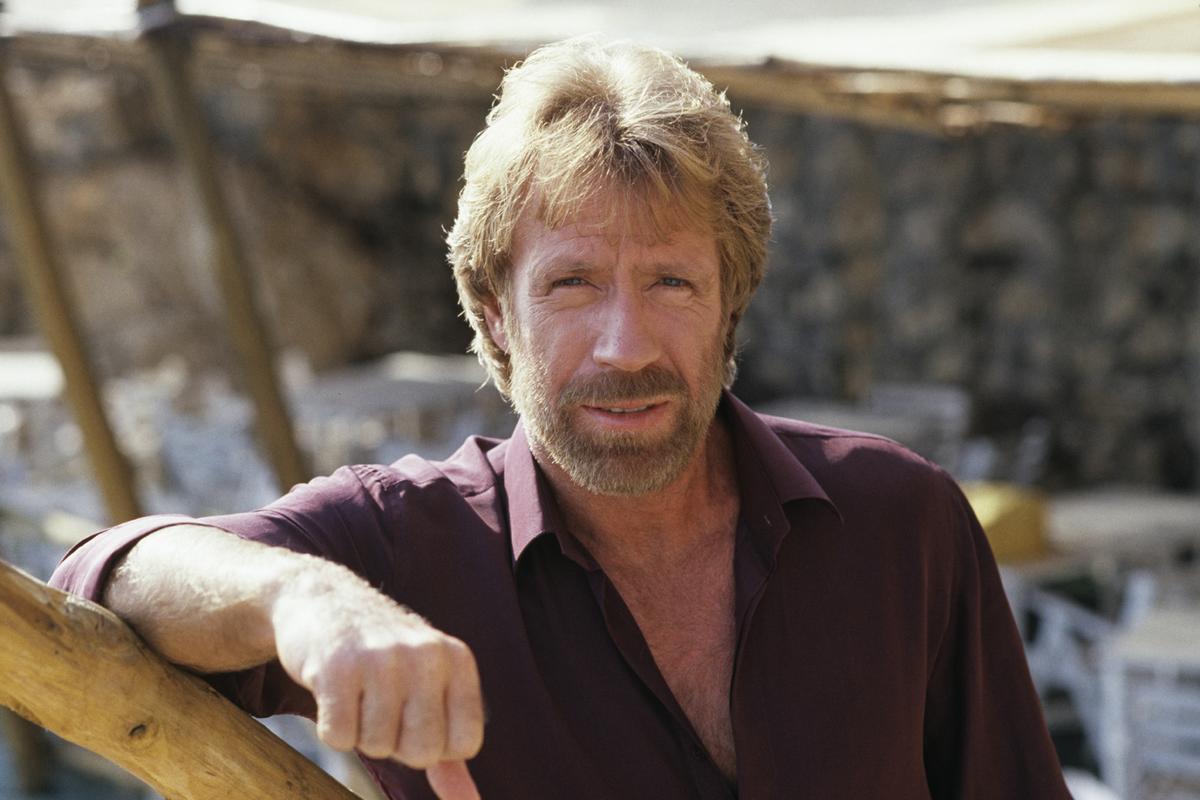
You reach an age where the icons of your youth start to pass with depressing regularity. One of mine, Chuck Norris, died last week aged 86.
I watched a lot of his movies growing up in the 1980s: Never in the cinemas – I was too young and I don’t know that they played in them for very long – but they were always on the shelves of my local video store. Norris had been around for years as a leading martial artist, friend of Bruce Lee and Steve McQueen, and star of martial arts movies which met with occasional modest success when he teamed up with Cannon Films for 1984’s Missing in Action, which brought him to the pinnacle of his career.
Notorious schlockmeisters, Cannon filmed two Missing in Action movies back-to-back, one about Colonel James Braddock’s (Norris) captivity in Vietnam and a sequel about his return to rescue American POWs. When executives watched the two movies, they realized that the second one was a pretty good action film while the first was rather dull, so they switched releases.
Missing in Action belonged to a genre of Vietnam POW rescue movies, the most famous of which was Rambo: First Blood Part II (1985) while the best was Uncommon Valor (1983). These movies enabled America to refight, and win, a war on screen which it had lost in real life. A recurring theme of these movies was that the politicians, not the soldiers, had lost the war: “I did what I had to do to win,” veteran John Rambo rages at the end of First Blood, “for somebody who wouldn’t let us win!”
It followed that, with new politicians, the soldiers might be allowed to do what they had to do to win, and Ronald Reagan was in charge now. “I am a conservative, a real flag waver, a big Ronald Reagan fan,” Norris explained. “I’m not so much a Republican or Democrat; I go more for the man himself. Ronald Reagan says what he thinks, he’s not afraid to speak his mind, even if he may be unpopular. I want a strong leader and he is a strong leader. And ever since he has been in office there has been a more positive, patriotic feeling in this country.”
Missing in Action was a hit, making $23 million on a $4 million budget. “One of the biggest thrills of my life came when I went to a theatre to see Missing in Action, and all the people stood up and applauded at the end,” Norris recalled. But Cannon had been right; when Missing in Action 2: The Beginning appeared in 1985, it made only half the money the first film had.
In 1986, Norris and Cannon teamed up again for The Delta Force, perhaps the closest he came to the standard of film Arnold Schwarzenegger or Sylvester Stallone were making. For the first hour, The Delta Force is a reasonably worthy recreation of the hijacking of TWA Flight 847 in June 1985, with actors like Shelley Winters and George Kennedy reprising the sorts of roles they played in 1970s disaster movies.
But this is prologued by a depiction of Operation Eagle Claw, the disastrous attempt to rescue American hostages held by Iran in April 1980. “Why in the hell wouldn’t they listen, Nick?” Captain Scott McCoy (Norris) asks as the mission ends in failure, “We told them it was too dangerous to launch this mission at night.”
Alexander: They thought their plan was better.
McCoy: I spent five years in Vietnam watching them do the planning, and us the dying. I’m resigning when I get back.
But things are different in 1985, and McCoy returns to the Delta Force to rescue the passengers of a hijacked aircraft and the second hour of the film departs completely from the sober tone of the first. McCoy and his team, led by a grizzled Lee Marvin in his final film role, tear around Beirut blowing away hordes of Hezbollah fighters – Norris, at one point, using a motorbike equipped with rocket launchers – and rescuing all the hostages.
One on level The Delta Force is, like Missing in Action, pure wish fulfilment; a chance to secure a more satisfactory outcome to the TWA hijacking, like Missing in Action was to secure a more satisfactory outcome to the Vietnam War.
But on another level, The Delta Force is about a more assertive America that knows who its enemies are and is going to fight them and beat them; the contrast the film draws between military humiliation under Jimmy Carter and potency under Reagan is crystal clear. Granted, the success is completely mythical, no hijack ever ended the way it did in The Delta Force, but that is almost beside the point. The 1970s policy of détente was gone, replaced with Reagan’s rhetoric about the “evil empire,” and Hollywood signed up. Red Dawn (1984) saw American schoolkids fight communist invaders and Top Gun (1986) ends with American fighters entering Soviet airspace and killing a bunch of their pilots. “Do we get to win this time?” Rambo asks in Rambo: First Blood Part II. Hollywood’s answer was “You betcha!”
The Delta Force was a hit, but not quite as big as Missing in Action. None of Norris’ subsequent movies reached either the standards of The Delta Force or the success of Missing in Action, and he eventually settled into a steady gig on TV as Walker, Texas Ranger and more or less retired after that.
Carlos Ray “Chuck” Norris, born in Ryan, Oklahoma, lived a hell of a life, and, while 86 is a good innings, it is still sad to see him go. A little bit of my childhood, and a little bit of that America and that Hollywood, died with him.