According to recent Joint Budget Committee staff analysis, Colorado’s Healthy School Meals for All (HSMA) program was operating within budget during the 2024-25 and 2025-26 fiscal years, before Propositions LL and MM were passed by voters in November.
This information raises significant concerns about what voters knowingly or unknowingly approved when they passed Propositions LL and MM.
Background on HSMA
As a previous Independence Institute analysis explained, HSMA, also known as the “free” school lunch program, was created via Proposition FF in 2022 and was quickly recognized as financially unsustainable in just its first year of operation.
The legislature responded by asking voters to save the program by de-TABORing HSMA and further raising taxes on the wealthy via Propositions LL and MM, which passed by even wider margins than did Proposition FF in 2022.
Many voters were led to believe that needy kids would no longer receive free lunches if Props LL and MM failed. In reality, kids who required state aid for lunches were going to continue receiving free lunches from the state due to the legislature’s contingency measure, Senate Bill 25-214.
However, that is not the only false information that may have persuaded Colorado voters.
Shortfall? Not anymore
Now, according to JBC analyst Amanda Bickel (relevant discussion begins at the 9:38 am mark), the One Big Beautiful Bill Act (OBBBA) actually resolved a major source of revenue uncertainty for the program when Congress passed it in July 2025.
Meaning, in fiscal year 2024-25, the HSMA’s $128.4 million in expenses were suddenly within the program budget. Moreover, HSMA’s costs were still projected to be within the program’s budget regardless of LL’s and MM’s passage.
Therefore, the legislature could have used this information during the special session to consider rescinding Propositions LL and MM, since there was no longer a program deficit.
Instead, because HSMA was now projected to collect sufficient funds, legislators amended Proposition MM to allow additional HSMA funds to be directed to the Supplemental Nutrition Assistance Program (SNAP), more commonly known as food stamps, as other changes from OBBBA would increase the state’s SNAP costs.
In other words, voters were led to believe that without Props LL and MM, kids would go hungry because HSMA was under budget, neither of which was true.
Although voters approved Proposition MM, which allows the diverting of HSMA funds to SNAP, the average voter was not led to believe that such a significant share of HSMA funds would go to SNAP.
With the passage of MM, the state receives an annual $95 million windfall from wealthy Coloradans, much of which will likely be used to pay for something that appeared essentially as a footnote in the ballot language.
Looking forward
As described on page 23 of the JBC analysis, “More than 50 percent of the additional revenue from Proposition MM could go to support SNAP on an ongoing basis… JBC staff’s early analysis suggests that over $108 million could be available for this purpose (funding a portion of SNAP’s benefits) in FY 2027-28 and that over $50 million per year may be available on an ongoing basis.”
Because Propositions LL and MM passed, the state will be able to fully fund HSMA and its associated administration and grants, repay the State Education Fund (funds used to shore up the fiscal year 2023-24 shortfall), fund SNAP administration costs, and distribute more than 50 percent of the additional MM revenue to SNAP benefits on a continual basis, all within the new budget.
Table 1: HSMA Balance Projections by Year
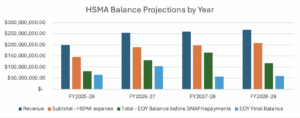
As shown in Table 1, the HSMA program is now expected to collect over $50 million more than the anticipated costs for free lunches, administration, and grants.
Next, after repaying the State Education Fund, maintaining a program reserve, SNAP administration, and SNAP benefits, the program is still projected to maintain an end-of-year balance of more than $50 million in TABOR-exempt funds, depending on future federal policy changes.
Conclusion
It is not unreasonable to assume that some voters may have been more hesitant had they known the HSMA program’s actual fiscal state, that children from low-income families would still be fed regardless of whether LL and MM passed, and that much of the new revenue would be diverted to another program altogether.