
Yesterday, looking to define some common ground on immigration, I noted that:
- The president enforces that law across the entire United States
- Congress makes immigration law for the entire United States
What does this mean in practical terms for our state?
3) Opposition to ICE is often the motte, opposition to immigration law is often the bailey…
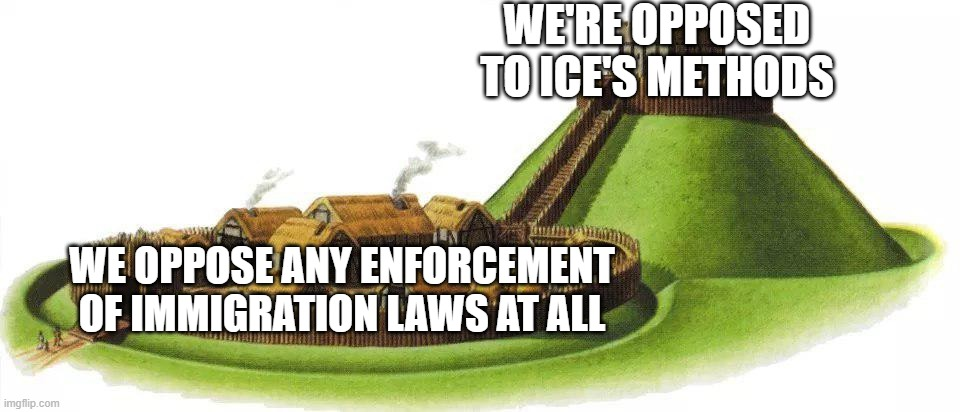
You might have seen the “motte and bailey” meme. This shows you a Norman castle where the motte — the village out front — is a strong statement that either cannot be supported or has very little support — and the bailey — the fortification up on the hill — is a more moderate argument which can be defended and/or has more support. The gag is that people with weak and/or unpopular arguments flee the motte for the safety of the bailey.
This captures a good chunk of the opposition to ICE’s activities in Minnesota. There are a lot of extremists — like Defend the 612, the People’s Action Coalition Against Trump, or People Over Papers — who oppose any enforcement of federal immigration law whatsoever — indeed, they oppose the existence of such laws in the first place — but know that this is an unpopular argument, a point I’ll return to in a moment. So, they hide this argument behind a narrower, more immediate opposition to ICE’s tactics.
4) …but not always: There are legitimate gripes with tactics
We should not infer from this, though, that all opposition to ICE’s methods is a Trojan Horse containing the abolition of the borders of the United States of America. A great many Minnesotans have gripes, and not all of these can, or should, be easily dismissed.
In December, the KSTP/SurveyUSA poll “conducted Dec. 9 through Dec. 12” found that “41% approve of the strategies used by ICE, while 56% disapprove and 3% are not sure.” Furthermore:
According to our poll, 43% approve of President Trump’s immigration enforcement policies while 53% disapprove. Within those numbers, 86% of Republicans approve of Trump’s immigration enforcement policies, compared to 11% of Democrats and 37% of independents.
Last June:
The latest Star Tribune/Hubbard School of Journalism and Mass Communication Minnesota Poll found that 55% of Minnesotans polled oppose Trump’s immigration moves while 43% support them.
Suburban respondents outside Hennepin and Ramsey counties were divided on Trump’s immigration policies, with 51% saying they support them, and in greater Minnesota, most strongly back the president on this issue.
…
The poll also found that a majority — 53% of poll respondents — disapprove of the Trump administration’s recent push to deport undocumented immigrants without a court hearing. Yet 92% of Republicans back the president on that question.
These are questions of tactics: How is the executive branch, via agencies like the Department of Homeland Security, executing the laws? Remember the Bill of Rights and those Constitutional protections discussed above which a conservative should value as highly as anyone.
5) What do Minnesotans want from immigration policy?
But if people have concerns about the tactics of immigration policy, what do they think of the aims?
When the Star Tribune asked “Which of the following statements comes closest to your point of view,” 28% of respondents said “All undocumented immigrants should be deported,” 12% said that “undocumented immigrants who do not have criminal records should be allowed to stay in the U.S. in order to work, but not allowed to become citizens,” and 59% said that “undocumented immigrants who do not have criminal records should be allowed to stay and become U.S. citizens if they meet certain requirements over time.”
This is not a terribly helpful question. What do the 71% of respondents who favor “undocumented immigrants who do not have criminal records” remaining under certain circumstances think ought to happen to those illegal immigrants who do? Should they be deported? If so, Mayor Jacob Frey, for one, disagrees: “Violent criminals should be held accountable based on the crimes they commit,” he tweeted earlier this week, “not based on where they are from,” lining up alongside those aforementioned extremists who oppose any deportations at all. He might say that he doesn’t want “a working dad who contributes to MPLS & is from Ecuador” deported, but he doesn’t want violent criminals deported either.
There is little that I can find in the KSTP/SurveyUSA poll or the Star Tribune’s Minnesota poll to indicate what Minnesotans think ought to happen to illegal immigrants with criminal records. In a New York Times-Ipsos poll conducted in January, 87% of respondents said they supported removing all migrants “who are here illegally and have criminal records.” What are the numbers for that in Minnesota?
We conduct our own Thinking Minnesota poll, which, alas, does not yet provide an answer. What does it tell us about Minnesotans views on immigration over the last couple of years?
At the federal level, it is a reasonably important issue.
Our March 2024 poll found that 69% of respondents thought that the federal government was doing “not enough” when it came to “illegal immigration and the situation at the border.”
In our November 2024 poll, 14% of respondents said that “Illegal immigration and border security” was “One of the most important” issues in their “choice of which candidate to support for President.” This was above “Government Reform” with 4%, “The environment and climate change” and “Taxes” with 8% each, “Public schools,” “Crime, drugs, and public safety,” and “LGBTQ+ and Transgender Issues” with 9% each, “Healthcare” with 11%, and tied with “The economy and jobs.” “Abortion” (15%), “Inflation and the cost of living (16%), and “Protecting democracy” (23%) all rated higher.
And President Trump was rated pretty well. In that poll, 56% of respondents thought that “Illegal immigration and border security” would get better under President Trump, with 25% thinking it would get worse.
But what about the state level?
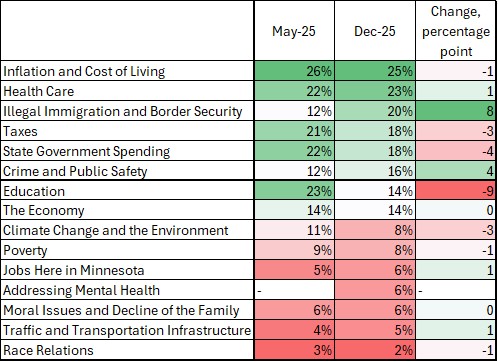
In both May and December 2025, we asked “Thinking about some issues, which ONE or TWO of the following issue areas do you believe should be the top priorities for the Governor and State Legislature here in Minnesota?” As Table 1 shows, “Inflation and Cost of Living” held its position as Minnesotan’s leading concern, so watch out for more from us on “affordability.” But we also see that the share of Minnesotans naming “Illegal Immigration and Border Security” surged by eight percentage points, moving from 7th out of fifteen issues to 3rd. It now ranks as a top three concern in both the “MSP Suburbs” and the “Rest of State.”
Table 1: Thinking about some issues, which ONE or TWO of the following issue areas do you believe should be the top priorities for the Governor and State Legislature here in Minnesota?
We do not, yet, have data on what is behind this surge in a desire for the state government to prioritize immigration: What do these folks want the state government to do, exactly? Perhaps we can get an idea from answers to adjacent questions?
In March 2024, we found that 59% of respondents opposed “a proposal in the state legislature to make Minnesota a sanctuary state — which would stop local law enforcement from cooperating with federal immigration officials and ban state government officials from enforcing immigration laws.” This is substantially the approach advocated by the likes of Mayor Frey and those extremists, and Minnesotans didn’t like it.
Our August 2024 poll found that 58% of respondents opposed “a law allowing illegal immigrants the ability to acquire a driver’s license,” up from 42% in February 2023: Support fell, over the same period, from 53% to 39%. Meanwhile, 66% of respondents were concerned that such a bill would accidentally register non-citizens to vote.
In May 2025, 61% of respondents opposed taxpayer funded healthcare for illegal immigrants, with 37% supporting it.
None of this suggests that Minnesotans are aligned with Mayor Frey and those other extremists. If we are looking for the common ground on immigration in Minnesota, this points us towards it. Proposals, such as those floated by DFLers for cash handouts to illegal immigrants, are not likely to be popular; proposals such as that from Rep. Harry Niska (R) that we “change Minnesota state law to facilitate more cooperation between the local and state communities and federal law enforcement” might be more so.
It is time to be constructive
Emotions have been running high in our state as a result of these recent events. There are those who would keep them running high as they need an issue to campaign on in November. Your anguish is their strategy.
As a policy shop, it is our job to look past this for workable solutions. Those emotions won’t subside until those solutions are discovered and enacted. When they are, we can all breathe a sigh of relief, so let us not dawdle.