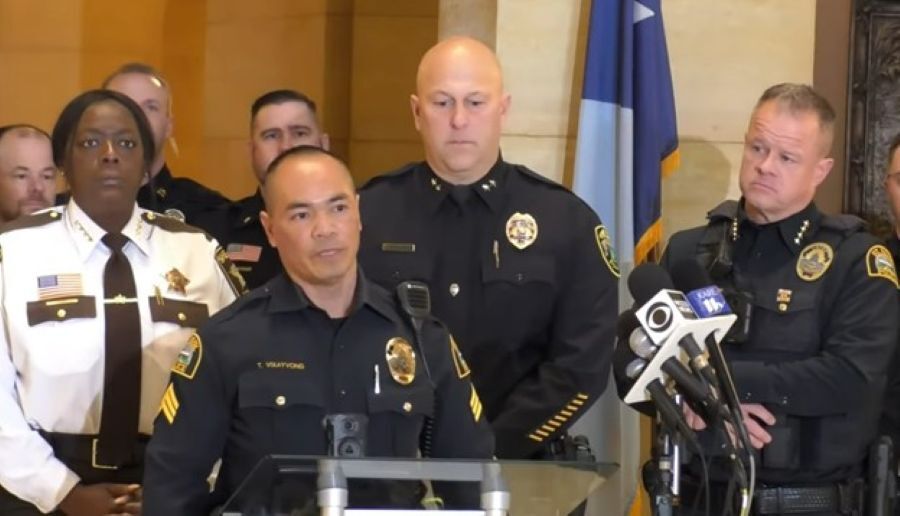
Yesterday morning a group of local law enforcement leaders gathered at the State Capitol for a press conference drawing attention to their belief that a small number of federal agents may be racially profiling as part of the immigration enforcement detail being led by the Department of Homeland Security (DHS), known as Operation Metro Surge.
A short time later, at the Whipple Building in Minneapolis, the chief of the US Border Patrol, Greg Bovino, and the Executive Director of Immigration and Customs Enforcement (ICE) Marcos Charles held a press conference updating the media on the accomplishments of the operation and disputing allegations agents were conducting random, non-targeted stops.
What was evident after watching both press conferences is that the executive level law enforcement leaders representing the feds and the locals are not speaking to each other and have yet to establish any level of coordination during this operation. That represents a disservice to the public and to there officer and agents in the field.
Political disfunction
Politics has come into play with state and local elected officials having far too much sway over the tactical decision of local law enforcement leaders, and with federal elected officials having far too much sway over the tactical decisions of federal law enforcement leaders. These law enforcement leaders need to meet face to face, without the media, without their elected leaders, to hash out a professional level of coordination and provide for deconfliction. This is basic incident command stuff. Yet with all that is on the line with Operation Metro Surge, these leaders have resorted to inflammatory press conferences.
I can understand the concerns from both sides – the locals rightly feel the feds have failed to reach out to coordinate as 3,000 agents operate in and around their jurisdictions, while the feds rightly feel that many of the local jurisdictions have turned their back on federal immigration enforcement by refusing to share information or honor ICE detainers – and by openly encouraging “peaceful” demonstrations against the agents when it’s clear those opposing the operation have no intention of remaining peaceful. Those concerns need to be aired in private between executive law enforcement leaders, not through competing press conferences.
Support for Operation Metro Surge
As we’ve noted, American Experiment supports Operation Metro Surge – a temporary surge of federal agents to Minnesota to conduct both enforcement of illegal immigration violations and investigation into rampant fraud of federal Medicaid programs – two issues that have broad public support.
The operation has been led by the Department of Homeland Security (DHS) which has deployed agents from three of its components – Immigration and Customs Enforcement (ICE), the US Border Patrol (USBP), and Homeland Security Investigations (HSI). This contingent of agents has surged to between 2,000 and 3,000 since December 1st and has reached its full strength mostly in the past 2-3 weeks.
The operation has been a statistical success with more than 3,000 illegal aliens arrested in Minnesota since December 1st, including a large list of aliens who either have criminal convictions or pending criminal charges.
Unforced errors
That statistical success has come with unnecessary drama – much of it avoidable if law enforcement leaders would stop playing politics and work together.
From what I understand, the DHS has set up a Joint Operations Center (JOC) to coordinate the actions of the agents in the field. Traditionally a JOC would have representatives from local law enforcement to coordinate, and more importantly, to deconflict issues that arise. The lack of state and locals in the JOC has reduced coordination to the pathetic level of agents having to call 911 when they need assistance from locals. That is a complete failure by law enforcement leadership, and whether it’s due to the feds not inviting the locals to be a part of the JOC, or the locals refusing to be a part of the JOC, the lack of coordination and deconfliction is shameful.
No one is asking state and local law enforcement to make immigration violation arrests, but many locals leaders have taken it too far. They have created firewalls to prevent information sharing with DHS/ICE. They have refused to establish any coordination with ICE in the field for fear of appearing like they are conducting immigration enforcement. In the case the many jails, they are refusing to honor ICE detainer requests to communicate with ICE and turn over local offenders to ICE when the state and local holds expire. And they have openly encouraged people to protest DHS in the field, but to do so “peacefully.” This is either naivete or complicity, given the history of organized activists coming to Minnesota to agitate, obstruct, and create chaos – anything but peacefully demonstrate.
Those agitators have been the source of chaos associated with the operation. Leaders need to stop encouraging people to protest. It only leads to people obstruction and violence. Very few stops or arrests would become “chaotic” if not for the presence of activists whose sole mission is to create that chaos.
Furthermore, local law enforcement must be more responsive in preventing these agitators from interfering with and obstructing with agents in the field. Improving response in this area would prevent or minimize the chaotic situations that have occurred in recent weeks.
Joint messaging
If we truly want to reduce the “fear” that many legal immigrants are reportedly feeling, then our law enforcement leaders need to come together and craft joint messages of what DHS is doing, who they are targeting and why, and what people should do if they are stopped or approached by agents.
Instead, people are getting the message that if stopped by agents, they don’t need to cooperate, they don’t need to roll their windows down, and they don’t need to identify themselves. They are being told to call 911 if they feel they feel the stop was not justified. This is wrong, and it’s dangerous.
When an agent stops anyone, the assumption that must be made is that agent has reasonable suspicious for the stop. (Reasonable suspicion was recently broadened specific to immigration enforcement in a Supreme Court ruling in Noem v. Vasquez Perdomo. The ruling paused a lower court’s ruling that reasonable suspicion to stop/detain could not rely solely on race, language, location, and workplace. The Court opined that reasonable suspicion could rely on combinations of those factors in a totality of the circumstance’s evaluation).
It is important to understand that it is the responsibility of the agent to ensure they have reasonable suspicion for a stop or an inquiry. Agents don’t need to share what their reasonable suspicion is at that moment. When agents stop a person, or come to a home looking for a person, that is not the time to challenge whether the encounter is “justified.” That is the time to cooperate with agents, provide identification, and explain one’s immigration status.
That is not the time to resist, or to ignore the agent’s instructions. If agents stop someone, the person should cooperate with the agents just as they would for any other law enforcement officer. Answer the door or roll the car window down, provide identification and answer basic questions. If this is done, and if the person is here legally, the agents will determine that and send them on their way. If the person refuses to roll a window down, open a door, or identify themselves, then agents may need to increase the level of force depending on the information they have and who they believe they are dealing with.
Proper recourse
After the encounter, if anyone feels their rights were violated, there is recourse in filing a complaint with the DHS or filing a lawsuit against the DHS. If people took this approach most of the conflict could be avoided – an important point the law enforcement leaders should be jointly making to the public, but we can’t get them in the same room at the moment.