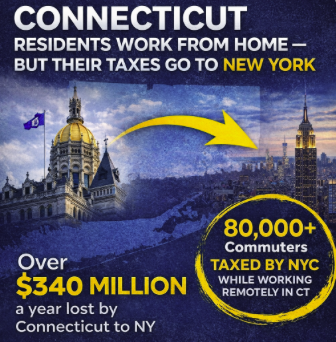
Connecticut House Republicans say a little-known tax policy is quietly sending hundreds of millions of dollars out of Connecticut each year, and it is increasingly drawing attention from lawmakers on both sides of the issue.
At a March 30 press conference, House Minority Leader Vincent Candelora highlighted what’s known as the “convenience of the employer” rule, which allows New York to tax Connecticut residents who workremotely for New York-based companies.
In practice, that means some Connecticut residents are living and working in-state — but paying income taxes to New York.
“There are roughly 80,000 people working in Connecticut not paying taxes here, but rather paying them to New York,” he said, estimating the impact at more than $340 million annually.
A Policy with Real Consequences
The issue is straightforward in concept, but complex in practice.
“If you’re working in Connecticut, you should be paying taxes in Connecticut,” Candelora said. “To think that you have individuals that are here, living in the state, working in the state, and not having to pay our income taxes… makes no sense whatsoever,” he added.
Under New York’s policy, income can still be taxed by New York even if the work is performed entirely outside the state, unless the employer requires the employee to be physically located elsewhere. Because Connecticut provides a credit for taxes paid to other states, the result is a loss of revenue that would otherwise stay here.
For Connecticut, that means fewer resources to support state and local priorities, even as residents continue to live, work, and spend within the state.
What the State’s Own Analysis Says
This is not a new issue. In 2025, Gov. Ned Lamont signed legislation directing the Office of the Attorney General to study “specific steps” Connecticut could take to address the problem.
The resulting report, submitted in December 2025, confirmed the core challenge: Connecticut likely cannot bring a direct legal challenge against New York.
“The U.S. Supreme Court has held that a state lacks standing to sue on its own behalf in situations such as this,” the report noted.
Instead, the report pointed to individual taxpayers as the most viable path forward. One such case is currently underway, brought by Connecticut resident Edward Zelinsky, who is challenging New York’s policy in state court.
For now, Connecticut has taken a measured approach, monitoring that litigation to assess next steps.
Lessons from Past Efforts
Connecticut has not always taken a passive role.
In 2021, when New Hampshire sued Massachusetts over a similar pandemic-era tax policy, Connecticut — along with New Jersey, Hawaii, and Iowa — filed an amicus brief supporting the case. The filing argued that taxing remote work performed out of state raised constitutional concerns and could result in between $339 million and $444 million in tax credits depending on remote work rates.
While the Supreme Court ultimately declined to hear the case, it demonstrated that states can play a role in shaping the broader legal conversation.
Different Approaches Across States
Connecticut has taken steps to support individual taxpayers. PA 25-172 allows residents who successfully challenge out-of-state taxation to claim a partial credit against their Connecticut tax liability.
Other states have taken additional approaches. New Jersey, for example, has an equivalent credit, which sits at 50%. But New Jersey didn’t stop there. In July 2023, Gov. Phil Murphy signed legislation that went beyond rewarding individuals who fight and win.
New Jersey created a $10 million grant pilot program to incentivize businesses to physically reassign New Jersey resident employees from out-of-state locations back to New Jersey, cutting New York off at the source before a single lawsuit needs to be filed. It also created a $2,000 tax credit for individual employees who get permanently reassigned to a New Jersey location.
These differing strategies reflect the broader challenge: while the legal framework limits direct action, there are still policy tools available to mitigate the impact.
A Broader Affordability Question
The issue also intersects with Connecticut’s broader affordability challenges. When income earned in Connecticut is taxed elsewhere, it affects the state’s ability to manage its fiscal structure and maintaincompetitive tax policies. It also raises questions about how Connecticut positions itself in an economy where remote work is increasingly common.
Rep. Joe Polletta pointed to rising local tax burdens, especially property taxes.
“Property taxes are the most regressive tax that Connecticut residents pay,” Polletta said.
To address that, Republicans are proposing to expand the state’s property tax credit.
“What we want to do is double the state property tax credit from 300 to $650… so that’s right away savings,” he said.
Unlike one-time rebate proposals, Polletta said the goal is ongoing relief.
“Republicans are looking for something that is more consistent, that is long term, that is residual, that will have an impact for years to come,” he said.
Candelora argued that capturing revenue currently going to New York could help fund that kind of relief.
“We’re just pointing out an observation that there’s $340 million being given over to New York that we could actually bring to Connecticut and incorporate tax relief,” he said.
Stop Watching. Start Fighting.
At some point, monitoring becomes a strategy for doing nothing.
Connecticut could file an amicus brief in the Zelinsky case tomorrow — it has done exactly that before in a nearly identical dispute. It could coordinate with New Jersey, which is still in this fight. It could actively promote the challenge credit it already passed so that more residents actually know it exists. And it could pursue employer-side incentives that don’t require individual residents to spend years in court to benefit.
The legal and policy constraints surrounding the issue are real. Connecticut cannot simply rewrite another state’s tax rules, and any resolution will likely involve ongoing litigation or broader federal guidance.
But the scale of the issue, both in terms of affected taxpayers and lost revenue, suggests it will remain part of Connecticut’s policy conversation.
With remote work now a permanent feature of the modern economy, the question is not whether the issue will persist, but how states choose to respond.
For Connecticut, that response may ultimately determine whether more of its residents’ income stays within the state, or continues to flow elsewhere.